Author: canatosmedia

  • How We Link Cinematic Short-Form Video Ads to Lead Generation Systems

    How We Link Cinematic Short-Form Video Ads to Lead Generation Systems

    The Lead Generation Problem With Most Short-Form Video Content

    Short-form video dominates social feeds for good reason: it stops scrollers, captures attention in seconds, and performs exceptionally well in algorithmic feeds. Yet most businesses struggle to convert that attention into actual leads.

    The gap exists because creating entertaining video and creating converting video require different skill sets. A video that gets 100,000 views but zero inquiries is expensive entertainment, not marketing. We see this constantly: brands pour budgets into production, nail the creative, then wonder why their phone isn’t ringing.

    The root cause is usually misalignment between creative messaging and lead capture infrastructure. A cinematic brand story might resonate emotionally, but if it doesn’t direct qualified prospects toward a next step—and if that next step isn’t optimized to convert—you’re leaving revenue on the table.

    Our approach flips this: we design short-form video ads with lead generation as the primary objective, not an afterthought.

    Why Cinematic Quality Matters for Ad Performance

    High production value doesn’t just look better—it performs better. When prospects see polished, professional video, they perceive your brand as established and trustworthy. That perception affects click-through rates, form completion rates, and conversion rates downstream.

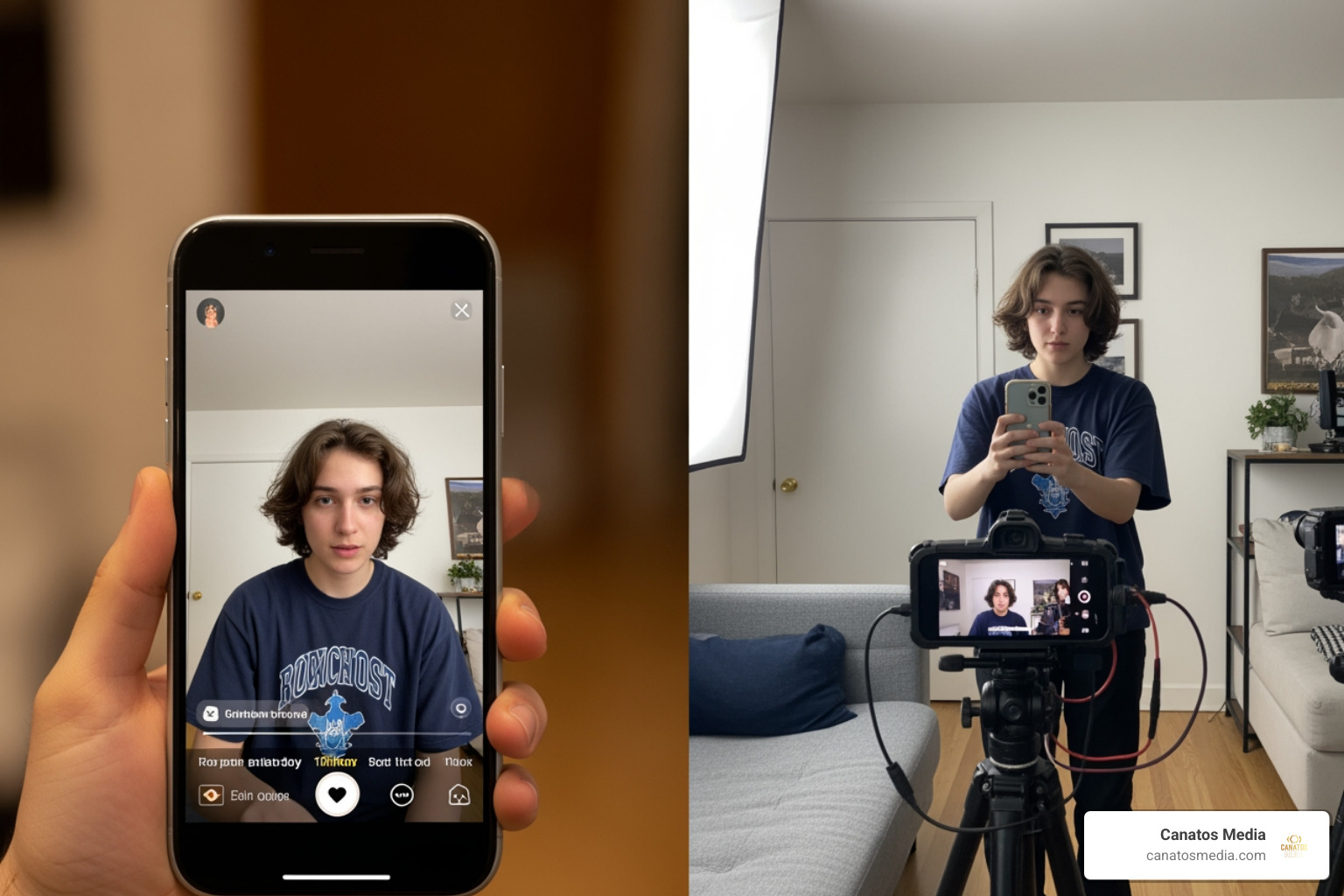
    Consider two scenarios. A plumbing service runs a DIY video shot on a smartphone showing a quick fix. Another runs a cinematic 15-second spot showing a professional technician confidently solving the same problem in a real home, with clear audio and color grading that makes the work look intentional and expert. The second ad typically generates qualified leads at a lower cost per acquisition because viewers trust the brand more.

    Cinematic quality signals investment in excellence. It doesn’t require Hollywood budgets, either. Strategic lighting, clean audio, intentional framing, and professional editing create the perception of quality that drives performance.

    What to do next: Audit your current video ads. Do they match the production standard your competitors are setting? If there’s a noticeable gap, quality upgrades should be your first priority.

    Building the Bridge Between Creative and Conversion

    The bridge between “wow, that’s a great video” and “I want to learn more” is structure. Every frame needs to serve two purposes: tell a compelling story and guide viewers toward action.

    We accomplish this through strategic calls-to-action embedded in the narrative itself. Rather than a static end-card saying “Click the link,” the video protagonist might ask a question that mirrors your prospect’s problem, then the CTA follows naturally. The message becomes part of the story, not separate from it.

    The second part of the bridge is the landing experience. A viewer clicks your ad and lands on a page that feels disconnected from the video message? Conversion plummets. Landing pages must match the video’s tone, visual identity, and offer. Consistency removes friction.

    We also layer in audience precision. A cinematic video about a luxury service might be beautiful, but if it reaches bargain-hunters, the cost per lead rises. We segment audiences and adapt video messaging so high-intent prospects see ads tailored to their stage in the buyer journey.

    Our Integrated Video Ad Framework for Lead Capture

    Our framework connects four components: creative design, audience targeting, landing page optimization, and lead nurturing automation. They operate as one system.

    Creative Design begins with strategy, not aesthetics. We identify your ideal prospect’s core pain point, then build the video around solving or validating that pain. Cinematic production value wraps around that strategic core.

    Audience Targeting uses behavioral, demographic, and interest data to reach people actively seeking solutions in your category. We layer in custom audiences built from your existing customers, ensuring we’re reaching people most likely to convert.

    Landing Page Optimization removes friction and aligns with the video’s message. Forms are stripped to essential fields. Copy reinforces the video’s value proposition. Design maintains visual continuity.

    Lead Nurturing Automation ensures that leads who submit information receive immediate, relevant follow-up. Email sequences, SMS reminders, or calendar invitations—depending on your process—keep momentum going.

    When these four work in sync, short-form video becomes a lead generation engine rather than a brand awareness spend.

    Designing Ads That Drive Qualified Prospects

    Qualified leads start with messaging precision. A home services company might have three distinct prospect types: homeowners with emergency repairs, those planning renovations, and those shopping for maintenance contracts. A single video won’t convert all three equally.

    We create video variations addressing each segment’s primary concern. The emergency repair spot emphasizes speed and reliability. The renovation spot showcases design expertise. The maintenance spot highlights long-term value. Same brand, same cinematic quality, different angles.

    Within each video, we use pattern interrupts and specificity to stand out. A prospect scrolling sees dozens of ads. A video that opens with a surprising stat or a relatable problem immediately captures attention. Specificity (“We help HVAC contractors reduce service callbacks by 40%”) converts better than generality (“We help contractors”).

    We also design for the platform. A 15-second Instagram Reel has different pacing and caption strategy than a 30-second YouTube skippable ad. We optimize each format independently rather than repurposing one video across all channels.

    Actionable step: Identify three distinct prospect segments within your target market. What’s their primary concern today? Build your next video campaign around addressing that specific concern, not your entire value proposition.

    Multi-Platform Short-Form Video Ad Deployment

    Platforms have different audiences, algorithms, and ad formats. We deploy short-form video strategically across Meta platforms (Instagram, Facebook), Google (YouTube, Discovery), and emerging channels based on where your prospects spend time.

    Meta’s advantages are granular audience targeting and lower cost-per-view. Google’s strength is high-intent search and discovery placements where prospects are actively problem-solving. TikTok, if your audience skews younger, offers untapped reach with lower competition.

    We don’t spread budgets evenly. Instead, we test 20-30% across platforms, identify which delivers the lowest cost per qualified lead, then concentrate 70% there. This allocation strategy maximizes ROI.

    Platform-specific optimization matters too. Meta ads perform well with bold, direct CTAs and immediate value statements. YouTube skippable ads need the hook in the first 3 seconds, since viewers skip otherwise. Each platform gets tailored creative and messaging.

    Lead Nurturing Through Consistent Visual Messaging

    A prospect sees your video ad and clicks. They land, submit a form, then what? Many leads go cold because follow-up is generic or inconsistent with the original message.

    We build nurturing sequences that maintain the cinematic brand identity established in the ad. Follow-up emails include short video snippets or animated explainers reinforcing key points. The visual language—color, typography, imagery—stays consistent. This coherence builds trust and keeps your brand top-of-mind.

    Nurturing also happens through social proof and education. We sequence case studies, testimonials, and educational content that address objections prospects typically raise. If your video mentioned “30-day implementation,” your nurture sequence shows exactly how that timeline works.

    Timing matters as much as message. A prospect who completes a form immediately receives a confirmation and next step within hours. Those who don’t convert quickly enter a longer sequence with spaced touchpoints designed to nurture without feeling pushy.

    Measuring Performance and Optimizing for Results

    Without measurement, optimization is guesswork. We track video performance across multiple metrics: view-through rate (how many viewers watch to completion), click-through rate (how many click the CTA), landing page conversion rate (how many become leads), and cost per qualified lead (the metric that matters most).

    We also track post-click behavior. Did leads open follow-up emails? Did they schedule a call? Did they convert to customers? Video ads that generate cheap leads but poor-quality prospects aren’t winning. We optimize for full-funnel performance, not just initial metrics.

    A/B testing is continuous. We run variations on video messaging, CTA placement, audience segments, and landing page copy. Weekly analysis identifies what’s working and what’s wasting spend. Small improvements compound: if one variation outperforms by 15%, scaled across a month’s budget, that’s significant revenue impact.

    We use UTM parameters to track which videos drive the highest-value leads, platform attribution to understand the customer journey, and CRM integration to measure final conversions back to the ad that started the relationship.

    How We Execute End-to-End Video-to-Lead Systems

    End-to-end means we own every component: video production, ad setup, audience targeting, landing page design, lead capture forms, and nurture automation. This eliminates handoff delays and ensures all pieces align strategically.

    Our process begins with a discovery call. We understand your lead qualification criteria, sales cycle, and current conversion metrics. This context informs every creative and technical decision.

    We then produce short-form video using cinematic techniques: intentional cinematography, professional lighting, color grading, and sound design that signals quality. The script is written to convert, not just entertain.

    Simultaneously, we design and build a landing experience that converts video viewers into leads. We set up your all-in-one marketing funnel with proper tracking, automation, and CRM integration so leads flow smoothly into your sales process.

    Once live, we monitor performance daily, adjusting bids, audiences, and creative based on real data. This hands-on optimization is where most of the ROI is actually generated.

    Getting Started With Your First Campaign

    Begin by identifying your single highest-value prospect segment and the one core pain point they experience. Don’t try to solve everything. A focused campaign that converts well is more valuable than a broad campaign that underperforms.

    Next, define what “qualified lead” means for your business. Is it someone who books a consultation? Completes a needs analysis? Requests a proposal? Clear definition ensures your ads target the right people and your landing page captures the right information.

    Then allocate budget realistically. Short-form video ad campaigns typically need 2-3 weeks to gather meaningful performance data. We recommend starting with $1,500-3,000 per month if you’re new to video ads, scaling up once you’ve confirmed the lead generation economics work.

    Our team handles the strategy, production, setup, and optimization. Your role is defining the prospect and the next step in your sales process. From there, we build the system that connects video attention to qualified leads—and ultimately, to revenue.

    Ready to turn short-form video into a lead generation asset? Let’s talk about your first campaign.

    Contact us today for a free consultation to see how we can help you grow your business.

    Frequently Asked Questions (FAQ)

    How do we connect short-form video ads to actual lead generation?

    We build a complete funnel that starts with cinematic video content designed to stop the scroll, then routes viewers to custom landing pages or lead capture forms tailored to their stage in the buying journey. Our process includes platform-specific ad optimization (Meta, Google, etc.), lead nurturing sequences, and conversion tracking so you see exactly which videos and audiences produce qualified prospects. We don’t treat video as a vanity metric—every frame serves the goal of moving prospects toward a sales conversation.

    What makes our short-form videos perform better for lead generation than standard ads?

    We combine cinematic production quality with psychological triggers that build trust and urgency, which means viewers are more likely to stop and engage rather than scroll past. We also design every video with a clear call-to-action and value proposition specific to your audience segment, then A/B test messaging and creative angles to identify what actually converts. This approach typically delivers higher-quality leads at a lower cost per acquisition than generic video content.

    How do we track ROI on short-form video ad campaigns?

    We set up conversion tracking across all platforms where your ads run, then connect that data back to the original video creative and audience segment so we can see what’s working. We provide monthly performance reports that show metrics like cost per lead, lead quality, and attribution to sales opportunities, and we continuously optimize based on that data rather than vanity metrics like views or engagement alone.

  • Hire a Local Marketing Agency That Doesn’t Suck

    Hire a Local Marketing Agency That Doesn’t Suck

    Why Finding the Right Marketing Agency Near Me Can Make or Break Your Business

    Looking for a quick answer? Here’s how to find and hire a great local marketing agency:

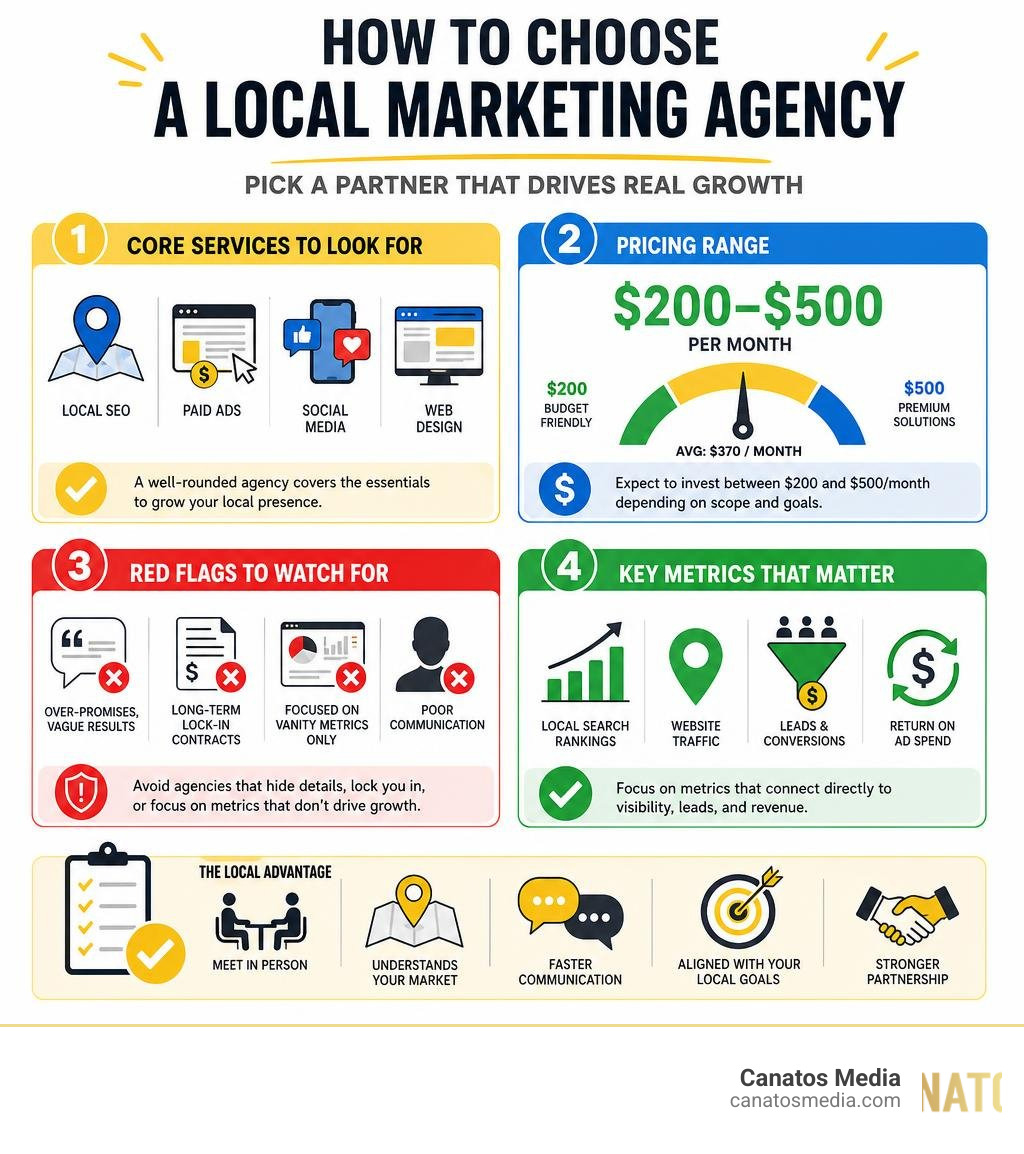
    1. Search local directories like Thumbtack or Bark.com and filter by rating and reviews
    2. Check their case studies — look for real results in your industry, not just pretty websites
    3. Confirm their core services — at minimum: local SEO, paid ads, social media, and web design
    4. Ask about pricing — expect to pay around $370/month on average, with quality options ranging from $200 to $500/month
    5. Meet them in person — a local agency should be willing to sit down with you and learn your business

    Most local business owners waste months bouncing between agencies that over-promise and under-deliver. They sign contracts, pay retainers, and end up with a generic social media calendar and a dashboard full of metrics that don’t mean anything.

    Here’s the uncomfortable truth: not all marketing agencies are created equal — and proximity alone doesn’t make one worth hiring.

    With over 87 marketers listed in major cities on platforms like Thumbtack, and agencies rated as high as 4.90 out of 5 based on more than 162,000 reviews, there’s no shortage of options. The hard part isn’t finding an agency. It’s finding one that actually fits your business, your market, and your goals.

    This guide cuts through the noise. It gives you a clear, practical framework for vetting, choosing, and working with a local marketing agency that will actually move the needle.

    I’m Nic Canobbio, founder of Canatos Media — I’ve spent over two decades navigating media production, content strategy, and high-stakes business deals, which gives me a front-row seat to what separates agencies that drive growth from those that just burn your budget when searching for a marketing agency near me. Everything in this guide comes from that experience, plus hard data from the market.

    Infographic showing how to choose a local marketing agency: services, pricing range $200-$500/month, red flags, and key

    Marketing agency near me helpful reading:

    Why Hiring a “Marketing Agency Near Me” Beats Going Remote

    When you run a business in the Tri-State area or right here on Long Island, your market is unique. The rhythm of a Tuesday morning in Manhattan is entirely different from a Saturday afternoon in Nassau County. That is why hiring a local partner is almost always superior to hiring a remote team halfway across the country.

    A remote agency might know how to run a Facebook ad, but they do not understand the local consumer. They do not know the difference between the North Shore and the South Shore, nor do they understand the seasonal shifts that dictate how local residents spend their money. Working with a team that can physically visit your storefront, capture authentic local content, and sit down with you for a face-to-face strategy session changes everything.

    When we work locally, we tap into existing community connections and regional trends. This isn’t just about convenience; it is about building a brand that feels authentic to the people living in your neighborhood. If you want to dive deeper into how local agencies stack up against each other, check out our guide on A No-Nonsense Comparison of Local Digital Marketing Agencies.

    What to Expect When Searching for a Marketing Agency Near Me

    As you begin your search for a marketing agency near me, you will notice a wide variety of pricing models and service offerings. To help you make sense of the landscape, we have broken down the typical market data for local agencies versus massive national firms.

    According to data from platforms like Thumbtack, the average cost of marketing services sits around $370 per month. However, this varies depending on your business size and goals. A “Great Value” tier typically starts around $200 per month, while premium, highly tailored local campaigns sit closer to $500 per month.

    Feature Local Marketing Agency National / Remote Firm
    Average Cost $200 – $500+/month $1,500 – $5,000+/month
    Market Knowledge Deep understanding of Tri-State/Long Island Generalized, broad-market approach
    Communication In-person meetings & direct phone access Ticket systems & automated emails
    Content Creation On-site video, real photos of your team Stock photography & generic graphics
    Community PR Direct relationships with local media/influencers Automated, generic press releases

    When you look at local directories, you will find highly rated professionals right in your backyard. For instance, Thumbtack lists 15 five-star marketers in New York, NY alone, with 87 total marketers near you ready to quote. Using platforms like the THE BEST 10 MARKETING IN LONG ISLAND, NY – Yelp directory is an excellent starting point to see who is active in your immediate area.

    The Power of Local PR and Community Networking

    One of the most overlooked advantages of hiring a nearby agency is their established network. A local agency does not have to build relationships with regional media outlets, business chambers, or local influencers from scratch—they already have them.

    If you are a business on Long Island or in the surrounding NY/NJ/CT metro area, getting featured in local publications or participating in community events can build massive brand trust. Local PR is not about sending out a cold press release to a national wire service; it is about knowing the local editors, supporting regional charity events, and engaging in neighborhood online communities. When your marketing partner has their boots on the ground, they can weave your brand directly into the community fabric.

    5 Core Services Your Local Agency Must Master in 2026

    In 2026, marketing is no longer about running isolated campaigns. It is about creating an integrated digital ecosystem where your social media, website, search visibility, and paid ads all work together.

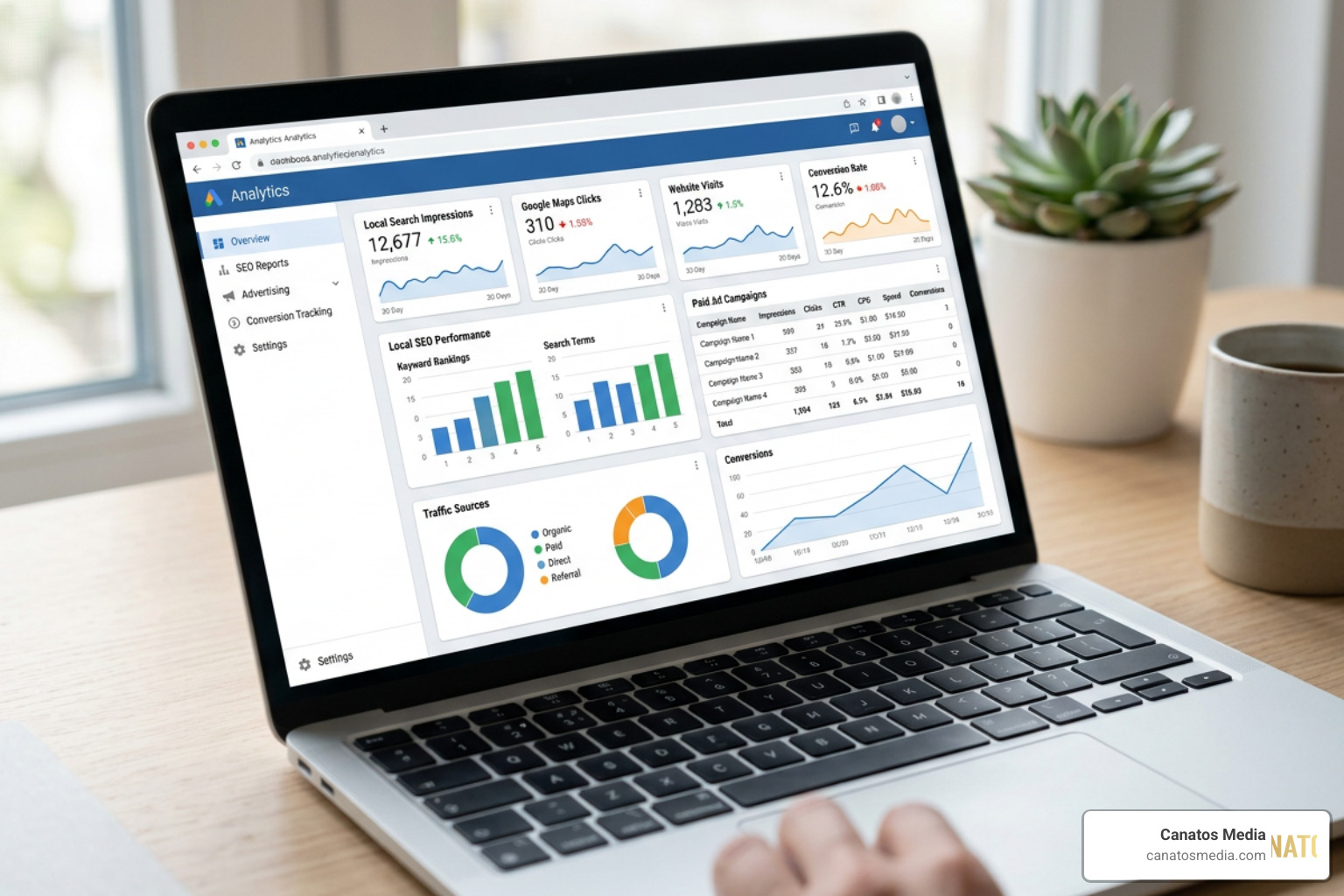
    A close-up of a modern digital marketing dashboard displaying local SEO metrics, conversion rates, and paid ad performance

    If you are looking for a partner to help you grow, they must have a firm grasp on how these channels connect. For a complete breakdown of how these moving parts fit together, read our article on The Ultimate Breakdown of What a Creative Digital Marketing Agency Actually Does.

    Local SEO and Google Business Profile Optimization

    If a customer searches for your services in your town and you do not show up in the “Map Pack” (the top three local map listings on Google), you are losing money to your competitors every single day.

    An expert local agency will optimize your Google Business Profile, build consistent local citations, and help you establish a system to collect and respond to customer reviews. They will also optimize your website for local keywords so that you rank high when people search for your services nearby.

    High-Converting Web Design and Development

    Your website is your digital storefront. It does not matter how many people click on your ads if your website is slow, confusing, or looks like it was built in 2012.

    A great local agency will focus on user experience, mobile speed, and conversion rate optimization (CRO). Every page should have a clear purpose, fast load times, and frictionless ways for potential customers to call you, book an appointment, or buy your products. Investing in high-quality web design is essential to elevate your local brand and turn visitors into paying customers.

    Organic reach on social media is harder than ever to achieve, which is why a hybrid approach of paid ads and organic content is essential. Your agency should be running targeted Meta (Facebook/Instagram) and Google Ads campaigns that place your brand directly in front of local buyers.

    But ads alone are not enough. In 2026, cinematic, short-form video content is the king of social media engagement. People want to see real faces, real projects, and real behind-the-scenes moments. If your agency is only posting stock images with generic captions, they are failing you. For businesses looking to scale using video, check out our curated list of the 5 Best Video Marketing Agencies for Growth-Focused Businesses in 2026.

    How to Evaluate and Choose a Local Marketing Partner

    Choosing an agency is a major business decision. You are not just hiring a vendor; you are choosing a partner who will represent your brand to the public.

    Two business owners in a bright office reviewing marketing case studies and digital performance charts on a tablet

    To avoid getting burned, you need a structured vetting process. Start by reading our guide on how to Stop Searching and Start Growing with the Best Local Marketing Companies.

    Red Flags to Avoid When Vetting a Marketing Agency Near Me

    When you are interviewing agencies, keep your guard up. Here are some immediate red flags that should make you run the other way:

    • Guaranteed Rankings: If an agency guarantees you the #1 spot on Google in 30 days, they are lying. Search algorithms change constantly, and no one has a secret cheat code.
    • Lack of Transparency: If they cannot explain where your ad spend is going or refuse to give you direct access to your ad accounts, they are hiding something.
    • Overuse of Stock Photography: If their own website and client portfolios are filled with generic stock images of people shaking hands, they lack the creative capability to build an authentic brand for you.
    • Vanity Metric Reports: If their monthly reports only talk about “impressions” and “likes” rather than leads, phone calls, and actual revenue, they are distracting you from a lack of real results.

    Verifying Industry Expertise and Client Results

    Before signing any contract, ask to see real case studies and client reviews from businesses similar to yours. Look for established firms in the region that can demonstrate a proven track record of success and transparent reporting.

    When reviewing their portfolio, pay attention to the metrics they highlight. Did they double a medical practice’s patient inquiries? Did they help a local restaurant increase bookings by 40%? These are the tangible results that matter. If you want a shortlist of top-tier creative teams to compare, check out The Best Creative Digital Agency Shortlist for 2026.

    Frequently Asked Questions About Local Marketing Agencies

    How much does a local marketing agency typically cost?

    While national agencies often demand hefty retainers starting at several thousand dollars per month, local marketing agencies are much more accessible for small and mid-sized businesses. On platforms like Bark and Thumbtack, the nationwide average sits at $370 per month. A basic, high-value campaign can cost around $200 per month, while premium, highly active local management typically ranges up to $500 per month.

    How long does it take to see measurable results?

    It depends on the channel. Paid advertising (like Google Ads and Meta Ads) can drive leads and phone calls within the first week of launching. Organic strategies like SEO and content marketing are long-term investments; you should expect to see measurable shifts in search rankings and organic traffic within 60 to 90 days, with full momentum building over 6 to 12 months.

    Do local agencies handle both organic and paid digital strategies?

    Yes, the best local agencies use an omnichannel approach. They combine organic strategies (like SEO, Google Business Profile optimization, and organic social posts) with paid strategies (like Google PPC and Meta Ads) to build a dominant local presence. This integrated approach ensures that you capture both immediate buyers and long-term brand advocates.

    Conclusion

    Finding a marketing agency near me does not have to be a stressful trial-and-error process. By focusing on local expertise, transparent pricing, and authentic content creation, you can find a partner that genuinely cares about your business growth.

    At Canatos Media, we do things differently. We serve the Tri-State area and Long Island with an integrated strategy that connects cinematic short-form video, hyper-targeted paid ads (Meta and Google), local SEO, and complete website support. We do not hide behind vanity metrics or send you confusing, automated reports. We focus on what actually matters: connecting your content to conversions to drive measurable growth.

    Ready to stop searching and start growing? Explore Canatos Media’s services today and let us build a marketing engine that actually works for your business.

  • How We Optimize Cinematic Video Ads for Maximum ROI on Meta and Google

    How We Optimize Cinematic Video Ads for Maximum ROI on Meta and Google

    Why Most Video Ads Fail to Convert: The Real Problem

    The core issue isn’t that video ads don’t work. It’s that most businesses treat them like broadcast content rather than performance marketing. We see brands spend five figures on production only to run ads with no clear offer, no urgency, and no tracking infrastructure behind them.

    Many video ads fail because they prioritize view counts over conversions. A 10-million-view video that generates zero leads is an expensive vanity metric. The disconnect happens when creative teams and performance teams don’t speak the same language. Filmmakers optimize for emotion and narrative; conversions live in specificity and clarity.

    Another major blocker: mismatched audience and message. We’ve watched companies blast the same 60-second hero video to cold audiences, warm prospects, and existing customers simultaneously. Each group needs different messaging, different lengths, and different calls-to-action. Running one generic ad wastes budget on viewers who aren’t ready to respond.

    Technical setup compounds the problem. Most platforms require pixel tracking, proper audience segmentation, and bid strategy alignment to deliver results. Without these fundamentals, even exceptional creative underperforms.

    Actionable next step: Audit your current video campaigns. Note which videos drove clicks, which drove actual conversions, and which just accumulated views. This baseline will clarify where your optimization gaps are.

    The Cinematic Advantage: How Premium Storytelling Drives Performance

    Cinematic production doesn’t mean slower, less effective ads. When done strategically, premium storytelling actually improves conversion rates because it builds trust and differentiation faster than generic stock footage.

    We’ve found that cinematic brand video campaigns outperform standard ads in three measurable ways. First, they stop the scroll. In a feed full of basic images and text, a beautifully shot 15-second video commands attention without sound. Second, they communicate quality and credibility instantly. A service-based company shot on professional equipment feels more established than one using smartphone footage. Third, they create emotional anchors that make people remember your brand and return to convert later.

    The key is pairing cinematic production with performance discipline. We don’t make art films; we make ads that sell. That means every shot serves a purpose, every transition reinforces your message, and every frame works without sound (since most platform views happen muted).

    A roofing contractor we worked with needed leads, not just brand awareness. We shot cinematic 15-second videos showing their process, their team, and real customer testimonials in a way that felt premium. The production quality signaled professionalism; the testimonials signaled social proof. Result: 3.2x return on ad spend within the first month.

    Cinematic storytelling also extends video lifespan. A well-crafted brand film works across multiple campaigns, platforms, and audiences over months or even years. That production investment compounds.

    Action for you: If your current video ads use basic B-roll or text overlays, consider investing in one high-quality 30-60 second brand film. Edit it into multiple shorter versions (15s, 6s) for different platforms and audiences. One premium production can fuel an entire quarter of campaigns.

    Meta Video Ad Optimization: Platform-Specific Strategies We Use

    Meta platforms (Facebook and Instagram) reward video ads that keep people watching. The algorithm prioritizes watch time and completion rate, which means your opening frame and first three seconds are critical.

    We structure Meta video ads differently than YouTube ads because the viewing context is different. Most Meta viewers are passive and muted. Your video must hook them instantly through visual storytelling, text overlay, or immediate action on screen. Hook first, then introduce your product or offer.

    Meta’s optimization options give us fine-grained control. We typically run campaigns with multiple objectives depending on the funnel stage:

    • Cold audiences: Optimize for video views to build awareness and generate creative feedback
    • Warm audiences: Optimize for conversions or lead form clicks with a clear offer
    • Retargeting: Optimize for conversion or catalog sales if you have an e-commerce component

    Our Meta and Google Advertising approach always includes A/B testing on primary elements: thumbnail image, opening hook, video length (we often test 6s vs 15s vs 30s), and call-to-action placement. We let the data guide optimization rather than guessing.

    We also adjust video specs for each Meta placement. Feed ads perform differently than Stories ads; Reels differ from standard video. We compress file sizes appropriately and frame content for vertical viewing when relevant.

    Your next move: Review your Meta ad account’s completion rates. If they’re below 50%, your hook isn’t working. Test shortening your video to 6 seconds or leading with a stronger visual element to grab attention sooner.

    Google Video Advertising: Search and YouTube Integration for Results

    Google’s video ecosystem spans YouTube (display), Search (text-triggered video ads), and YouTube Shorts. Each channel serves different intent and requires different optimization.

    YouTube ads work well for interest-based targeting and brand awareness at scale. If someone is watching content related to your industry, a YouTube bumper or skippable ad reaches them in a receptive moment. We optimize YouTube campaigns for view-through rates and cost-per-view, then retarget viewers who didn’t skip.

    Google Search video ads are underutilized but powerful. When someone searches a high-intent keyword (like “commercial HVAC repair near me”), a short video answer appears alongside text results. These ads catch people mid-decision, and they perform exceptionally well for service businesses.

    YouTube Shorts ads are newer but increasingly effective for reaching younger audiences and capturing short-form attention. These follow social media principles more than traditional YouTube, so we treat them similarly to Meta Reels.

    Our Google video ad strategy focuses on intent alignment. We match video messaging to what people are actively searching for or the content they’re consuming. A plumber shouldn’t run the same ad on YouTube videos about home renovation as they do on searches for “emergency plumber near me.”

    We also layer Google conversion tracking across all video properties. This means we can connect video views to actual calls, form submissions, or sales, not just vanity metrics.

    What to test: Search for your own high-intent keywords in your industry. If you’re not appearing with a video ad, you’re missing opportunity. Start with 5-10 high-intent keywords and test YouTube Search video ads for 2-4 weeks.

    Building Your Video Production Workflow for Campaign Success

    Sustainable video advertising requires a production workflow that scales without becoming chaotic. We’ve built systems that allow us to produce multiple videos monthly while maintaining cinematic quality and performance focus.

    Our workflow starts with strategy, not cameras. Before shooting anything, we define the campaign objective, audience segment, and primary offer. A video made without these anchors almost always underperforms. We brief the production team on performance goals, not just aesthetic goals.

    During pre-production, we script every video with the assumption that most viewers won’t have sound. We include text overlays, on-screen action, and visual storytelling that work independently of audio. We also build in multiple edit variations during shooting so one day of filming yields several video lengths (6s, 15s, 30s).

    Post-production focuses on optimization from day one. We color-grade to match your brand; we edit for platform specs; we add subtitles and overlays. Then we prepare multiple variants: muted versions, versions with music, versions with voiceover, versions with captions. This variation library becomes fuel for ongoing testing.

    Once videos launch, we monitor performance weekly. Underperforming creative gets paused; high-performing ads get scaled budget. We also gather audience feedback through pixel data and comments, which informs the next round of production.

    The result: continuous improvement. Your first video rarely performs as well as your fifth. A structured workflow lets you iterate quickly without breaking the bank.

    Implementation step: Document your current video creation process from concept to launch. Where are the bottlenecks? Most teams lose weeks waiting for approvals or revisions. Build a single approval path and define revision rounds upfront to accelerate your timeline.

    Measuring What Matters: Tracking Performance Metrics That Predict Sales

    Not all metrics are equal. Impressions and views feel good but don’t pay bills. We focus on metrics that predict actual business outcomes: cost-per-conversion, cost-per-lead, and ultimately, return on ad spend.

    Every video campaign needs proper tracking infrastructure. This means conversion pixels installed on your website, form submission tracking in your CRM, and if possible, offline conversion data (phone calls, in-store visits) synced back to your ad platform. Without complete tracking, you’re flying blind.

    We separate metrics by audience stage:

    • Top-of-funnel (cold audiences): Track view-through rate, engagement rate, and cost-per-video-view
    • Mid-funnel (warm audiences): Track cost-per-click, cost-per-lead, and lead quality indicators
    • Bottom-of-funnel (retargeting): Track conversion rate, cost-per-conversion, and customer acquisition cost

    This segmentation prevents us from over-investing in awareness-stage campaigns while lead-stage campaigns starve for budget. Each funnel level has appropriate expectations and metrics.

    We also track secondary signals that predict future performance: time-on-page after clicking a video ad, bounce rate, and form abandonment rate. A video that drives 100 clicks but 95% bounce rate isn’t working, even if the click cost looks good.

    Action: Set up conversion tracking on your website today if you haven’t already. Install the Meta pixel and Google pixel on every page. Without this, you cannot accurately measure whether your video ads actually convert. Once tracking is live, allow 2-4 weeks of data collection before optimizing campaigns.

    Lead Generation Through Strategic Video Ad Placement

    Video ads are exceptional lead generators when placed strategically in your funnel. We don’t just rely on organic video views; we use videos as conversion tools within a structured lead-generation system.

    One effective approach: create a curiosity-driven video ad (15-30 seconds) that leads to a landing page with a video-enhanced form. The video establishes credibility and motivation; the form captures contact information. This two-step process typically converts better than asking for an email immediately in the ad.

    Another high-performing tactic is video testimonials in lead-stage campaigns. When a warm or retargeting audience sees a customer sharing specific results (25% revenue increase, 40 days faster delivery), they move toward a decision. Video testimonials outconvert text testimonials significantly because they feel authentic and specific.

    We also use video to educate prospects who aren’t ready to buy. A 3-minute educational video explaining your service, answering common questions, or showing your process pre-qualifies leads and reduces sales team friction later. When someone converts after watching educational content, they’re typically further along and easier to close.

    Strategic placement across your All-in-One Marketing Funnel means different videos at different points. Top-of-funnel videos build awareness. Mid-funnel videos educate. Bottom-of-funnel videos include clear offers and social proof.

    Immediate tactic: Map your current sales funnel. Where are prospects dropping off? A video placed at that stage (addressing objections, showing proof, or explaining next steps) will likely improve conversion rate.

    Integrating Video Ads Into Your Broader Digital Strategy

    Video ads don’t exist in isolation. They work best as part of a comprehensive digital strategy that includes organic social content, email marketing, SEO, paid search, and website optimization.

    We see the highest ROI when video campaigns align with other channels. For example, a video ad campaign announcing a new service should coincide with organic posts about that service, email announcements to your list, and updated website copy. This multi-channel consistency reinforces your message and improves overall conversion rates.

    Video also extends the lifecycle of other campaigns. A winning SEO article can become the foundation for a video summary. A popular email offer can become a video ad. Repurposing high-performing content into video format multiplies your content investment.

    Retargeting pixel data from video ads also feeds your email strategy. People who watch 75% of your brand video but don’t convert might benefit from a follow-up email sequence. Those same video viewers become higher-value lookalike audiences for future paid campaigns.

    We also integrate video into your organic social strategy. Videos that perform well as ads often perform well as organic content too. The reverse is true: organic hits should be considered for paid amplification. This connection creates a flywheel where content and paid support each other.

    Strategy session: List your three best-performing organic social posts from the past three months. Could any of these become a paid video ad? Start with one and test it for 2-4 weeks.

    Common Video Ad Mistakes We Help You Avoid

    Most video ad underperformance stems from a few preventable mistakes. Knowing these helps you skip ahead to what actually works.

    The most common error is leading with your logo or company name. Your audience doesn’t care about your brand in the first three seconds; they care about what’s in it for them. Lead with benefit, result, or curiosity. Introduce your brand once you’ve earned attention.

    Another frequent mistake is mismatched production quality and targeting. A beautifully shot video about high-end services shouldn’t reach budget-conscious audiences. Conversely, overspending on production for a simple discount offer often wastes budget. Match production caliber to audience willingness-to-pay.

    We also see businesses run single videos to all audiences and call it a strategy. Effective campaigns use audience-specific videos or at least audience-specific messaging overlays. Your existing customers need different motivation than cold prospects.

    Poor file optimization is another hidden drain. Video files that are too large load slowly and get fewer views. Ads that aren’t properly formatted for vertical viewing on mobile get poor engagement. These technical details matter more than most realize.

    Finally, not testing variants is a missed opportunity. Running one video at one ad length to one audience and expecting optimal results rarely happens. A/B testing different hooks, lengths, calls-to-action, and audiences almost always reveals performance gains of 20-50%.

    Diagnostic check: Review your three lowest-performing video ads from the past year. Do any violate these mistakes? If so, fix them and relaunch.

    Our Process: From Concept to Launch and Beyond

    Our approach to video ad optimization begins long before we hit record. We start with a strategy session where we understand your business, audience, conversion goals, and current marketing performance.

    From there, we develop a video content roadmap that aligns with your sales funnel and business objectives. We identify which videos serve awareness, which serve consideration, and which serve conversion. We also determine budget allocation across each stage based on your funnel data.

    Production happens next, with the performance requirements built into every decision. We script for muted viewing, shoot for multiple edit lengths, and include B-roll that supports text overlays and lower-thirds. Every production day yields multiple finished assets.

    Once videos are ready, we set up tracking infrastructure: pixels, audience segments, and conversion connections. We configure each platform (Meta, Google, or both) with the specific optimization objectives for that audience stage.

    Launch is coordinated across channels. We start with smaller budgets and tight audience targeting to validate creative performance. As videos prove themselves, we increase budget and broaden audience parameters. We also begin A/B tests immediately: different hooks, different lengths, different calls-to-action.

    Post-launch, we monitor performance daily and optimize weekly. We pause underperformers, scale winners, and test new variations continuously. We also prepare monthly performance reports that show not just spending and views, but actual conversions and ROI.

    Throughout this process, we maintain constant communication with your team. You’ll see performance dashboards, understand what’s working and why, and have input on creative direction and budget allocation.

    Next step: If you’re ready to optimize your video ad performance, schedule a strategy session with us. We’ll audit your current campaigns, identify optimization opportunities, and build a roadmap for turning video attention into measurable leads and sales.

    Contact us today for a free consultation to see how we can help you grow your business.

    Frequently Asked Questions (FAQ)

    How do we optimize video ads differently on Meta versus Google?

    We tailor our approach to each platform’s strengths. On Meta, we focus on thumb-stopping creative within the first three seconds and leverage detailed audience targeting to reach high-intent users. On Google, we emphasize search intent alignment and YouTube placement strategy, where we integrate keywords naturally and design ads for both skippable and non-skippable formats to maximize completion rates and conversions.

    What metrics do we actually track to measure if a video ad campaign will generate sales?

    We monitor watch-through rates, click-through rates, and cost-per-lead, but we prioritize tracking conversion velocity and lead quality over vanity metrics. Our system connects video ad performance directly to your sales pipeline, so we can see which creative elements and audience segments produce qualified leads that actually close deals.

    Why does our cinematic video production approach deliver better ROI than standard video ads?

    Cinematic storytelling builds trust and emotional connection, which translates to higher engagement and lower customer acquisition costs. We combine premium production quality with platform-specific optimization, so your brand stands out in crowded feeds while the ads remain strategically designed to convert, not just entertain.

  • Meta Business Suite 101: Streamline Your Instagram and Facebook Presence

    Meta Business Suite 101: Streamline Your Instagram and Facebook Presence

    Why Meta Business Suite Is the Smartest Way to Manage Facebook and Instagram

    Meta Business Suite is Meta’s free, all-in-one platform for managing your Facebook and Instagram business presence from a single dashboard — on desktop or mobile.

    Here’s what it does at a glance:

    • Create and schedule posts and Stories for Facebook and Instagram
    • Manage all messages and comments from one unified inbox
    • Automate replies to save time on routine customer questions
    • Track performance with insights on posts, Stories, and ads
    • Stay on top of tasks with a centralized notifications and to-do list

    If you’re running a local business and trying to juggle Facebook and Instagram at the same time, you already know how quickly things fall apart. Posts go out late. Customer messages get missed. You have no clear picture of what’s actually working.

    That’s exactly the problem Meta Business Suite was built to solve.

    With over 100 million downloads on Google Play alone — and a 4.7-star rating across nearly half a million App Store reviews — it’s clearly a tool that millions of business owners rely on every day. And for good reason: it brings your most important social media tasks into one place, so you spend less time platform-hopping and more time growing.

    I’m Nic Canobbio, founder of Canatos Media, and after managing social content and paid campaigns across Meta platforms for clients in multiple industries, I’ve spent considerable time inside Meta Business Suite — learning exactly where it shines and where it falls short. In this guide, I’ll walk you through everything you need to know to use it effectively.

    Meta Business Suite ecosystem infographic showing features: scheduling, inbox, insights, automation, and mobile access

    Simple meta business suite glossary:

    What is Meta Business Suite and Who Is It For?

    At its core, Meta Business Suite is a centralized platform designed to bring your Facebook Pages and Instagram professional accounts under one roof. Instead of logging into separate apps, switching profiles, and trying to remember where you left off, you get a single workspace. This workspace is built to streamline your workflow and make your digital marketing efforts far more efficient.

    By linking your business assets, you can manage your organic content, interact with your audience, and run basic promotions without ever leaving the dashboard. To learn more about how Meta’s ecosystem fits together, you can explore the Marketing Tools and Advertising Solutions on Facebook and Instagram | Meta for Business portal, which outlines the broader scope of Meta’s business tools.

    Target Audience and Business Support

    Whether you are running a cozy coffee shop on Long Island or managing a multi-location brand across the tri-state area, Meta Business Suite is built to adapt to your scale:

    • Small Businesses: If you are a team of one (or have a handful of employees wearing too many hats), this platform is a lifesaver. It allows you to schedule a week’s worth of content in one sitting, so you can get back to serving your customers.
    • Content Creators: Creators can manage their brand partnerships, track which Reels are driving the most engagement, and interact with followers without getting distracted by their personal feeds.
    • Large Enterprises & Agencies: For larger teams, the suite offers robust role permissions. You can assign specific access levels to employees or external agencies (like us!) to manage content and community moderation without hand over your master login credentials.

    The platform is designed for resource allocation. By automating tedious tasks and putting your critical metrics in front of you, it frees up your schedule so you can focus on high-impact business decisions.

    Core Features for Cross-Platform Management

    Managing a modern digital presence requires constant content creation and swift customer interaction. Meta Business Suite acts as your central command center, optimizing your workflows so you never feel overwhelmed by the demands of maintaining two distinct social networks.

    Scheduling Content with Meta Business Suite

    One of the most powerful features of the meta business suite is its cross-platform publishing and scheduling engine. Instead of posting in real-time, you can plan your social calendar days, weeks, or even months in advance.

    When you create a post or a Story, you can customize the text, hashtags, and links specifically for Facebook and Instagram. For example, you can add a clickable link to your Facebook post while keeping your Instagram caption clean and pointing users to your link-in-bio.

    To see this in action, check out this guide on How To Use Meta Business Suite to Schedule Posts to Instagram … .

    Planning your content ahead of time is especially important when you are producing high-quality media. We often emphasize how much visual quality matters; for instance, understanding How Cinematic Short Form Content Improves Meta Paid Ad Performance can help you design organic posts that transition beautifully into high-performing paid campaigns.

    Unified Inbox and Automated Replies

    Customer service can make or break a local business. If a potential client sends a message on Facebook Messenger or leaves a comment on an Instagram Reel, they expect a quick response.

    The unified inbox in Meta Business Suite aggregates:

    • Facebook Messenger conversations
    • Instagram Direct Messages (DMs)
    • Comments on Facebook posts
    • Comments on Instagram posts

    To make things even easier, you can set up automated replies. These include “Instant Replies” (sent as soon as someone messages you), “Away Messages” (for when your business is closed), and custom automated responses for frequently asked questions (like your hours, location, or pricing).

    By streamlining these interactions, you improve your customer service efficiency dramatically. For a deeper look at how to leverage these messaging tools, read about The Best Way to Utilize Meta Business Suite to Run Your … – Reamaze .

    Analyzing Performance in Meta Business Suite

    You can’t improve what you don’t measure. The Insights dashboard in Meta Business Suite gives you a clear, side-by-side view of how your content is performing on both platforms.

    analytics dashboard showing reach and engagement metrics

    Within the dashboard, you can track:

    • Audience Demographics: See exactly who is following you, including their age, gender, and top locations in the tri-state area.
    • Post Reach & Engagement: Learn which posts, Reels, and Stories are getting the most eyes and interactions.
    • Ad Performance: Get basic overviews of how your boosted posts and simple ad campaigns are performing.

    Understanding these metrics is vital, especially when trying to generate local leads. For example, knowing How to Optimize Short Form Video Ads for Local Lead Generation relies heavily on monitoring your reach and engagement data to see which creative hooks resonate most with your local audience.

    Mobile App Performance and Platform Comparison

    While the desktop version of Meta Business Suite is perfect for deep-dive planning and detailed analytics, the mobile app is designed for on-the-go updates. Whether you’re snap-shooting a behind-the-scenes Story or replying to an urgent customer message from the field, the mobile experience is crucial.

    content calendar view mobile management on the go updates

    Android vs. iOS Features and Ratings

    The mobile experience can vary slightly depending on your device’s operating system. Both platforms offer the core suite of tools, but user ratings and feedback show some interesting differences.

    Metric / Feature Android (Google Play) iOS (App Store)
    Average Rating 4.4 out of 5 stars 4.7 out of 5 stars
    Total Reviews / Ratings ~4.99 Million reviews ~472,000 ratings
    Total Downloads 100 Million+ N/A (App Store does not publicize downloads)
    International Ratings High volume of global users 4.6 stars (Switzerland), 4.8 stars (Bolivia)
    Core Features Scheduling, inbox, insights, real-time calls Scheduling, inbox, insights, real-time calls
    App Size Varies by device ~315 MB (requires iOS 15.1 or later)

    To download the app or read more user reviews for Apple devices, visit the ‎Meta Business Suite App – App Store page.

    Common User Complaints and Technical Issues

    Despite its high ratings, the mobile app is not without its flaws. Social media managers and business owners frequently report a few common technical bugs in recent app reviews:

    • Notification Delays: Some users report that they do not receive push notifications for new messages or comments in real-time, forcing them to open the app and refresh manually.
    • Sync Errors: Occasionally, the app may struggle to sync scheduled posts between the mobile and desktop versions, causing temporary panic about whether a post will actually go live.
    • App Crashes: Following major software updates, some users experience sudden app crashes, particularly when trying to upload high-resolution video files or managing multiple accounts.
    • Login Issues: Security protocols can sometimes trigger loop logins, where the app repeatedly asks for verification codes or fails to connect to linked Instagram accounts.

    Privacy, Recent Updates, and Complementary Tools

    As digital privacy regulations tighten and platforms evolve, staying compliant and up-to-date with Meta’s technical ecosystem is essential for keeping your business accounts running smoothly.

    App Store Privacy and Data Collection Practices

    According to the official App Store privacy disclosures, Meta Business Suite collects a significant amount of user data to power its business tools and ad networks. This collection is standard across Meta’s app family but is worth noting for privacy-conscious business owners.

    Data collected and linked to your identity may include:

    • Financial and Purchase Info: Used primarily when you run ads or manage shop features.
    • Location Data: To help target local audiences and provide localized insights.
    • Contact Info & Contacts: To help connect your business network.
    • Usage & Diagnostic Data: To monitor app performance, track crashes, and improve user experience.

    Recent App Updates and Feature Improvements

    Meta frequently updates the suite to make managing your business easier. As of our current date in June 2026, several major improvements have rolled out:

    • Side-by-Side Content Report: You can now view organic post metrics and paid ad performance side-by-side in real-time, making it incredibly easy to see if a top-performing organic post is worth boosting.
    • Enhanced Calendar View: The content calendar has been upgraded to show published, scheduled, and draft content in a much cleaner, drag-and-drop monthly grid.
    • Real-Time Call Feature: Businesses can now make real-time audio calls to customers directly through the inbox interface, simplifying lead follow-ups.

    Complementary Tools for Advanced Advertisers

    While Meta Business Suite is fantastic for organic management and basic post boosting, serious advertisers will eventually outgrow its simplified ad creation tools.

    If you are looking to scale your business with paid campaigns, we highly recommend integrating these complementary tools:

    • Meta Ads Manager: This is where the real magic happens. It offers advanced targeting, custom audience building, A/B testing, and deep funnel optimization. If you are new to the platform, check out our guide on Mastering Meta Business Suite Ads Manager for Beginners and our comprehensive Meta Ads Management Ultimate Guide to get started.
    • Meta Blueprint: Meta’s free educational resource that offers courses and certifications to help you master digital marketing across their platforms.

    To avoid costly mistakes when transitioning to paid advertising, we also recommend reading our guides on how to Stop Burning Cash on Bad Meta Ads and how to Stop the Scroll and Start the Toll with Meta Paid Ads.

    Frequently Asked Questions

    How do I schedule posts on both Facebook and Instagram simultaneously?

    To schedule posts simultaneously, open the Meta Business Suite dashboard (or mobile app) and click Create Post. In the “Placements” section at the top, check the boxes for both your Facebook Page and your Instagram account. Write your caption, upload your media, and then select Schedule instead of publishing immediately. You can choose different dates and times for each platform if you want to optimize for when your specific audiences are most active.

    What is the difference between Meta Business Suite and Meta Ads Manager?

    Meta Business Suite is primarily designed for organic social media management, community engagement (inbox), and basic page administration. Meta Ads Manager is a separate, highly advanced tool built specifically for creating, managing, and scaling paid advertising campaigns with complex targeting, budgeting, and placement options.

    Is Meta Business Suite free to use?

    Yes! Meta Business Suite is a completely free tool provided by Meta. There are no subscription fees or hidden costs to use any of its organic management, scheduling, inbox, or insight features. You only pay if you choose to run paid advertising campaigns or boost your posts.

    Conclusion: Strategic Growth with Canatos Media

    Mastering the meta business suite is one of the fastest ways to take back control of your time and build a consistent online presence on Facebook and Instagram. By scheduling your content, automating your customer service, and keeping a close eye on your analytics, you transition from reactive posting to proactive brand building.

    However, consistent digital growth requires more than just scheduling posts. To truly stand out—especially in competitive markets like Long Island and the broader tri-state area—you need an integrated strategy that connects high-quality content with precision targeting.

    At Canatos Media, we specialize in creating cinematic short-form videos, managing social media channels, running high-ROI paid ad campaigns (Meta and Google), and optimizing your website’s SEO. We don’t just post to post; we connect content, targeting, and conversions to drive measurable growth for your business.

    Ready to stop guessing and start scaling? Explore our Meta Google Advertising services today, and let’s build an advertising engine that turns local clicks into loyal customers.

    Visit Canatos Media to supercharge your digital growth today!

  • How to Win with Short-Form Content on Facebook and Instagram

    How to Win with Short-Form Content on Facebook and Instagram

    Why Short-Form Video Dominates Your Facebook and Instagram Feed

    Your customers are scrolling. Fast. Between coffee and their morning commute, they’re consuming dozens of videos in mere minutes. Short-form content on Facebook and Instagram isn’t a trend anymore—it’s the dominant format that platforms actively prioritize in their feeds.

    Meta’s algorithm heavily favors video content because it keeps users engaged longer. A three-second clip can stop a scroll mid-swipe, while text posts struggle to compete. For service-based businesses and multi-location brands, this shift means the old playbook of static imagery and lengthy captions no longer moves the needle.

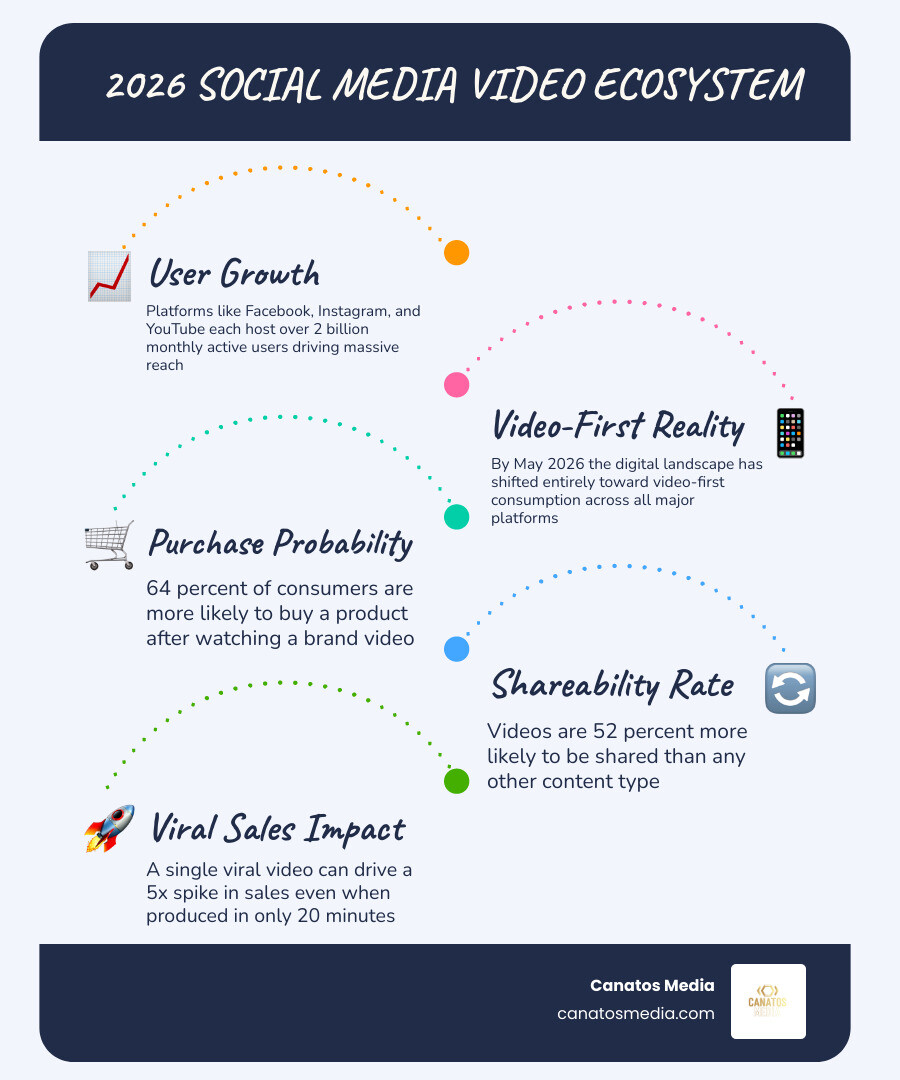
    The numbers support this shift. Video accounts for approximately 80% of internet traffic, and short-form specifically drives measurably higher engagement rates than any other content type on Facebook Reels and Instagram Reels. Platforms are deliberately burying traditional content to promote video. If you’re not creating it, you’re essentially invisible to your audience.

    The practical implication: your competitors who’ve already moved to short-form content are capturing audience attention that used to be distributed more evenly. You’re not just competing against other brands in your industry—you’re competing for milliseconds of attention in a feed designed to reward video.

    The Real Problem: Creating Content That Converts, Not Just Entertains

    Here’s what we see most often: businesses create short-form videos that get views, shares, and comments—but generate zero leads or sales. The content is entertaining. It’s well-shot. It performs. And it accomplishes nothing for the business.

    The gap between viral content and converting content is massive. A funny, trending-audio video might reach 50,000 people. But if it doesn’t include a clear call-to-action, doesn’t build trust in your brand’s specific value, or doesn’t drive people to a lead capture point, those views are wasted effort.

    Many businesses fall into the entertainment trap because metrics feel good in the moment. High view counts create a dopamine hit that makes teams feel productive. But vanity metrics obscure the real question: did this content move someone closer to buying?

    Converting content solves a specific problem your customer has. It demonstrates your expertise or shows how your service works. It includes a reason to engage beyond passive consumption. That’s fundamentally different from content that simply exists to be entertaining.

    Your short-form strategy must answer this: what should a viewer do after watching? If you can’t articulate that, the content isn’t serving your business.

    How Platform Algorithms Reward Strategic Short-Form Video

    Meta’s algorithm operates on predictable signals. When you understand what the platform rewards, you can work with it instead of guessing.

    The platform prioritizes content based on several factors:

    • Watch time: How long people watch before scrolling. Platforms measure this in fractions of a second, so pacing and hook matter enormously.
    • Shares and saves: These actions signal that content is valuable enough to come back to, which carries more weight than likes.
    • Profile visits: When viewers click to your profile after watching, the algorithm treats it as a strong engagement signal.
    • Messaging and conversation: Direct messages in response to content indicate genuine interest.
    • Retention rate: What percentage of viewers watch until the end of your video.

    Strategic short-form content leverages these signals intentionally. A hook in the first frame keeps people watching. A clear value proposition makes people want to save it. A direct call-to-action drives profile visits or messages.

    The algorithm is also context-aware. It learns what your audience engages with and serves similar content to similar people. If your core audience comprises service-based business owners aged 35-55, the platform will distribute your content preferentially to lookalike audiences with similar behaviors.

    Testing and iteration accelerate this learning. By creating multiple versions of similar content and measuring which hooks and calls-to-action drive stronger engagement, you essentially train the algorithm to favor your content.

    The Canatos Approach: Cinematic Content Meets Digital Strategy

    We’ve built our practice around a simple premise: short-form video should look professional and serve a strategic business purpose simultaneously. That’s where most creators miss.

    Our approach combines cinematic production quality with strategic thinking about your customer’s actual journey. We don’t create content in isolation. Every piece of video we produce connects to your broader digital strategy—your paid advertising, your email sequences, your lead capture systems.

    When we produce short-form video production for clients, we’re thinking about where that content lives in your funnel. Is it a top-of-funnel awareness piece designed to reach new audiences? A mid-funnel piece that builds credibility with people already interested? A conversion piece that drives immediate action?

    The cinematic element matters more than many realize. Viewers make split-second judgments about brand quality based on production value. A shaky, poorly-lit video damages brand perception even if the message is solid. Professional production signals that you take your business seriously, which builds trust with high-value customers.

    We also integrate your video content with the rest of your digital marketing. A great short-form video performs better when paired with strategic paid advertising that amplifies it to your target audience. It converts better when paired with a clear landing page and lead capture system. It builds authority when supported by SEO and website optimization.

    Building Your Short-Form Video Strategy for Maximum Impact

    Strategy precedes production. Before you shoot anything, map out what you’re actually trying to accomplish.

    Start with your customer’s journey. At what point do they first learn about businesses like yours? What problems are they trying to solve? What objections do they have? What proof would convince them to buy? Your short-form content should address these moments.

    Next, identify three to five core content themes that support your business goals. For a pest control company, these might be: pest identification, prevention tips, before-and-after treatments, customer testimonials, and seasonal warnings. For a fitness studio, they might be: workout demos, nutrition tips, member transformations, class highlights, and community events.

    Create a content calendar that rotates through these themes. Consistency matters to the algorithm, and batching content production is far more efficient than shooting ad-hoc videos. Plan to produce 2-4 short-form videos weekly if you’re serious about moving the needle.

    Each video should have a distinct purpose:

    • Educational content (tips, how-tos, explanations) builds authority
    • Behind-the-scenes content builds connection and transparency
    • Testimonial and case study content builds trust
    • Promotional content with clear CTAs drives immediate action
    • Trending audio and trending formats keep content fresh and increase reach

    Test different hooks, calls-to-action, and value propositions. Measure what works. Double down on what drives engagement and conversions, not just views.

    Integrating Video Content with Paid Advertising

    Organic reach has limits. To scale results, pair your short-form content with strategic paid advertising.

    Paid advertising allows you to reach audiences beyond your current followers. It also lets you target with precision. Instead of hoping the right people see your content, you’re placing it directly in front of specific demographics, interests, and behaviors.

    The most effective approach: create your organic short-form content first, then amplify top-performing pieces with paid campaigns. This avoids wasting budget on content that underperforms organically. You already know people engage with it.

    When running paid campaigns, you can optimize for different objectives. Awareness campaigns maximize reach to new audiences. Engagement campaigns reward shares, saves, and comments. Traffic campaigns drive people to your website or landing page. Conversion campaigns target people most likely to complete a desired action.

    Match your video content to your campaign objective. An educational video works well for awareness and engagement. A testimonial video works well for conversion campaigns. A product demo works well for traffic campaigns.

    Budget allocation matters too. Most businesses underestimate the budget required for meaningful results. Facebook and Instagram advertising requires enough spend to accumulate data and let the algorithm optimize. We typically recommend minimum daily budgets of $15-20 per campaign to get meaningful results.

    From Views to Leads: Our Lead Generation System

    The bridge between content and conversion is your lead generation system. Without one, even great content fails to translate views into actionable business results.

    We build systems that capture viewer interest and move people into your sales funnel. This typically includes:

    • A clear, valuable call-to-action in your video (visit link in bio, message us, sign up for a guide)
    • A landing page designed to convert viewers into leads (email signup, phone call, demo booking, free consultation)
    • An email sequence that nurtures leads and moves them toward purchase
    • Retargeting ads that remind people about your offer as they continue scrolling

    The system works because it reduces friction. A viewer interested in your offer shouldn’t have to search for the next step. Make it obvious and easy.

    For example, a home remodeling company might use short-form videos showing before-and-after transformations. Each video includes a call-to-action: “Message us for a free design consultation.” That message goes to a team member who responds with information about booking a consultation. People who book become leads.

    Without this system, those viewers might engage with the content and move on. With the system, you’ve captured their contact information and started a conversation.

    Track which videos drive the most leads. Double down on that content theme and refine your approach. Over time, you’ll build a reliable, repeatable system that turns social attention into business results.

    Measuring Success: Metrics That Actually Matter

    Vanity metrics feel good. Actionable metrics drive decisions. Know the difference.

    Metrics that often mislead:

    • View count alone
    • Likes and comments without context
    • Reach divorced from conversion
    • Viral moments that don’t align with your business

    Metrics that actually matter:

    • Click-through rate to your landing page or website
    • Cost per lead generated
    • Lead to customer conversion rate
    • Customer acquisition cost
    • Return on ad spend

    Set specific targets for these metrics before you launch campaigns. If your customer acquisition cost should be under $150, track what your actual CAC is. If your conversion rate from lead to customer typically runs 25%, measure whether video-sourced leads convert at that rate.

    Create a simple dashboard that shows these metrics weekly. Share it with your team. Let it guide decisions about content themes, budget allocation, and strategy refinement.

    Most importantly, connect video metrics back to revenue. A video that costs $100 to produce and generate $500 in profit is a success, regardless of view count. A viral video that cost $500 to produce and generated zero profit is a failure.

    Scaling Your Content Across Multiple Locations

    Multi-location businesses face a unique challenge: how do you create content that feels locally relevant while maintaining brand consistency?

    The solution is systematic variation. Create a core content template that works across locations, then customize elements for each market.

    For example, a home services company with five locations could create this core template: testimonial from a local customer, showing their problem before your service, the transformation after, and the customer talking about their experience. The template is consistent. The customer, the specific project, and the location details change for each branch.

    This approach scales production. You’re not creating entirely different content strategies for each location. You’re producing variations efficiently.

    Assign ownership for local content creation. A manager at each location can source local testimonials and coordinate with your production team. This distributes the work and ensures content feels authentically local rather than centrally forced.

    Cross-promote content across locations. A customer testimonial from Location A should still appear on the pages and feeds for Locations B, C, D, and E. This builds social proof that applies company-wide.

    Consider also creating location-specific landing pages that correspond to location-specific paid campaigns. This improves both relevance and conversion rates.

    Getting Started with Professional Short-Form Production

    You don’t need to overhaul everything immediately. Start with a clear first step.

    Audit your current content. What short-form videos have you already created? Which performed best? What themes resonated? You likely have insights already; they’re just scattered across platforms.

    Define your three core content themes based on what your customers actually want to know about your business.

    Produce 4-6 videos around one theme. Keep them simple initially. A phone camera, good lighting (natural light works well), clear audio, and a focused message are enough to start. Professional production quality becomes more important as you scale.

    Publish consistently. Two to four videos per week is a reasonable starting cadence. Use scheduling tools to spread them throughout the week.

    Measure everything from day one. Track which hooks, content themes, and calls-to-action drive engagement and conversions. Let data guide your next round of production.

    If production feels overwhelming, that’s a signal to bring in professional help. We specialize in translating business goals into short-form video strategies that move the needle. Our team handles the production, testing, and optimization so you can focus on running your business.

    The brands winning with short-form content on Facebook and Instagram aren’t necessarily the ones with the biggest budgets. They’re the ones who combined strategic thinking with consistent execution. That’s something every business can do.

    Contact us today for a free consultation to see how we can help you grow your business.

    Frequently Asked Questions (FAQ)

    What’s the difference between entertaining short-form content and content that actually generates leads?

    We’ve found that most brands create videos designed purely for entertainment or vanity metrics like views and likes. Our approach flips this: we craft cinematic short-form content with a specific conversion goal built in from the script stage. Every video we produce includes a clear call-to-action, a hook that speaks to your ideal customer’s pain point, and strategic placement within a broader lead generation system that connects social engagement to your sales pipeline.

    How do we know if our short-form video strategy is actually working?

    We track metrics that matter to your bottom line: click-through rates, qualified lead volume, cost per lead, and ultimately, how many leads convert to customers. Rather than celebrating high view counts, we measure whether the people watching your content are the right people for your business and whether they’re taking action. We integrate our video analytics with your advertising data and CRM to show you exactly how social content feeds into revenue.

    Can we manage short-form content across multiple locations without looking disjointed?

    Yes. We develop a unified brand voice and content framework that works across all your locations while allowing flexibility for local relevance. We handle everything from production to scheduling across your accounts, ensuring consistency in messaging, visual style, and posting cadence so your multi-location brand appears as a cohesive operation rather than disconnected individual branches.

  • Cinematic Storytelling Meets Performance Marketing: A Complete Guide

    Cinematic Storytelling Meets Performance Marketing: A Complete Guide

    Why Most Brands Fail to Connect Story with Sales

    Most brands treat storytelling and performance marketing like separate departments. Marketing teams create beautiful, emotionally resonant content while sales teams demand conversion-focused metrics. The result? Compelling videos that don’t drive leads. Conversion-optimized landing pages that feel sterile and forgettable.

    This disconnect costs you real money. A prospective customer sees your cinematic brand story on social media, feels genuinely connected to your mission, then abandons the sales process because the follow-up feels impersonal or disconnected from what drew them in.

    The missing piece isn’t better creative or better data. It’s integration. When storytelling and performance metrics work together from day one, your audience doesn’t just remember your brand. They become customers. The brands winning in 2026 understand that emotion drives attention, but systems drive conversion.

    Your next step: Audit your current content strategy. Where does your best-performing video content live? Does the follow-up experience (email, landing page, paid retargeting) reflect the same brand voice and visual style?

    The Performance Marketing Problem: Data Without Heart

    Performance marketing excels at efficiency. You know exactly how much you’re spending per click, per conversion, per dollar of revenue. Dashboards show real-time performance. Attribution models tell you which channels earn their cost.

    But optimization for metrics alone creates hollow campaigns. A perfectly optimized ad with a generic headline might hit your target CPA, yet the click-through rate remains low because it doesn’t resonate emotionally. People scroll past without reading. They see another ad, not a story worth their attention.

    Data-driven marketers often find themselves maximizing the wrong variables. Click rates go up while lead quality drops. Cost per acquisition falls while customer lifetime value stagnates. The funnel looks healthy on a spreadsheet, but your business growth plateaus because you’re attracting the wrong kind of attention.

    The breakthrough comes when you ask a different question: What if we optimized for resonance first, then built the measurement systems around it? What if the same video that makes someone stop scrolling also includes the strategic elements that move them toward a sale?

    Actionable insight: Review your top three performing campaigns from the last quarter. Are they performing well because they generated the most revenue, or because they generated the most volume? There’s a difference.

    How Cinematic Storytelling Changes Everything

    Cinematic storytelling operates at a deeper level than typical marketing content. It doesn’t just show what you do. It shows why it matters. It puts your customer at the center of the narrative, not your product.

    When a service-based brand tells the story of a client transformation, that narrative doesn’t just inform prospects. It creates emotional stakes. A prospective customer watching that story can imagine themselves in that position. They see the before, experience the struggle, and witness the resolution. That’s powerful psychology.

    Cinematic quality elevates this further. Professional lighting, thoughtful framing, intentional pacing, and authentic performance create content that feels premium. Consumers subconsciously equate production quality with business quality. You’re not just communicating a message. You’re demonstrating that you invest in excellence.

    Here’s what changes when you apply this approach systematically: Your content becomes shareable. Social platforms reward content that keeps people engaged, and cinematic storytelling holds attention naturally. Your brand recall increases because emotional narratives stick in memory better than feature lists. Your cost per acquisition drops because you’re attracting people who already believe your story before they even land on your website.

    What to do: Identify one transformation story from your customer base. What was the specific problem they faced? What was the moment they realized they needed help? That’s your next video.

    Building a Visual Strategy That Actually Converts

    A visual strategy isn’t just a content calendar. It’s a framework that connects aesthetic choices to business outcomes.

    Start by defining your visual identity clearly. What does cinematic mean for your brand specifically? For a luxury service brand, it might mean wide shots of peaceful spaces and slow, deliberate movement. For a tech startup, it might mean dynamic transitions and bright, modern palettes. The specific choices matter less than consistency.

    Next, map your visual elements to your funnel stages:

    • Awareness: Cinematic brand films and short-form stories that introduce your perspective
    • Consideration: Customer transformation videos showing your process in action
    • Decision: Testimonials and case studies with high production values
    • Retention: Behind-the-scenes content and updates that deepen customer relationships

    Each stage needs different visual treatment because the audience’s mindset differs. Someone discovering you for the first time needs broader context. Someone deciding between options needs proof. This distinction should drive your creative approach.

    Production consistency matters too. Mixing professional cinematic content with low-quality phone videos confuses your brand perception. If budget is limited, shoot fewer videos at higher quality rather than many videos at inconsistent quality.

    Practical next step: Create a visual brand guide specific to video. Document your color palette, typical shot types, pacing preferences, and music style. Share it with whoever’s creating your content.

    Integrating Video Content Into Your Marketing Funnel

    Video doesn’t belong in one channel. It needs to flow through your entire system.

    Start with your website. Static copy converts at one rate. Video converts at a higher rate because it communicates authority and personality simultaneously. We’ve seen cinematic website videos increase time on page by 80% and boost conversion rates on service-based sites by 30 to 50%.

    From your website, video flows into email sequences. A prospect who watched your transformation story is more primed to engage with your email follow-up. They’ve already been introduced to your narrative.

    Social media distribution is next. Each video should have a native version for each platform (vertical for Instagram and TikTok, square for Facebook, horizontal for LinkedIn). Platform algorithms favor native formats, so this simple adaptation increases organic reach substantially.

    Finally, paid advertising amplifies the best performers. Videos with high organic engagement translate to lower cost per view in paid campaigns because platforms recognize that audiences engage with them.

    The integration means this: One well-crafted cinematic story gets used across seven to ten touchpoints, each optimized for its specific context.

    Action item: Take your best-performing video from last quarter. Count how many different places it appears across your owned channels. Most brands under-distribute their best content.

    Social Media as Your Discovery Engine

    Social platforms are discovery engines, not broadcasting channels. Your audience doesn’t follow you because they want more ads. They follow you because your content answers questions or makes them feel something.

    Cinematic short-form content outperforms generic posts across every platform. On Instagram Reels, authentic transformation stories outrank polished product demos. On LinkedIn, cinematic founder stories drive more meaningful engagement than industry news regurgitation. On TikTok, behind-the-scenes production content humanizes your brand in ways no promotional post can.

    The algorithm favors authenticity and watch time. When you prioritize visual storytelling over explicit selling, the algorithm rewards you with broader reach. This means your content costs less to distribute because organic reach increases before you spend a dollar on ads.

    The secondary benefit is recruitment and partnership. When your best content showcases your team, your work, and your values, you attract collaborators and employees who already align with your mission. They’ve essentially pre-screened themselves.

    Strategy here: Create a posting calendar that balances storytelling (60%), education (25%), and promotional content (15%). The ratio feels counterintuitive but works because storytelling builds the permission to promote.

    Next step: Analyze your top five posts from the last month. What do they have in common? Is it visual style, topic, length, or posting time? Replicate those variables in your next 10 pieces.

    Paid advertising without a strong story is like shouting in a crowded room. Your message might be heard, but it won’t be remembered.

    When your ads lead with cinematic storytelling, three things happen. First, your click-through rates improve because the creative stops the scroll. Second, your cost per click drops because better-performing ads get favorable algorithm treatment. Third, your landing page experience becomes coherent. Someone who clicked because your ad told a compelling story lands on a page that continues that narrative rather than pivoting to features.

    On Meta (Facebook and Instagram), video ads with captions and clear visual storytelling outperform static image ads by 2.5x on average. On Google, video ad extensions increase click-through rates by 25 to 30%. These aren’t small improvements. They compound across your entire ad spend.

    The key is matching ad creative to the audience stage. Retargeting audiences who visited your website should see different ads than cold audiences. Your remarketing creative can be more specific, referencing what they already know about you. Cold audiences need broader context first.

    Budget allocation matters too. Many brands spread ad spend evenly across platforms. Better approach: Test your top three video stories on each platform with modest budgets (20% of spend). Identify which stories perform best where, then concentrate budget on the winners. This concentration typically yields 15 to 25% better ROAS than even distribution.

    What to implement: Run a 30-day test. Select three of your best organic-performing videos. Promote each to a small cold audience on your primary platform. Measure cost per video view and engagement rate. The winner gets more budget next month.

    Tracking Results: From Views to Qualified Leads

    Video metrics often focus on vanity. Views, impressions, and engagement rate matter less than whether video is actually moving prospects toward a sale.

    Set up proper attribution. When someone watches your video, then visits your website, then books a call, you need to know that video played a role. Most analytics setups miss this connection because they focus on last-click attribution. Implement a system that tracks assisted conversions. Google Analytics 4 offers this natively.

    Create specific landing pages for video campaigns. If you’re running paid video ads, don’t send traffic to your homepage. Send it to a page that continues the story the video started. This keeps the experience coherent and makes attribution clean.

    Track quality metrics alongside volume metrics. A hundred clicks from people who leave after 10 seconds is worse than 20 clicks from people who spend three minutes exploring. Watch rate, time on page, and scroll depth tell you whether your story actually resonated, not just whether it was visible.

    Most importantly, close the loop with your sales team. Ask them: Which prospects mention they saw your video content before contacting us? Which videos correlate with higher-quality leads? This feedback shapes your future production priorities better than any algorithm.

    Immediate action: Set up UTM parameters on all video links. If you’re running ads, ensure each creative variation has a unique UTM. This turns your ad account into a testing laboratory.

    Our Approach to Video-First Marketing

    We’ve spent years proving that cinematic storytelling and performance marketing aren’t opposing forces. At Canatos Media, we build brands that tell stories people want to watch, then convert those viewers into customers through integrated strategy.

    Our process starts with understanding your business deeply. We learn about your customers, their struggles, the transformations you create. We identify the narratives that matter most to your growth.

    From there, we create short-form cinematic content specifically optimized for social discovery. These videos are beautiful, but they’re strategically beautiful. Every frame serves the story and the conversion goal simultaneously. We handle production, social distribution, paid amplification, and lead tracking.

    We don’t hand off video content to a separate team for advertising. We don’t create stories and then optimize them apart from performance data. Everything connects. Your website video, your social content, your paid ads, and your email sequences all feel like chapters in one coherent brand narrative.

    Our clients typically see 30 to 60% increases in qualified leads within three months, alongside significant improvements in brand perception and customer lifetime value. Our case studies show real numbers from real businesses.

    Getting Started With Your First Campaign

    You don’t need a massive budget to start. You need clarity, commitment, and a single compelling story.

    Begin by choosing one customer transformation story or one key message you want to own. Define it in one sentence. For example: “We help overwhelmed service business owners systematize their operations so they can finally take time off.” This becomes your narrative North Star.

    Produce one three to five minute cinematic video telling that story. Focus on production quality over breadth. Better to have one beautiful, authentic story than five mediocre ones. Your story should introduce the problem, show the transformation, and demonstrate the outcome.

    Once that video is complete, deploy it across your ecosystem. Website homepage. Social channels optimized for each platform. Email to your existing audience. Paid promotion to cold audiences. Each touchpoint uses the same story, adapted for context.

    Measure performance across all channels. Track views, engagement, clicks, and most importantly, qualified leads. After 30 days, you’ll have clear data showing whether this story resonates with your audience.

    That data becomes your foundation. If this story drives results, you replicate the process with a second story. If it underperforms, you learn quickly and adjust your narrative focus.

    The brands winning with cinematic storytelling and performance marketing aren’t the ones with unlimited budgets. They’re the ones who commit to integration, test methodically, and let results guide their creative direction. You can start this work today.

    Contact us today for a free consultation to see how we can help you grow your business.

    Frequently Asked Questions (FAQ)

    How do we measure whether our cinematic storytelling is actually driving leads and sales?

    We track performance across the entire funnel, from initial video views through qualified lead capture. Our reporting connects engagement metrics with conversion data so you see exactly how many leads and sales each piece of content generates. We integrate video analytics with your CRM and advertising platforms to show the direct ROI of your visual content strategy, not just vanity metrics.

    What makes short-form video more effective for lead generation than traditional marketing approaches?

    We’ve found that short-form video stops the scroll, tells your brand story in seconds, and builds trust faster than static content. When paired with strategic paid advertising and optimized landing pages, video content drives 3-5x higher engagement rates and significantly more qualified leads compared to text or image-only campaigns. The combination of cinematic quality and performance data gives us the ability to identify which stories actually convert your audience into customers.

    Can we integrate our existing social media and advertising efforts with a video-first strategy?

    We absolutely can work within your current setup and enhance it with our video production and optimization expertise. Our approach combines your existing social channels, Meta and Google advertising accounts, and website with professionally produced short-form content specifically designed to convert. We manage the entire integration so your new video content amplifies what’s already working rather than creating unnecessary change.

  • How to Choose Between VaynerMedia and Canatos Media for Local Lead Generation

    How to Choose Between VaynerMedia and Canatos Media for Local Lead Generation

    The Lead Generation Challenge for Growing Service Businesses

    Growing service-based businesses face a peculiar problem: attention doesn’t equal revenue. You can generate thousands of video views, build impressive follower counts, and still watch your lead pipeline stay flat. The disconnect typically stems from one core issue: most marketing efforts focus on visibility without designing a path from eyeballs to qualified prospects.

    For multi-location contractors, agencies, and service providers, this gap widens further. Your local market isn’t national. You need content that resonates with neighborhood-specific problems, advertising that targets people actively searching for your services within your geography, and systems that convert curiosity into actual inquiries. Generic creative and broad-reach strategies rarely solve this.

    The real cost of misalignment here isn’t just wasted budget. It’s the compounding effect of inconsistent messaging across platforms, content that doesn’t match where your customers are looking, and lead flows that require manual follow-up instead of operating systematically.

    Why Traditional Creative Agencies Fall Short for Local Markets

    Large creative production houses excel at building brand awareness at scale. They have the resources, the talent, and the portfolio to produce stunning work. What they typically lack is the infrastructure to connect that creativity directly to lead generation and revenue.

    This matters because their business model isn’t aligned with yours. When an agency makes its money from project fees and production budgets, the incentive is to create memorable, award-winning work. When you need measurable leads from a constrained marketing budget, you need something different: content designed explicitly for conversion, paired with advertising systems that put it in front of the right people at the right moment.

    Traditional shops also tend to operate in silos. Your video production team works separate from your social media manager, who works separate from your paid advertising specialist. Information doesn’t flow between these functions, so opportunities to optimize the entire customer journey get missed. Local businesses paying for this separation end up with beautiful content that doesn’t perform where it matters most.

    Our Video-First Approach to Converting Attention Into Leads

    We build our entire strategy around a simple principle: video is the highest-engagement format available, so we start there and structure everything else to amplify it.

    That means short-form video production designed for social platforms from the ground up, not repurposed from broadcast work. We create content that hooks viewers in the first two seconds, tells a complete story or delivers value in under 60 seconds, and leaves viewers wanting to learn more about what you offer.

    But production is just the beginning. We then deploy that content across paid channels, owned social accounts, and organic reach strategies simultaneously. The video doesn’t live in isolation. It becomes the centerpiece of an integrated system where each channel reinforces the others.

    For a local HVAC service company, this might look like: cinematic content showing your team solving a customer’s heating problem, distributed across Meta and Google with geographic targeting, retargeted to viewers who watched but didn’t inquire, and refreshed based on what messaging actually converts. That’s not creativity for its own sake. That’s creativity with a direct line to your phone ringing.

    How Cinematic Short-Form Content Drives Local Customer Acquisition

    Cinematic doesn’t mean expensive or slow to produce. It means intentional. We use lighting, composition, color grading, and pacing to make ordinary service work look professional and trustworthy. When someone watching a 30-second video of your electrician installing a panel sees clean lighting and polished editing, they infer competence even before they hear your message.

    This matters for local businesses because trust precedes the inquiry. A homeowner choosing between three contractors often hasn’t worked with any of them before. They’re evaluating based on limited signals. Professional, well-produced video elevates those signals immediately.

    Beyond aesthetics, our content strategy ensures every video has a specific job. Some introduce your business and the problems you solve. Others demonstrate your expertise. Still others directly request the action we want (a call, a form submission, a click to book). We don’t assume one video does all three.

    The secondary benefit compounds over time. Consistent, quality content builds familiarity and recall. When someone needs your service three months after seeing your video, professional production increases the odds they remember you rather than a competitor.

    Integrated Digital Systems We Build to Support Your Growth

    Video production without distribution is expensive art. Distribution without a conversion system is marketing noise. We build both in concert.

    Your integrated system includes:

    • Content calendar coordination across all platforms
    • Audience segmentation and messaging variation
    • Cross-channel attribution to understand which content drives which leads
    • Continuous optimization based on performance data
    • A website and landing page infrastructure that matches your paid and organic messaging

    This integration eliminates the friction that usually occurs between teams. Your social content doesn’t contradict your paid messaging. Your website landing pages don’t have a different value proposition than your video ads. Everything points toward the same few actions we want your prospect to take.

    Social Media Management That Works Alongside Your Video Content

    Social media management in isolation often means posting content on a schedule and hoping it performs. Paired with a video-first strategy, it becomes something more useful: a system for building relationships and funneling attention toward your lead generation objectives.

    We manage your accounts with consistent posting, timely responses, and community engagement that positions you as accessible and professional. Equally important, we use platform-specific strategies. Instagram and TikTok users expect different content styles and pacing than LinkedIn audiences. We adapt our approach to match platform norms while maintaining your brand consistency.

    The real value emerges when your social presence feeds your paid advertising pipeline. High-performing organic posts become paid campaigns. Engaged followers become audiences for retargeting. Comments and messages become data about what resonates, which informs our next round of content production.

    Paid advertising without strategy is budget hemorrhage. We design campaigns that recognize your customer isn’t ready to buy the first time they see your ad.

    Most local service decisions involve a consideration phase. Someone might see your content, become interested, then spend weeks comparing options before deciding. Our advertising strategy accounts for this timeline. We use different messaging for cold audiences (awareness and problem-identification), warm audiences (consideration and comparison), and hot audiences (final decision and conversion).

    We manage Meta and Google advertising with a focus on local targeting. Geofencing, zip code targeting, and radius-based campaigns ensure your budget reaches people who can actually become customers. We also continuously test creative variations, headlines, and calls-to-action, shifting budget toward whatever combination performs best for your specific market.

    AEO Optimization and SEO Integration for Better Visibility

    AEO (Answer Engine Optimization) and SEO work together to ensure your business appears where customers are actively searching for solutions. While paid advertising reaches people on their social feeds, search optimization reaches people who have already decided they need help.

    We optimize your website for both search engines and AI-powered answer engines. That means keyword targeting, content structure, technical performance, and authority signals all work in concert. For local service businesses, this includes local SEO strategies: Google Business Profile optimization, local citation building, and geographically-targeted content.

    The synergy between paid advertising and SEO is critical. Paid campaigns create traffic spikes and engagement signals that support organic ranking. High organic visibility reduces your reliance on paid spend over time. Neither strategy stands alone effectively; combined, they create a sustainable lead generation system.

    Lead Generation Systems That Turn Views Into Revenue

    Views don’t pay your bills. Qualified leads do. We build systems designed explicitly to convert attention into actionable inquiries.

    This includes:

    • Clear, visible calls-to-action in every piece of content
    • Multiple conversion paths (phone calls, form submissions, chat, booking links)
    • Lead qualification before they reach your team
    • Automated follow-up sequences that nurture prospects who aren’t ready to buy
    • Tracking systems that show exactly which content and channels drive which leads

    We measure success not by vanity metrics but by cost-per-qualified-lead and close rates. If a particular video format or advertising channel consistently produces lower-quality leads, we shift resources toward what works.

    How We Support Multi-Location and Service-Based Brands

    Multi-location businesses require specialized approaches because brand consistency must coexist with local relevance. A corporate messaging framework works only if individual locations can adapt it to their markets.

    We develop content templates and production systems that allow consistency while enabling customization. Headquarters controls brand standards; locations customize messaging and geographic targeting. This scales production without sacrificing local resonance.

    For service-based brands specifically, we recognize that your competitive advantage often lives in your people and processes, not in product differentiation. Our content strategy highlights your team, your problem-solving approach, and your customer results. This builds the trust that drives local service decisions.

    Getting Started With a Strategy Built for Your Business

    Begin by clarifying what “success” means for your business. Is it more phone calls? More booked consultations? Lower cost-per-acquisition? Different goals require different content and distribution strategies.

    Next, audit what you’re currently doing. Where is your audience spending time? Which platforms drive actual leads today? What content performs well, even if you haven’t optimized it yet? Use this as your baseline.

    Finally, reach out for a strategy conversation. We’ll discuss your market, your current challenges, and what an integrated video-first approach could look like for your specific situation. No obligation, just an honest assessment of what would move the needle for your business.

    The choice between different agencies ultimately comes down to alignment. Do they understand your local market? Do they have the production capability and the performance marketing expertise to create content and distribute it effectively? Do they measure success the way you do?

    We’re built for exactly this: growing service-based businesses that need professional creative paired with a systematic approach to turning attention into revenue. If that describes your situation, let’s talk about what’s possible.

    Contact us today for a free consultation to see how we can help you grow your business.

    Frequently Asked Questions (FAQ)

    How does our video-first approach actually generate leads for service businesses?

    We combine cinematic short-form content with integrated digital systems that guide prospects from social media attention to qualified leads. Our videos are designed to stop scrolls and tell your brand story, while we simultaneously run paid advertising, manage your social channels, and optimize your website to capture interested viewers. This means we’re not just creating content for engagement—we’re building complete customer journeys that convert attention into measurable revenue.

    What makes our lead generation strategy different for multi-location brands?

    We understand that multi-location businesses need consistency across markets while maintaining local relevance, which is why we develop scalable content and advertising frameworks that work across your locations. We handle social media management, AEO optimization, and paid campaigns at the system level, allowing you to maintain brand authority while reaching local customers in each service area. This approach saves you from managing fragmented agencies and ensures every location benefits from the same strategic foundation.

    Can we integrate our services with your existing marketing efforts?

    Yes, we’re designed to complement what you’re already doing rather than replace it entirely. Whether you have an existing website, current advertising campaigns, or in-house team members, we work within your current ecosystem and strengthen it with our video production, paid advertising expertise, and lead generation systems. We’ll audit what’s working and what isn’t, then build our services around your specific gaps.

  • How to Make Cinematic Short Form Video Without Breaking the Bank

    How to Make Cinematic Short Form Video Without Breaking the Bank

    Why Professional Video Production Is the Fastest Way to Stand Out in 2026

    Professional video production is the process of creating high-quality video content using skilled crews, broadcast-grade equipment, and a structured workflow — covering everything from planning and scripting to filming, editing, and final delivery.

    Quick answer: What is professional video production?

    Stage What Happens
    Pre-Production Goal setting, scripting, storyboarding, location scouting
    Production Filming with professional crew and broadcast-grade gear
    Post-Production Editing, color grading, audio mixing, graphics
    Distribution Optimized cuts for social media, web, and broadcast

    Video is now 82% of all internet traffic, according to Cisco. And viewers retain 95% of a video’s message compared to just 10% from reading text. In 2026, that gap matters more than ever — especially for local businesses trying to compete for attention online.

    But here’s the problem most business owners run into: great video looks expensive. The gear, the crew, the editing — it all adds up fast. And the DIY route? A shaky iPhone clip with bad audio doesn’t build trust. It quietly damages it.

    This guide breaks down how to get cinematic short-form video that actually converts — without blowing your entire marketing budget.

    I’m Nic Canobbio, founder of Canatos Media, and with over two decades of experience in professional video production — overseeing live productions, building content strategies, and generating over 60 million views across social platforms — I’ll walk you through exactly how to make this work. Let’s get into it.

    Professional video production workflow infographic showing pre-production, production, post-production stages infographic

    Defining Professional Video Production in 2026

    Professional film crew on set for a commercial shoot

    In 2026, the line between “content” and “professional media” has become a chasm. While everyone has a smartphone in their pocket, Professional video production is defined by its ability to tell a story that drives a specific business result. It isn’t just about “filming”; it’s about the strategic application of light, sound, and narrative structure to establish brand authority.

    DIY vs. Professional: The First Impression Gap

    We often hear the question: “Can’t our intern just shoot this on their phone?” While user-generated content (UGC) has its place in social engagement, it rarely carries the weight needed for brand awareness or high-ticket conversions. Professional services provide broadcast-grade quality that signals to your audience that you are a serious, established player in the market.

    When you invest in Professional Video Production Services, you aren’t just paying for someone to press “record.” You are hiring a team that understands technical expertise—from 4K sensor dynamics to the nuances of color science. Research shows that 70% of buyers turn to video content during their decision-making process; if that video looks amateurish, the decision often becomes a “no.”

    Technical Expertise and Verified Talent

    The industry has evolved to a point where finding the right crew is easier than ever, with platforms now hosting over 150,000 verified profiles for specialized roles like gaffers, sound mixers, and editors. However, the magic happens when these professionals work under a unified creative process. High-quality results come from the synergy between the director’s vision and the technical execution of the crew. For a deeper dive into how this fits into your broader growth plan, check out The Ultimate Guide to Video Marketing for Service Businesses in 2026.

    Pre-Production: Planning for Professional Video Production Success

    If you want to save money without sacrificing quality, the secret is in the pre-production. This is where we “fix it in prep” so we don’t have to “fix it in post” (which is always more expensive).

    • Goal Setting & Audience Identification: Who are we talking to, and what do we want them to do? A video without a goal is just an expensive home movie.
    • Scriptwriting & Storyboarding: We visualize every shot before the camera even leaves the bag. This ensures we don’t waste time on set.
    • Location Scouting & Scheduling: In the Tri-State area and Long Island, location is everything. Whether it’s a sleek office in Manhattan or a coastal backdrop on the Island, we scout for light and noise levels in advance.
    • Budgeting: By following Our Strategic Video Production Process, we allocate resources where they matter most—like high-quality audio and lighting—rather than on unnecessary “bells and whistles.”

    Achieving Cinematic Quality in Professional Video Production

    What makes a video look “cinematic”? It’s rarely just the camera. It’s the intentionality of the image.

    1. Lighting Techniques: We use soft lighting to avoid harsh shadows, creating a “wrapped” look that is flattering for testimonials and brand films.
    2. Audio Quality: People will tolerate “okay” video, but they will click away instantly if the audio is scratchy. We use professional field-audio kits to ensure every word is crisp.
    3. Color Grading: This is the “secret sauce.” Professional grading gives your footage a consistent, high-end look that matches your brand’s vibe.
    4. 4K Resolution & B-Roll: Shooting in 4K allows us to “punch in” during the edit, giving us two shots for the price of one. We also capture extensive B-roll—supplemental footage—to keep the visual variety high and the viewer engaged.

    To see how we maintain these standards at scale, read How We Scale Cinematic Short-Form Content Without Sacrificing Quality.

    The Three Pillars of the Video Production Process

    Video editor working on a cinematic timeline with color grading tools

    Every successful project we undertake at Canatos Media follows a rigorous three-pillar structure. This is the only way to ensure turnkey services that don’t result in “sticker shock” or missed deadlines.

    1. Pre-Production (The Foundation)

    This is the “brain” of the operation. Beyond just scripts, this involves narrative development. We don’t just talk about your company; we make your customer the hero of the story. We identify the “pain points” and position your service as the solution.

    2. Production (The Execution)

    This is “principal photography.” This is when the crew is on-site, the lights are up, and the cameras are rolling. In professional video production, this stage is a choreographed dance. We manage the crew coordination, equipment management, and sound effects capture to ensure every second of the shoot day is productive.

    3. Post-Production (The Polish)

    Short Form Video Production lives or dies in the edit. This is where we take the raw footage and transform it into a compelling narrative. This stage includes:

    • Editing & Pacing: Ensuring the video moves quickly enough to hold attention on social media.
    • Sound Mixing: Balancing music, voiceovers, and environmental sounds.
    • Graphics & Branding: Adding text overlays and calls to action (CTAs) that guide the viewer toward a conversion.

    Maximizing ROI: Why Businesses Invest in Professional Content

    Investing in video isn’t a cost; it’s an asset that works for you 24/7. Companies that invest in video see 49% faster revenue growth than those that don’t.

    Infographic comparing DIY vs Professional Video ROI metrics infographic

    The Numbers Don’t Lie

    • 87% of B2B marketers now use video as a core part of their branding strategy, according to HubSpot.
    • 78% of people watch videos weekly, and 55% watch daily.
    • 6 million+ searches occur every year for production professionals, proving that the demand for high-end content is at an all-time high.

    Whether you need brand videos to live on your homepage, customer testimonials to build trust, or explainer videos to simplify complex services, the ROI is measurable. For those in the decision-making phase, our guide on Lead Generation Video Production: How to Choose the Right Agency in 2026 can help you navigate the landscape.

    Frequently Asked Questions about Video Production

    How long does a typical professional video project take?

    From the initial “kick-off” meeting to the final delivery, most professional video production projects take between 6 to 12 weeks.

    • Weeks 1-3: Pre-production and planning.
    • Week 4: Filming (usually 1-3 days).
    • Weeks 5-10: Post-production, including multiple rounds of revisions.
    • Weeks 11-12: Final delivery and distribution setup.

    Of course, short-form social content can often be turned around much faster if we are working on a recurring monthly retainer.

    What are the typical costs for professional video services?

    Every project is custom, but in the current market, a professional full-production video typically ranges from $5,000 to $50,000.

    • Small Projects ($5k – $10k): Usually a single-day shoot with a small crew, perfect for a high-end brand film or a series of social clips.
    • Mid-Range ($10k – $25k): Multi-day shoots, professional actors, or more complex editing and motion graphics.
    • Enterprise ($25k+): Large-scale commercials, national campaigns, or high-end 3D animation. At Canatos Media, we believe in transparent, line-item budgets so you know exactly where every dollar of your resource allocation is going.

    How do I choose the right professional video production company?

    Don’t just look at the price tag. Look for:

    1. Portfolio Review: Does their previous work have the “vibe” and quality you want for your brand?
    2. Marketing Knowledge: Do they understand SEO, social algorithms, and conversion rates, or do they just make “pretty” pictures?
    3. Teamwork & Communication: You want a partner, not just a vendor. Look for a team that over-communicates and has a structured creative process.
    4. Local Expertise: If you’re in Long Island or the Tri-State area, hiring a team that knows the local landscape (and the local permits!) is a massive advantage.

    Conclusion

    At Canatos Media, we don’t believe you should have to choose between “cinematic” and “affordable.” By integrating our strategy—connecting content, targeting, and conversions—we help businesses in the Tri-State area and Long Island achieve measurable growth.

    From professional video production and cinematic short-form content to social media management, paid Meta/Google ads, SEO, and website support, we provide the full stack of digital marketing tools needed to win in 2026.

    Ready to stop making “videos” and start making “assets”? Start your social media growth today and let’s build something that actually moves the needle for your business.

  • Maximizing Visibility with Answer Engine Optimization Services in 2026

    Maximizing Visibility with Answer Engine Optimization Services in 2026

    Why Traditional SEO Alone No Longer Drives Visibility

    The search landscape has shifted beneath our feet. For years, businesses optimized for keyword rankings, built backlinks, and monitored page position to capture traffic. That strategy still matters, but it no longer tells the complete story.

    Traditional SEO assumes users are typing questions into a search box and clicking blue links. Today, many consumers ask questions directly to AI-powered tools, chat interfaces, and voice assistants. When someone asks ChatGPT, Claude, or Perplexity a question, they’re not visiting your website through a search result. They’re getting an answer synthesized from multiple sources, and your content may be invisible.

    This shift means visibility alone doesn’t guarantee leads or sales. A business can rank on page one and still miss customers who’ve already moved to answer engines. The first-mover advantage now belongs to brands that appear in AI-generated responses, cited sources, and structured answer formats.

    We’ve watched high-traffic websites fail to convert because their audience sourced answers elsewhere. Conversely, we’ve seen businesses with moderate traffic accelerate growth by optimizing for where their customers actually search.

    Actionable takeaway: Audit your traffic sources this week. Look beyond organic search at where your potential customers are asking questions and finding answers.

    Understanding Answer Engine Optimization and Its Impact on Your Business

    Answer Engine Optimization (AEO) is the practice of structuring and presenting your content so it appears prominently when AI systems synthesize answers to user queries. Unlike traditional SEO, which focuses on ranking for keywords, AEO focuses on being cited, quoted, and recommended by answer engines.

    The impact on your business is immediate and measurable. When an AI tool cites your content as authoritative, several things happen: you gain credibility through third-party validation, you attract qualified visitors who’ve already had their initial questions answered and are now ready to engage, and you position your brand as a trusted resource.

    For service-based businesses and multi-location brands, this is particularly powerful. A local service provider who appears in AI responses for “best plumbing in Denver” or “HVAC maintenance explained” gains both visibility and authority in their market. E-commerce brands benefit similarly, as answer engines often surface product recommendations and buying guides.

    We’ve seen AEO drive lead generation for clients across industries. The key difference is that AEO traffic tends to be more intent-rich and conversion-ready because the user has already received foundational answers and is actively seeking implementation or purchase options.

    How AEO Differs From Conventional Search Engine Optimization

    The core distinction is the entity answering the user’s question. Traditional SEO optimizes for Google’s ranking algorithm. AEO optimizes for AI systems that read content and synthesize responses.

    Google search rewards keyword density, backlinks, and domain authority. Answer engines reward clarity, expertise, and structured information. A piece of content can rank well on Google but rarely appear in AI answers if it’s not architected correctly. Conversely, highly authoritative content poorly formatted for AI visibility will underperform in answer engines.

    Here’s where they diverge in practice:

    • Content structure: SEO favors long-form content with natural keyword integration. AEO favors clearly labeled sections, numbered steps, and definition-style passages that AI can easily extract and cite.
    • Source authority: SEO weighs domain age and backlink volume. AEO prioritizes author expertise, citations, and verifiability signals within the content itself.
    • User intent matching: SEO targets keywords. AEO targets specific answer types (how-to, list, definition, comparison).
    • Claim substantiation: SEO relies on relevance signals. AEO requires visible evidence, data, examples, and expert attribution.

    Both strategies matter. Most businesses need both traditional search visibility and answer engine visibility. The difference is implementation. You can’t simply apply SEO tactics and expect AEO success.

    The Role of AI-Powered Search in Modern Consumer Behavior

    AI search tools are no longer niche products. Major platforms including Google, Bing, and dedicated answer engines process millions of queries daily, and usage continues to accelerate among younger demographics and early adopters.

    Consumer behavior has changed accordingly. When someone searches “how does email marketing work,” they’re likely asking ChatGPT or Perplexity rather than typing into Google. When they ask “best CRM for small business,” they want synthesis and recommendations, not a list of search results.

    This behavioral shift affects businesses across the board. B2B companies lose qualified leads when decision-makers research solutions through answer engines instead of traditional search. E-commerce brands lose traffic when product recommendations come from AI rather than reviews. Service providers lose phone calls when their expertise isn’t visible in AI-generated guides.

    The competitive advantage goes to businesses that adapt. Companies embedding themselves in answer engine visibility are capturing users earlier in the decision journey, building trust before competitors appear in conversation, and establishing authority in their market.

    We’re designing our client strategies around this reality. It means creating content that answers real customer questions with such clarity and expertise that AI systems naturally cite and recommend it.

    Our Integrated Approach to AEO and Digital Marketing

    We combine AEO AI search optimization with our full-service digital strategy because visibility means nothing without conversion. Here’s how we structure it:

    First, we identify the specific questions your target customers are asking across all platforms. We analyze search queries, social conversations, customer inquiries, and industry forums to build a map of customer intent.

    Second, we create content that directly answers those questions with the depth and structure that answer engines require. This includes step-by-step guides, expert definitions, data-backed comparisons, and solution frameworks that showcase your unique approach.

    Third, we distribute this content strategically across your owned channels, social platforms, and earned media to build the citation network that answer engines favor. Content that appears in multiple authoritative places signals importance.

    Fourth, we measure how often your content appears in AI-generated responses and track the quality of traffic it drives. We adjust content architecture, topic coverage, and distribution based on real performance data.

    This integrated approach works because AEO isn’t separate from your overall marketing strategy. It’s foundational to it. Every piece of content we create serves multiple purposes: ranking in search, answering customer questions, supporting sales conversations, and establishing authority in your market.

    Creating Content That Answers Customer Questions Across Platforms

    The best AEO content starts with a genuine customer question. Not a keyword phrase, not a marketing angle, but a real question your target audience asks.

    A roofing contractor’s customers ask: “How long does a roof last?” “What are signs my roof needs replacing?” “How much does roof replacement cost?” These questions appear in search, social comments, support emails, and answer engine queries. By answering them thoroughly once, you create a foundational piece of content that serves multiple channels.

    Effective answer content has several characteristics:

    • Immediate clarity: The answer appears in the first paragraph or first numbered step. Readers and AI systems should understand the core response before reading deeper.
    • Expert voice: Explain not just what, but why. A roofing contractor explaining roofing materials and climate impact provides more value than a generic article.
    • Structured information: Use headings, lists, tables, and definitions that answer engines can parse and cite directly.
    • Verifiability: Include data, expert quotes, case studies, or specific examples that substantiate claims.
    • Multi-format delivery: Your answer should work as a blog post, video script, social caption, and email content.

    We start every client project by documenting the questions their ideal customers ask. From there, content creation becomes systematic and strategic rather than guesswork.

    Combining AEO with Short-Form Video for Maximum Impact

    Answer engines cite text, but customers consume content in many formats. This is where short-form video production amplifies AEO strategy.

    Video content answers questions differently than text. A 60-second video showing how to fix a common problem reaches different audiences and reinforces answers that appear in AI responses. Someone who reads your written guide on LinkedIn is more likely to engage when they later see your video answer on TikTok or Instagram Reels.

    Video also builds authority faster. A founder on camera explaining their methodology has more credibility than the same information in text alone. This matters to answer engines, which increasingly weight multimedia authority signals.

    Here’s how they work together in practice: Your long-form written answer explains a complex topic thoroughly, appears in answer engine responses, and drives traffic to your website. Your short-form video clips the key insights, reaches audiences on social platforms, and directs viewers to the full answer. Together, they create multiple touchpoints and reinforce your expertise.

    We structure written answers specifically to be videofied. That means clear steps, visual moments, and narrative flow that translates to short-form content. One great answer becomes 3-5 video assets that serve different platforms and audiences.

    Measuring AEO Success Through Lead Generation and Sales

    Visibility metrics alone don’t indicate success. We measure AEO effectiveness through two lenses: answer engine appearance and business outcomes.

    Answer engine metrics: How often your content appears in AI responses. Which queries trigger your answers. How frequently your content is cited versus competitors. These signals indicate market share in the answer engine space.

    Business metrics: How much traffic answer engines send to your website. Conversion rate of answer engine traffic versus search traffic. Cost per lead and lead quality. Whether customers cite your answer engine appearance when explaining why they chose you.

    Many of our clients find that answer engine traffic converts at higher rates than search traffic. The reason is clear: answer engine visitors have already received a basic answer and are now actively seeking implementation or purchase. They’re further along the decision journey.

    We establish baseline metrics for each client, then optimize content, distribution, and follow-up processes based on what drives actual leads and sales. A piece of content appearing in answer engines is only valuable if it connects to your business objectives.

    Why Businesses Are Shifting Their Digital Strategy to AEO

    The shift isn’t optional anymore. Brands that ignore answer engine visibility are ceding market share to competitors who optimize for it. Early adopters already capture disproportionate share of AI-driven traffic because they published optimized content first.

    Businesses are shifting because the ROI is measurable. Unlike some marketing tactics that feel like speculation, AEO produces clear attribution. You can see that a customer learned about your solution through an answer engine, engaged with your content, and became a customer.

    The shift also reflects reality. Search behavior has changed. Your target market is asking questions in different places. Meeting them where they are is business strategy, not marketing trend.

    Companies that build AEO into their strategy also build a stronger overall digital foundation. Content optimized for answer engines tends to be more useful, better structured, and more authority-building than content created without this lens. It elevates everything you publish.

    Getting Started with Our AEO Optimization Services

    Starting your AEO journey requires three steps:

    Map your customer questions. Document every question your target customers ask about your industry, solutions, and buying process. This becomes your content roadmap.

    Audit your current content. Review what you’ve published and identify which pieces answer customer questions effectively. Determine what’s missing and what needs restructuring for answer engine visibility.

    Create and optimize. Build new content around your highest-priority customer questions, structured specifically for answer engine appearance and audience conversion. Then distribute strategically to build the citation authority that AI systems reward.

    We handle this entire process for our clients. We combine AEO with social media management, paid advertising, video production, and website strategy to create integrated marketing systems that turn visibility into leads and sales.

    If you’re ready to capture traffic from answer engines and reach customers earlier in their decision journey, let’s talk about your AEO strategy. The businesses gaining traction now are the ones who started optimizing last year.

    Contact us today for a free consultation to see how we can help you grow your business.

    Frequently Asked Questions (FAQ)

    How does AEO differ from traditional SEO, and why should we invest in both?

    We’ve found that traditional SEO focuses on ranking for broad keywords, while our answer engine optimization services target the specific questions your customers are asking across AI-powered search platforms and conversational interfaces. We recommend investing in both because they serve different parts of the customer journey: SEO captures high-intent searches on Google, while AEO positions your brand as the authoritative answer on emerging AI search platforms like Perplexity and ChatGPT. Our integrated approach ensures you’re visible regardless of how your customers search.

    What role does short-form video play in our AEO content strategy?

    We use short-form video to reinforce the answers we’re providing through text-based AEO content, creating a multi-format presence that appeals to how modern audiences consume information. When we optimize video content with structured data and answer-focused messaging, we amplify your visibility across both traditional search and AI answer engines. This combination significantly increases the likelihood that your brand appears when AI systems synthesize answers for users.

    How do we measure whether our AEO efforts are actually generating business results?

    We track AEO success through lead generation metrics and sales conversions rather than vanity metrics like rankings or traffic volume. Our team connects AEO campaign data directly to your CRM and sales pipeline so we can show exactly which answer-optimized content drives qualified leads and closes deals. This approach gives us clear accountability and lets us refine our strategy based on what actually moves your business forward.

  • Animation Station: The Ultimate Guide to Digital Marketing Animation Videos

    Animation Station: The Ultimate Guide to Digital Marketing Animation Videos

    Why Animated Video Is Now the Engine of Digital Marketing

    A digital marketing animation video is one of the fastest ways to grab attention, explain your offer, and turn viewers into customers — all in under two minutes.

    If you’re looking for the key types and benefits at a glance:

    Type Best For Avg. Length
    Explainer Video Simplifying a product or service 60-90 seconds
    Product Demo Showing features in action 90-120 seconds
    Brand Film Building awareness and trust 60-120 seconds
    Social Ad Animation Driving clicks and conversions 15-30 seconds
    Whiteboard Animation Education and onboarding 60-90 seconds

    Why animation works:

    • Animated videos can boost conversion rates by up to 20% vs. static content
    • 85% of consumers say they’ve been convinced to buy after watching a brand’s animation
    • Animation gets 15% higher engagement than traditional marketing video formats
    • 91% of businesses now use video as a marketing tool

    Animation isn’t just a creative choice anymore. It’s a growth strategy. Brands from Starbucks to Amazon use animated video to cut through the noise, simplify complex ideas, and move people to act — at a fraction of the cost of live-action production.

    But here’s the thing most guides miss: a beautiful animation that wins internal applause won’t always win customers. The difference is strategy — the right style, the right message, and the right platform.

    That’s exactly what this guide covers.

    I’m Nic Canobbio, founder of Canatos Media, where I’ve spent over two decades driving results through media production and content strategy — including building social content that has surpassed 60 million views, and integrating digital marketing animation video into high-performing paid and organic campaigns. In the sections ahead, I’ll walk you through everything you need to know to make animation work as a real business asset, not just a visual upgrade.

    Benefits of animated marketing videos: conversion rates, engagement, cost efficiency, and video types infographic

    Essential digital marketing animation video terms:

    Why Every Brand Needs a Digital Marketing Animation Video

    In today’s digital environment, capturing a prospect’s attention is harder than ever. Static images and text-heavy landing pages are no longer enough to keep users engaged. That is where a digital marketing animation video changes the game. By blending dynamic visuals, sound design, and clear storytelling, animations make your brand memorable and highly shareable.

    Beyond visual appeal, there are three primary reasons why animation has become an essential pillar of modern digital marketing:

    1. Massive Boost in Brand Awareness: Animation allows you to build a completely custom world that perfectly matches your brand guidelines. You are not limited by the physical constraints of live-action video—no actors to hire, no locations to scout, and no weather delays. You can create unique characters and visual metaphors that instantly stick in the minds of your audience.
    2. Direct Conversion Growth: According to industry data, incorporating an animated video on a landing page can increase conversion rates by up to 20% compared to static content. Because animations can hold attention longer, they give you the perfect opportunity to deliver a compelling call to action (CTA) to a highly engaged viewer.
    3. Unmatched Cost Efficiency: Traditional live-action shoots require directors, actors, equipment, location permits, and extensive post-production. If your product updates next month, you have to reshoot. With a digital marketing animation video, updating your message is as simple as modifying the design files and rendering a new version. This makes animation an incredibly sustainable, long-term asset that compounds in value.

    Animated marketing metrics showing conversion rate lifts

    To explore how animation fits into a broader, comprehensive video strategy, check out our resource on The Complete Guide to Video Marketing.

    Core Types of Animated Marketing Videos

    Not all animated videos serve the same purpose. To build a campaign that actually converts, you must match the style of animation to your specific marketing goals.

    Animation Style Best Marketing Goal Key Channels
    2D Motion Graphics Explaining complex data & tech SaaS Landing Pages, LinkedIn Ads
    2D Character Animation Building emotional connection Social Media, Brand Awareness Campaigns
    3D Animation High-end product showcases Product Launch Pages, Meta Ads
    Whiteboard Animation Educational content & tutorials Email Marketing, Help Centers, YouTube

    For instance, if your goal is to introduce your company’s core values, a character-driven brand film can establish a powerful emotional connection. A great example of this approach is the Animated Brand Video – SHFT – The Animation Guys, which blends 2D character movement with real-world urban backgrounds to position a brand as modern, tech-savvy, and highly approachable.

    On the other hand, if you need to explain a complex software feature, a technical motion graphics video is the superior choice. Let’s dive deeper into how these different styles function in practice.

    Explainer Videos and Product Demos

    If you run a SaaS company, a fintech platform, or a business with a complex service model, you know how difficult it can be to explain what you do in under a minute. This is where explainer videos and product demos shine. They excel at taking abstract, technical, or multi-step processes and turning them into simple, digestible visual narratives.

    SaaS explainer video workflow from script to final render infographic

    Instead of forcing prospects to read a 30-page whitepaper or sit through a dry, text-heavy slideshow, a 90-second animated explainer video can walk them through the problem, the solution, and the exact steps to get started.

    For example, creator platforms like Teachable have used animation to drive massive event registrations. Their summit campaign, highlighted in the Summit Animation Video for Teachable | VID, generated over 152,000 leads and nearly 70,000 registrations by using clean, modern motion graphics to communicate the value of their event.

    Whether you use cutting-edge AI tools like the Make AI Animated Explainer Video Maker in Minutes | Pexo to quickly prototype ideas, or work with a professional production agency to build custom assets, simplifying your offer is the fastest way to shorten your sales cycle.

    Choosing the Right Style for Your Digital Marketing Animation Video

    Selecting the right visual style is critical because it dictates how your audience perceives your brand’s authority and personality.

    Examples of 2D motion graphics vs 3D animation styles

    • 2D Motion Graphics: This style focuses on kinetic typography, shapes, and iconographies. It is clean, professional, and perfect for B2B tech companies that want to look sleek and modern.
    • 3D Animation: Highly detailed and realistic, 3D is ideal for physical product launches, medical devices, or high-end consumer goods. It allows you to show internal mechanics and angles that are impossible to capture with a camera.
    • Whiteboard Animation: This style simulates a hand drawing on a whiteboard in real-time. It is highly effective for educational content because the step-by-step drawing process naturally keeps viewers curious about what will be drawn next.

    If you need a quick overlay asset or want to explore pre-made motion graphics templates, platforms like the Digital Marketing Strategy 4K Animation, Motion Graphics | VideoHive offer excellent stock resources to help get your project off the ground.

    Best Practices for Creating High-Converting Animations

    Creating a high-converting digital marketing animation video requires a careful balance of art and science. It is not just about beautiful illustrations; it is about guiding the viewer’s eye and mind toward a specific action.

    To ensure your animation drives real business results, we recommend following a structured production process that prioritizes your marketing funnel. For a deep dive into how short-form video content fits into modern lead generation, read our guide on How Cinematic Short-Form Video Drives Meta and Google Lead Generation.

    Scripting and Storyboarding for Maximum Impact

    The script is the foundation of your entire video. If the script is weak, even the most beautiful 3D animation will fail to convert. A high-converting script must follow a proven marketing structure:

    The anatomy of a high-converting animation script with a strong 5-second hook infographic

    1. The Hook (First 5 Seconds): Address your target audience’s primary pain point immediately. Do not start with a slow intro or a logo animation. Grab their attention right away.
    2. The Problem (Next 15 Seconds): Agitate the pain point. Show that you understand the frustration they are facing.
    3. The Solution (Next 30 Seconds): Introduce your product or service as the ultimate solution. Focus on the benefits of your offer, not just the features.
    4. The Proof (Next 20 Seconds): Briefly share a stat, a testimonial, or a visual demonstration that builds credibility.
    5. The Call to Action (Final 10 Seconds): Tell the viewer exactly what to do next, whether it is visiting a landing page, booking a call, or downloading an app.

    Once the script is locked, the storyboarding phase begins. This is where you map out the visual elements scene-by-scene to ensure the visual narrative perfectly supports the voiceover and keeps the viewer engaged.

    Optimizing Animations for Social Media and Paid Ads

    When you are running paid ads on platforms like Meta, Google, or TikTok, your animation has to be optimized for the user experience of those specific channels.

    • Design for Silent Autoplay: Up to 85% of social media users watch videos with the sound turned off. Your animation must make complete sense without audio. Use bold typography, kinetic text, and clear visual cues to deliver your message.
    • Use the Right Aspect Ratios: Do not rely on a single widescreen (16:9) video for every channel. Create square (1:1) cuts for feed ads and vertical (9:16) cuts for Reels, Shorts, and Stories.
    • Keep it Short and Punchy: For social ads, aim for 15 to 30 seconds. You need to deliver your value proposition and CTA before the user scrolls away.

    A great real-world example of this multi-format approach is detailed in the Shogun Animated Hype Video Case Study | Epipheo , where a 90-second core brand video was broken down into 15-second and 30-second ad cuts in both square and widescreen formats to maximize paid ad performance.

    For practical steps on optimizing your video campaigns for local audiences, see our guide on How to Optimize Short-Form Video Ads for Local Lead Generation.

    Measuring Campaign Success and Performance

    Investing in a digital marketing animation video is only half the battle. To maximize your return on investment, you must track how your target audience interacts with your content and measure its impact on your bottom line.

    To learn how to connect your top-of-funnel video views to real business appointments, explore our article on How to Measure Video Campaign ROI from Social Views to Booked Appointments.

    Key Metrics to Track

    When evaluating your video’s performance, look beyond “vanity metrics” like total views. Instead, focus on these actionable data points:

    • Play Rate: The percentage of landing page visitors who actually click play on your video. A low play rate usually means your video thumbnail or placement needs to be optimized.
    • Engagement / Retention Rate: This shows you exactly where viewers drop off. If 50% of your audience stops watching at the 10-second mark, your hook isn’t strong enough, or the video’s pacing is too slow.
    • Click-Through Rate (CTR): The percentage of viewers who click your call-to-action link during or after the video.
    • Conversion Rate: The percentage of video viewers who complete your desired goal (e.g., signing up for a trial or booking a consultation).

    By analyzing these metrics, you can make data-driven adjustments to your video placement, ad targeting, or even the video script itself. For more on how we turn these views into actual revenue, read about How We Turn Video Views into Real Revenue for Service Businesses.

    Additionally, high-quality video content plays an increasingly important role in modern search engine visibility. To understand how video assets can improve your organic reach, read How Video Content Drives Success in AI Search Results and AEO Optimization.

    Measuring the ROI of Your Digital Marketing Animation Video

    The success of your animated marketing campaign comes down to return on investment (ROI). To calculate this accurately, you need to look at your Customer Acquisition Cost (CAC) and compare it to the Lifetime Value (LTV) of the customers generated by your video campaigns.

    When an animated video successfully simplifies your value proposition, it pre-qualifies your leads. Prospects who watch your video before booking a call already understand what you do and how you can help them, which naturally leads to higher close rates and a lower overall CAC.

    To see how we align brand storytelling directly to lead generation, check out our insights on How We Connect Cinematic Brand Stories to Qualified Leads.

    Frequently Asked Questions about Animated Marketing Videos

    How much does a digital marketing animation video cost?

    The cost of producing an animated marketing video depends entirely on the style, complexity, and length of the project.

    • Basic Animations ($2,000 – $5,000): Typically includes clean, simple 2D motion graphics, basic character movements, or templated whiteboard animations. Great for startups or local service businesses on a budget.
    • Mid-Range Productions ($5,000 – $15,000): Custom-designed 2D animations, professional voiceovers, custom character designs, and highly polished motion graphics. This is the sweet spot for most growing brands.
    • Premium Animations ($15,000 – $30,000+): High-end 3D animations, complex character development, custom sound design, and multi-format ad packages.

    For businesses in the Tri-State area and Long Island, working with regional experts ensures your production budget is allocated efficiently. You can explore local services via resources like Video Production Services | Long Island Media Inc. or a dedicated Long Island Video Production Company | New York to get a sense of local market pricing.

    To learn more about video budgets and what to look for in a production partner, read our Beginner’s Guide to Video Production Services.

    Which industries benefit most from animated videos?

    While almost any business can benefit from video, animation is exceptionally powerful for industries with complex, abstract, or highly regulated offerings:

    • SaaS and Tech: Visualizes software interfaces, workflows, and cloud-based systems that cannot be captured with a traditional camera.
    • Fintech and Finance: Explains complex financial products, investment strategies, or security compliance in a way that feels safe, clear, and easy to understand.
    • Healthcare and Biotech: Animates cellular processes, medical devices, or patient treatment pathways with precision and clarity.
    • Service-Based Businesses: Local service providers use animation to make their booking and service processes feel incredibly straightforward and transparent.

    For a deeper look at how service-based businesses can leverage video to generate high-quality leads, check out our guide on Why Video Production is the Key to Modern Lead Generation for Service Businesses.

    Regional campaigns also show the power of local video storytelling. For example, local organizations frequently use video to build community trust, as seen in the Discover Long Island Launches Second Video Series in Award … campaign, which successfully boosted regional engagement.

    How long should a marketing animation video be?

    Your video’s length should be dictated by where it sits in your marketing funnel and where your audience will watch it:

    • Social Media Ads (Meta, TikTok, YouTube Shorts): 15 to 30 seconds. Focus on one clear message and a fast call to action.
    • Landing Pages & Website Homepages: 60 to 90 seconds. This is the ideal length for a standard product explainer video.
    • Deep-Dive Demos & Onboarding: 2 to 3 minutes. Perfect for prospects who are already in the consideration phase and want to see exactly how your product works.

    Conclusion

    A well-crafted digital marketing animation video is much more than a creative asset—it is a powerful conversion tool that simplifies your message, engages your audience, and drives measurable business growth. However, the most beautiful animation in the world will not deliver results without an integrated marketing strategy to back it up.

    At Canatos Media, we specialize in connecting high-quality video production with targeted digital marketing strategies. Serving businesses throughout the Tri-State area and Long Island, we build end-to-end campaigns that seamlessly integrate content creation, paid social advertising, SEO, and conversion optimization to turn casual viewers into loyal customers.

    Ready to elevate your brand’s digital presence and turn video views into real revenue? Explore our End-to-End Video Marketing: How We Drive Real Results for Growing Businesses services, and let’s build an animation strategy that actually converts.