Author: canatosmedia

  • Steal These Ideas: Best Social Media Ad Campaigns of the Year

    Steal These Ideas: Best Social Media Ad Campaigns of the Year

    Why the Best Social Media Ad Campaigns Are Worth Stealing From

    The best social media ad campaigns of the past few years have one thing in common: they don’t feel like ads.

    Here’s a quick look at the standout campaigns you’ll find in this article — and what made them work:

    Campaign Brand Result
    Michael Cera Super Bowl mystery CeraVe Millions of views + massive search spike
    Cheddar sauce AI drama KFC Arabia 4M+ views, 130K+ shares, zero paid seeding
    Pitbull concert ambush Currys 20M+ views, £7K budget, £0 media spend
    800 dogs renamed “Taylor Swift” SecondeChance.org Cannes Lions Bronze + real adoptions
    “Pope Yes” real-time tweet Popeyes 1.8B impressions, $16M earned media value
    Om Bdr seasoning collab KFC Saudi Arabia Sold out in under 3 weeks

    These campaigns didn’t win by spending more. They won by being smarter, faster, and more culturally tuned-in than everyone else.

    Whether you’re running a local business or managing ads across multiple locations, the gap between a forgettable post and a campaign people actually talk about usually comes down to a few repeatable principles — not luck.

    That’s exactly what this article breaks down.

    I’m Nic Canobbio, founder of Canatos Media, and with over two decades in media production and content strategy — including social content that’s driven 60+ million views — I’ve seen what separates the best social media ad campaigns from the ones that get scrolled past. Let’s get into it.
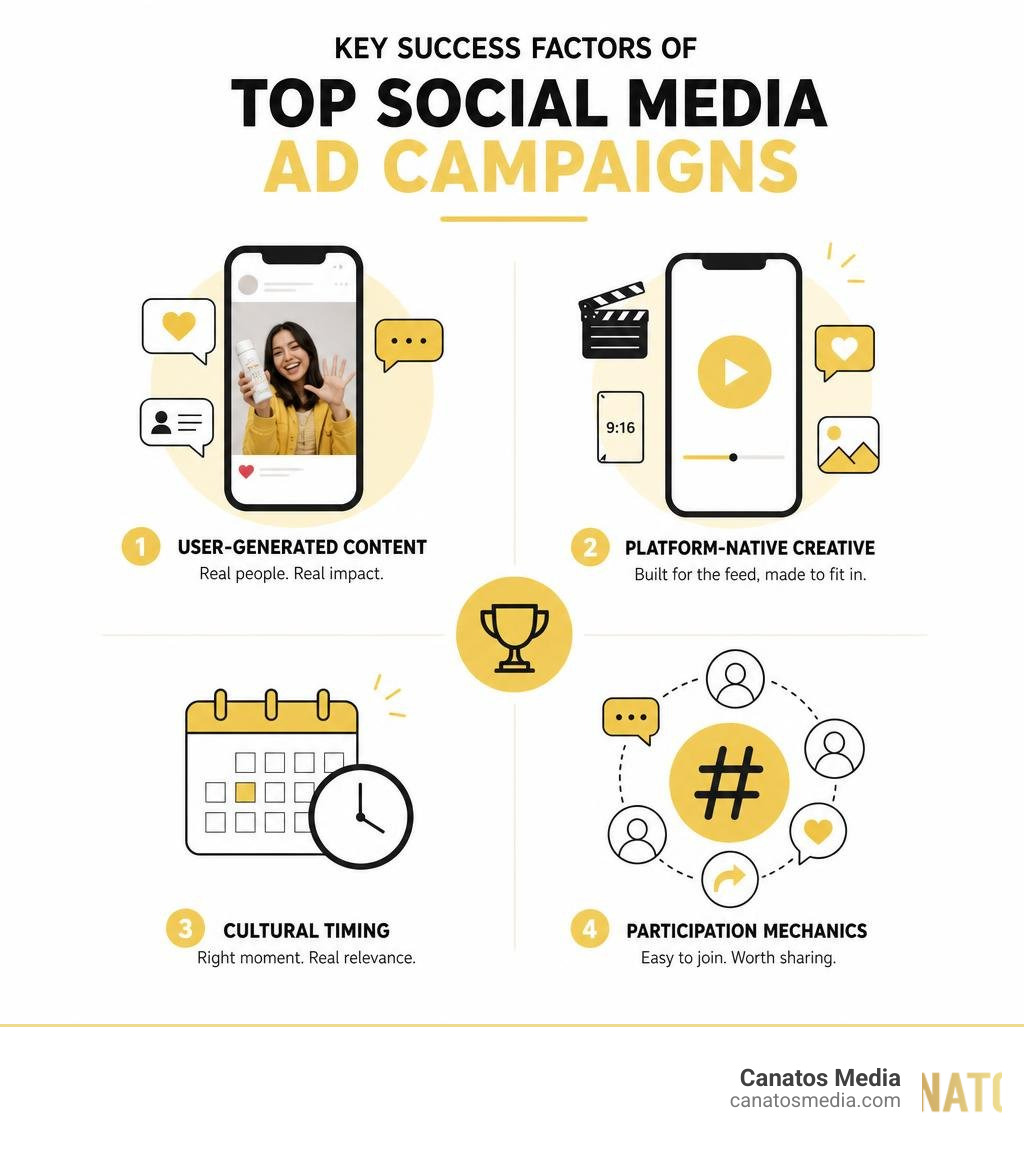
    Infographic showing key success factors of top social media ad campaigns including UGC, platform-native creative, cultural

    Know your best social media ad campaigns terms:

    What Makes the Best Social Media Ad Campaigns Actually Work?

    To build a campaign that actually stops the scroll, you have to understand that social media users are actively trying to ignore traditional advertising. They swipe past anything that screams “corporate pitch” in less than a second.

    The best social media ad campaigns succeed because they prioritize four key pillars:

    1. Platform-Native Creative: The content must look and feel like it belongs on the feed. If it’s a TikTok ad, it should look like a TikTok. If it’s an Instagram ad, it should match the aesthetic of organic Reels.
    2. Authentic Human Connection: People buy from people. Campaigns that feature real faces, genuine emotions, and relatable stories consistently outperform polished, faceless brand messaging.
    3. Audience Participation: The most successful campaigns give the audience something to do—whether that’s joining a challenge, using a branded filter, or sharing their own stories.
    4. Brand Consistency: While adapting to different formats, the core brand identity, voice, and values must remain unmistakable.

    To understand how to allocate your resources, it helps to compare the roles of organic social and paid social campaigns:

    Feature Organic Social Campaigns Paid Social Campaigns
    Primary Goal Build community, foster loyalty, and nurture existing followers. Drive targeted reach, generate leads, and scale conversions.
    Reach Mechanics Dependent on platform algorithms and shareability. Guaranteed delivery to a highly defined, custom audience.
    Content Lifespan Short-lived unless it goes viral organically. Long-lasting and scalable as long as budget is allocated.
    Primary Metric Engagement rate, comments, shares, and saves. Click-through rate (CTR), cost per acquisition (CPA), and ROI.

    For a complete breakdown of how to structure your paid strategy, check out The Ultimate Guide to Social Media Ads.

    Key Elements of the Best Social Media Ad Campaigns for Enterprise Brands

    For enterprise brands operating across multiple regions—including our local partners here in the Tri-State area and Long Island—scaling a creative idea presents unique challenges. What works for a single location can easily get lost in translation when deployed across dozens of markets.

    To scale effectively, enterprise campaigns rely on:

    • Social Media Toolkits: A comprehensive toolkit containing pre-approved asset libraries, platform-specific templates, localized copy variations, and clear compliance guidelines. This allows regional teams to deploy campaigns quickly without starting from scratch.
    • Multi-Market Scaling: Creative assets must be built with modularity in mind. A master video shoot should yield dozens of shorter, localized variations tailored to specific demographics or geographic areas.
    • Production Quality: High-end production quality doesn’t mean “stiff and corporate.” It means professional creative direction, crisp audio, clear lighting, and deliberate editing that looks native but commands authority.

    To learn more about how to scale your creative assets efficiently, take a look at our guide on How to Scale Short Form Ad Creative Across Meta and Google Ads.

    Balancing Creativity and Platform-Native Formats

    The magic happens when high-level creative concepts meet platform-native execution. Far too many brands make the mistake of taking a traditional TV commercial and simply cropping it to a 9:16 vertical format. The result? A clunky, out-of-place ad that users skip instantly.

    Instead, top-performing brands design content with a “social-first” mindset. They combine cinematic storytelling with the , high-energy editing style of short-form video. This gives you the best of both worlds: the credibility and emotional impact of professional film production, delivered in a format that the social algorithms love to reward.

    Discover how this approach can transform your paid media results by reading How Cinematic Short Form Content Improves Meta Paid Ad Performance.

    6 Award-Winning Social Media Campaigns to Learn From

    Now that we’ve covered the foundational theory, let’s look at how the world’s most innovative brands put these principles into action. These six case studies showcase how to leverage cultural moments, viral marketing, and clever storytelling to drive massive business results.

    1. CeraVe x Michael Cera: The Power of Cultural Humor
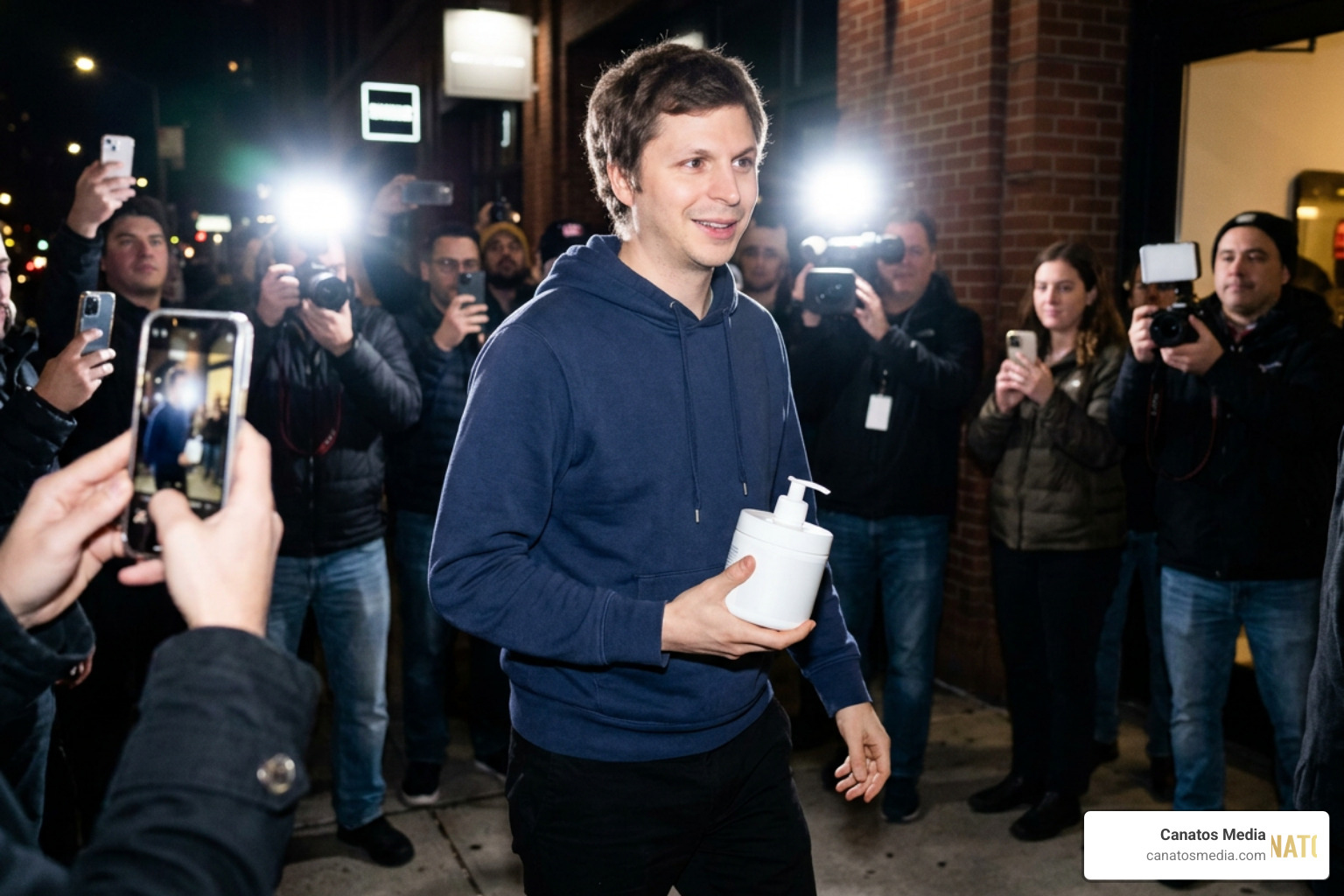
    CeraVe Michael Cera campaign concept

    When skincare brand CeraVe set out to dominate the conversation around the Super Bowl, they didn’t just buy a standard commercial spot. Instead, they orchestrated a multi-week, slow-burn viral mystery that perfectly leveraged internet culture and celebrity name-play.

    The brand partnered with actor Michael Cera, dropping subtle, “paparazzi-style” breadcrumbs across social media. Rumors began circulating on TikTok and Instagram that Michael Cera was claiming to be the actual mastermind behind the CeraVe brand. Influencers and beauty creators joined the conversation, debating whether the actor was indeed the creator of the cult-favorite moisturizer.

    This brilliant campaign succeeded because it leaned heavily into dry, self-deprecating humor and allowed the internet to do what it does best: speculate and make memes. The payoff came during the big game, where a hilarious commercial officially debunked the rumor while reinforcing the brand’s actual dermatological credentials.

    This wasn’t CeraVe’s first time finding massive success by leaning into viral, human-centric marketing. To see how they achieved incredible growth through another clever partnership, read about How CeraVe’s Kevin Durant campaign led to a 43% sales lift.

    2. KFC Arabia: Turning a Crisis Into AI-Generated Drama

    What does a brand do when a fan-favorite product goes missing? When KFC Arabia faced a regional shortage of its popular cheddar cheese sauce, they didn’t issue a boring corporate apology. Instead, they worked with agency TBWA\RAAD to turn the supply chain hiccup into a viral, three-episode AI-generated drama series.

    The campaign treated the missing cheese sauce as the victim of a dramatic kidnapping mystery. Menu items, including chicken strips and fries, were cast as dramatic, emotional characters reacting to the “tragedy.”

    By using generative AI to rapidly produce the content, the brand was able to respond to cultural listening in real-time. The campaign generated over 4 million views and 130,000 shares across Meta and TikTok with absolutely zero paid seeding. Fans loved the self-aware absurdity, even staging mock “boycotts” of the chicken strips for “betraying” the missing cheese sauce.

    Read the full breakdown of how they pulled off this creative pivot at KFC Arabia Turns a Cheddar Sauce Crisis Into a Viral AI Drama | LBBOnline.

    3. Currys: Ambush Marketing at a Pitbull Concert

    To promote a product as mundane as a travel adapter, UK electronics retailer Currys had to think completely outside the box. Operating with a tiny £7,000 production budget and zero media spend, they decided to hijack a trending meme during a concert by the musical artist Pitbull.

    Knowing that fans often dress up as the bald, suit-wearing “Mr. Worldwide” at his shows, Currys dressed their staff as Pitbull lookalikes and sent them into the concert crowd. Their mission? Hand out free “worldwide” travel adapters to fans while filming the entire experience on mobile phones.

    The resulting content felt 100% organic, matching the exact aesthetic of user-generated TikToks. The campaign went massively viral, racking up over 2 million organic views on the brand’s channels, 20 million views via fan-shared content, and a staggering 600 million global earned media impressions.

    Get the full, hilarious story of this low-budget, high-impact stunt at Why Currys dressed as Pitbull to ambush his concert with free adapters | The Drum.

    4. SecondeChance.org: Renaming 800 Taylor Swifts

    “Black dog syndrome” is a heartbreaking reality in animal shelters, where dark-furred dogs are consistently overlooked by potential adopters. To combat this issue in France, adoption platform SecondeChance.org and agency BETC Paris launched a beautifully simple, culturally relevant campaign.

    During the height of Taylor Swift’s global tour, the platform simultaneously renamed 800 of its black shelter dogs “Taylor Swift.”

    The sheer absurdity of searching for a pet and seeing hundreds of identical, famous names immediately caught the attention of the internet. The “Swiftie” fan community quickly caught wind of the campaign, rallying to share the dog profiles, create fan art, and ultimately drive a massive wave of real adoptions. The campaign won a prestigious Bronze Lion at Cannes, proving that a powerful emotional truth wrapped in a clever pop-culture hook can change lives.

    Explore the creative strategy behind this award-winning campaign at CANNES WINNERS: “Black Dogs” — How 800 Taylor Swifts Took Over French Shelters – BETC Paris – Adforum.com.

    5. Popeyes: The “Pope Yes” Real-Time Hijack

    Real-time marketing is incredibly difficult to execute. If you’re too slow, you miss the window; if you’re too forced, you look out of touch. But when the Vatican announced the selection of a new Pope, Popeyes Louisiana Kitchen was ready with a response that was five years in the making.

    Just 76 minutes after the official white smoke rose from the Vatican, Popeyes posted a simple, two-word graphic on social media: “Pope Yes.”

    By leveraging a natural linguistic connection within their own brand name, they hijacked a massive global news event with zero forced corporate messaging. The brilliant real-time play generated 535,000 social engagements, 1.8 billion media impressions, and over $16 million in earned media value—outperforming the Vatican’s own official announcement by 55% on X.

    See the official award case study at Popeyes Louisiana Kitchen | Pope Yes | The One Club.

    6. KFC Saudi Arabia: The Om Bdr Seasoning Sellout

    The best social media campaigns don’t invent new trends; they listen to what their audience is already doing and legitimize it. In Saudi Arabia, KFC noticed a fascinating organic behavior: TikTok users were buying KFC chicken and pouring a traditional, homemade spicy seasoning called “Srar Hail” over it.

    Instead of ignoring this or trying to push their own menu items, KFC Saudi Arabia and TBWA\RAAD partnered directly with Om Bdr, the local home cook who made the viral seasoning. They brought her into the campaign as the face of an official, limited-edition product collaboration.

    By using minimal production and focusing on Om Bdr’s authentic voice, the campaign felt entirely native to Saudi TikTok culture. The collaboration was a massive commercial success, selling out completely in under three weeks, driving KFC Saudi’s highest sales mix to date, and winning the highly coveted G.O.A.T. trophy at the TikTok Ad Awards.

    Read more about how they turned cultural listening into commercial gold at TBWA\RAAD and Win TikTok’s Highest Honor for Turning On Bdr’s Homemade Seasoning into Saudi Arabia’s Fastest Sellout – Roastbrief US.

    How to Measure and Scale Your Social Ad ROI
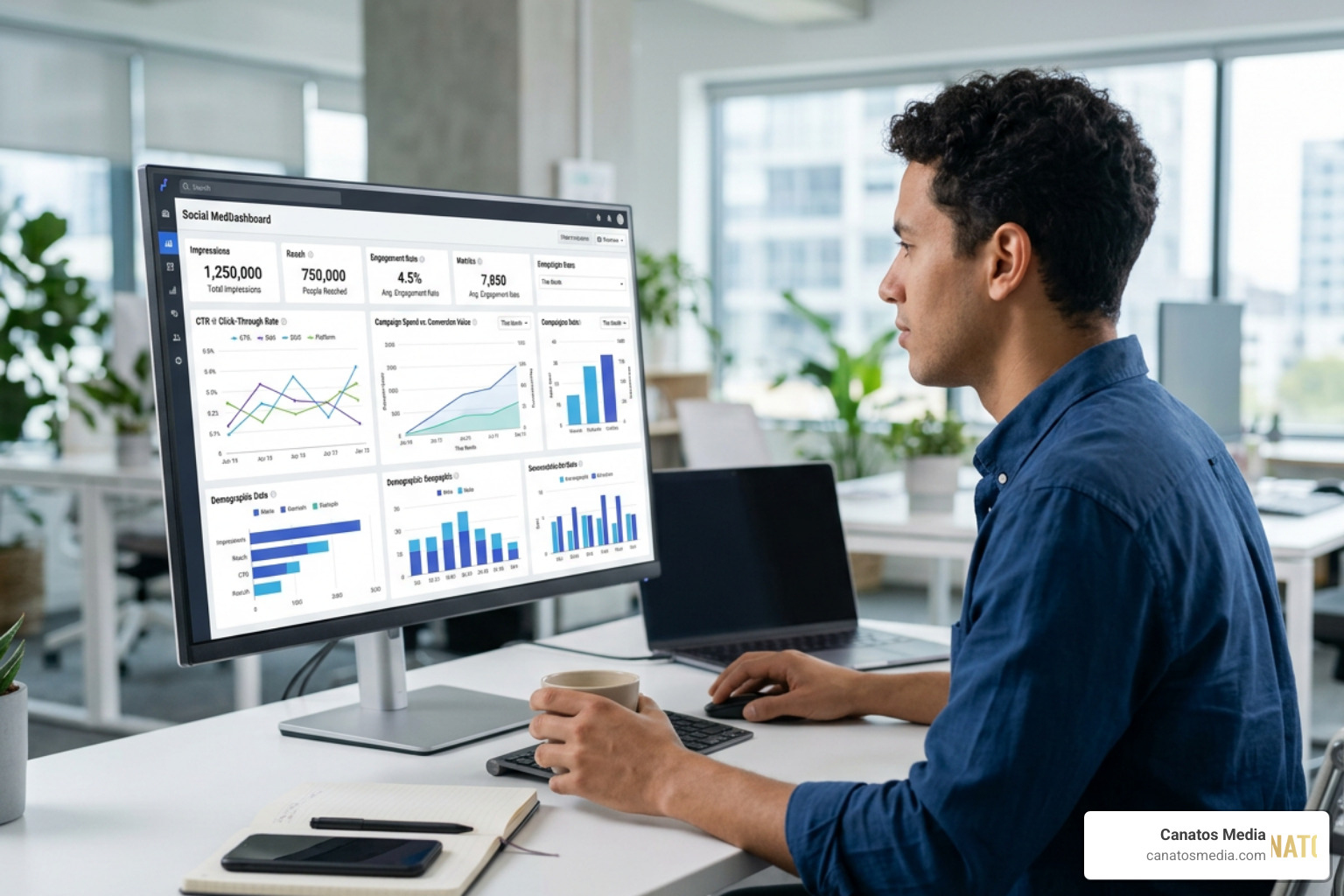
    analytics dashboard tracking social media ad campaign performance

    A brilliant creative concept is only half the battle. To justify your marketing spend, you must be able to track, measure, and scale your results. Without proper attribution and performance tracking, you are essentially throwing money at the wall and hoping something sticks.

    To ensure your campaigns are actually driving business growth, you should focus on these core metrics:

    • Conversion Rate (CVR): The percentage of users who take a desired action (making a purchase, filling out a lead form) after clicking your ad.
    • Return on Ad Spend (ROAS): The total revenue generated divided by the total amount spent on the campaign.
    • Cost Per Acquisition (CPA): How much it costs your business to acquire a single new customer through paid channels.
    • Social Listening & Sentiment Analysis: Tracking brand mentions, comments, and direct messages to understand how the public actually feels about your campaign.

    If you want to stop wasting your marketing budget on campaigns that don’t deliver, read our guide on how to Stop Burning Cash on Bad Meta Ads. To learn how to turn casual scrollers into paying customers, check out Stop the Scroll and Start the Toll with Meta Paid Ads.

    Designing the Best Social Media Ad Campaigns for Different Platforms

    Every social media platform has its own unique culture, user behavior, and creative requirements. A creative asset that performs incredibly well on Facebook might completely bomb on TikTok.

    To win, you must tailor your approach to each channel:

    • Meta Ads (Facebook & Instagram): Perfect for highly targeted demographic campaigns, retargeting warm leads, and showcasing beautiful, high-production imagery and cinematic Reels.
    • TikTok: Requires a raw, unpolished, and highly energetic approach. Lean heavily into music, trending audio, and creator partnerships.
    • YouTube Shorts: Great for quick, punchy product demonstrations, educational “how-to” content, and behind-the-scenes storytelling.

    For a deep dive into mastering the visual formats that convert on Instagram, read Stop Scrolling and Start Selling: The Secrets of Most Effective Instagram Ads.

    Leveraging UGC and Influencer Partnerships

    User-generated content (UGC) is one of the most powerful tools in modern digital marketing. In fact, campaigns that incorporate UGC see a 50% increase in engagement compared to traditional, brand-only content.

    When you partner with influencers or encourage your customers to create content for your brand, you gain several massive advantages:

    • Instant Credibility: Consumers trust the recommendations of real people far more than they trust corporate messaging.
    • Cost-Effective Production: Instead of hiring an expensive production crew for every minor asset, you can build a massive library of high-converting creative through your community.
    • Algorithm Optimization: Platforms like TikTok and Instagram naturally favor human-centric, engaging video formats, giving your UGC campaigns a significant organic boost.

    Frequently Asked Questions about Social Media Ads

    What makes a social media ad campaign successful?

    A successful campaign is built on a foundation of platform-native creative, authentic human connection, and a clear call to action. It must speak directly to the target audience’s specific desires or pain points while maintaining a consistent brand voice across all touchpoints.

    How do brands measure the ROI of social media ad campaigns?

    Brands measure ROI by setting up robust conversion tracking (such as the Meta Pixel and Google Analytics), monitoring cost per acquisition (CPA), and using social listening tools to track brand sentiment and organic brand search lift.

    What is the difference between UGC and influencer content?

    User-generated content (UGC) is created organically by your actual customers, offering unmatched authenticity but limited brand control. Influencer content involves partnering with professional creators who produce content based on a specific creative brief, combining authenticity with strategic brand messaging.

    Conclusion

    The best social media ad campaigns of 2026 prove that you don’t need a multi-million dollar budget to capture the internet’s attention. What you need is an integrated strategy that seamlessly connects high-end, cinematic video with smart targeting, cultural timing, and measurable conversion frameworks.

    Whether you are looking to scale your brand across the Tri-State area, dominate the local Long Island market, or launch a nationwide digital campaign, we are here to help you make it happen. At Canatos Media, we specialize in creating cinematic short-form content, managing high-performing paid social campaigns, and building integrated strategies that turn views into measurable business growth.

    Ready to take your paid social results to the next level? Explore our comprehensive Meta Ads Management Ultimate Guide and let’s start building your next winning campaign today.
  • Lead Generation Video Production: Converting Social Viewers into Qualified Leads

    Lead Generation Video Production: Converting Social Viewers into Qualified Leads

    Why Traditional Video Isn’t Driving Your Consultation Bookings

    Video content isn’t optional anymore. It’s the primary way your prospects discover, evaluate, and decide whether to contact you. But most video strategies miss the critical connection between what you produce and what actually converts viewers into consultation bookings. We’ve built our entire approach around closing that gap.

    Your team likely has plenty of video content out there. Brand reels, testimonials, product demos, company culture clips. They’re polished. They look professional. But they’re not generating the consultation calls you expected.

    The problem is simple: beautiful video without a conversion strategy is just entertainment. Traditional video production prioritizes storytelling and aesthetics without tying those elements to the specific actions you need prospects to take next. A stunning two-minute brand film might rack up thousands of views and zero qualified leads.

    We often see service-based businesses and multi-location brands invest heavily in production quality while leaving conversion mechanics on the table. The video performs well in the algorithm, but viewers don’t know what to do, where to book, or why they should act now rather than tomorrow. Friction kills leads.

    Your next step: audit your last five video posts. For each one, track how many people clicked your booking link or sent an inquiry. That gap between views and conversions is exactly what we’re solving.

    The Lead Generation Problem Most Agencies Miss

    Most video agencies separate content creation from conversion strategy. They hand you finished video, then your marketing team figures out how to use it. That handoff costs you leads.

    Lead generation requires video that works backward from your sales process. What does a qualified prospect actually need to see, hear, and feel before they’re ready to book a consultation with you? That insight determines every creative choice in production.

    We approach it differently. We start by understanding your ideal client profile, the specific objections they have, the trust signals that matter to them, and the precise call-to-action that moves them forward. Then we craft cinematic content that directly addresses those conversion points.

    When video is built with lead generation in mind from day one, you get higher-intent engagement, faster decision cycles, and more booked consultations per piece of content.

    How Strategic Video Content Captures Qualified Prospects

    Strategic lead generation video does three things simultaneously: it builds authority, it removes objections, and it creates urgency.

    Authority comes through cinematic quality and client success proof. When your video looks premium and features real client results, prospects perceive you as the established choice in your market. They’re more likely to trust your pricing and process.

    Objection removal is tactical. Identify the three to five biggest hesitations your leads have before booking (cost, time commitment, lack of experience, fear of wasting money) and address them directly in your content. A 45-second video showing your onboarding process removes the mystery. A client testimonial specifically addressing “Will this actually work for my situation?” converts skeptics.

    Urgency comes from clear CTAs and scarcity signals. “Book a free 20-minute strategy call this week” performs better than generic “learn more” buttons. Limited-time offers and time-specific messaging move fence-sitters.

    The result is video that doesn’t just inform or entertain. It qualifies prospects and moves them closer to a booking decision.

    Building Your Video Sales Funnel From Awareness to Action

    Your lead generation video strategy needs different content for different stages of prospect readiness.

    Awareness stage videos introduce your expertise without asking for commitment. These are short educational clips, industry insights, or quick wins that solve a small problem. You can run these broadly on social and search to reach people who don’t yet know you exist.

    Consideration stage content shows why your specific approach matters. Case studies, before-and-afters, client testimonials, and methodology breakdowns belong here. These videos target engaged audiences and warm leads who’ve already seen your awareness content.

    Decision stage content removes final objections. Pricing transparency videos, detailed process walkthroughs, and direct calls to action push qualified leads toward booking. These perform best when retargeted to people who’ve interacted with your previous content.

    Building this funnel means producing varied content consistently. We’ve found that businesses booking 20+ consultations per month typically run 8-12 pieces of video content weekly across multiple platforms and stages.

    Our Process: From Concept to Conversion-Focused Production

    We structure every project around conversion first, quality second.

    We start with strategy. You tell us about your ideal client, your sales process, and your lead goals. We map where video fits and what each piece needs to accomplish. A consultation booking system is completely different from a webinar registration or a product purchase, and the video approach changes accordingly.

    Then we design content specifically for those conversion points. Our team develops creative briefs that outline not just the visual story, but the psychological triggers and specific CTAs that drive action. Are you trying to build urgency? We emphasize limited availability. Trying to address skepticism? We feature third-party credibility and results.

    Production brings that strategy to life with cinematic quality. We focus on short-form formats that perform across platforms because that’s where your prospects spend time and where the algorithm favors engagement. Short-form video production allows us to create multiple conversion assets from single shooting days, maximizing your content volume and testing different approaches.

    Finally, we optimize each video for its platform and purpose. A YouTube thumbnail works differently than a TikTok frame. A LinkedIn CTAssociate is different from a Meta one. We handle all those details.

    Integrating Video With Your Digital Marketing Ecosystem

    Video that sits alone underperforms. Video integrated into your broader marketing system compounds.

    When we produce lead generation video, we’re simultaneously building it into your all-in-one marketing funnel. That means coordinating with your paid advertising, email sequences, landing pages, and sales follow-up.

    A prospect might see your awareness video on Instagram, get retargeted with consideration content on Google, land on a custom page with decision-stage video, and receive a series of emails containing clips from your process walkthroughs. Each touchpoint reinforces the previous one.

    We also optimize for SEO and audience algorithms. The same script and footage might become a YouTube video optimized for search intent, a series of carousel posts for LinkedIn, and short clips for TikTok discovery. One production creates assets across channels.

    This integrated approach turns casual viewers into consistently qualified prospects because they encounter your message across platforms in a logical sequence that moves them toward booking.

    Measuring ROI: Tracking Video Performance to Booked Calls

    You can’t optimize what you don’t measure. We implement tracking on every piece of video content we produce.

    We monitor views, engagement, and click-through rates, but those are starting points. The metrics that matter are lower-funnel ones: how many viewers clicked your booking link, how many landing page visits came from video traffic, and ultimately how many qualified consultations were booked from people who engaged with video.

    We use UTM parameters to track video sources through your booking system. We set up conversion pixels on your consultation confirmation pages. We often add simple surveys asking new callers how they found you, specifically asking about video content they remember seeing.

    Most of our clients discover that their highest-performing video pieces are driving 40-60% of their booked consultations within three months of consistent distribution. Once you identify which styles and topics convert best, you double down on that format.

    Monthly reporting shows exactly which videos are working and why, so we’re continuously improving both creative and strategy.

    Common Mistakes Brands Make With Lead Generation Video

    The biggest mistake is treating video like content instead of a conversion tool. You produce one video, post it once, and expect it to work. Lead generation video needs frequency and distribution strategy.

    Another common error is optimizing for views instead of conversions. A viral video that gets 100,000 views but zero bookings has failed its purpose. We always prioritize quality engagement and conversion over vanity metrics.

    Many businesses also underestimate the power of repetition. The same core message, presented slightly differently across multiple videos, actually converts better than constantly switching topics. Repetition builds authority and removes doubt.

    Finally, we see brands skip the CTA entirely or make it too soft. “Check our link in bio” is weaker than “Book your free 20-minute strategy call this week. Link in the comments.” Specificity drives action.

    Scaling Your Consultation Pipeline With Consistent Content

    Single videos don’t scale. Systems do.

    We typically recommend businesses aiming for consistent lead generation commit to producing 2-3 pieces of new video content per week. This sounds like a lot until you realize that with efficient production, one shooting day creates enough footage for 4-6 finished videos.

    Consistency serves two purposes. First, the platform algorithms favor regular publishers. Second, your prospects need repeated exposure before most will book. Publishing consistently means more of your audience sees your message multiple times.

    We’ve found that scaling consultation pipelines follows a predictable pattern. In month one, you establish the production system and baseline performance. Month two shows early results as content accumulates. By month three and four, you’re typically seeing 3-4x more booked consultations than you started with, assuming proper distribution and conversion optimization.

    The businesses that hit 30+ consultations per month maintain this consistency. They stop treating video as a project and start treating it as a standard business system.

    Getting Started With Your Lead Generation Video Strategy

    Start by documenting your current lead generation reality. How many consultations are you booking monthly? How long does the sales cycle take from first contact to signed client? What percentage of prospects who book actually move forward?

    Next, identify your top three objections prospects raise before booking. These become your primary content topics for the first quarter.

    Then choose your primary distribution platform. If your ideal clients are on LinkedIn, focus there first. If they’re on Instagram or TikTok, prioritize those platforms. Consistency on one platform beats scattered presence across many.

    Finally, commit to a small production test. Produce 4-6 pieces of lead-generation focused video content, distribute them strategically over two months, and measure which content drives booking interest. Let data guide your next investments.

    Lead generation video isn’t a nice-to-have. It’s become the primary way prospects evaluate whether to book with you. Building it with conversion strategy, cinematic quality, and integrated distribution turns it from a content expense into your highest-ROI marketing channel.

    Contact us today for a free consultation to see how we can help you grow your business.

    Frequently Asked Questions (FAQ)

    How do we ensure video content actually converts viewers into qualified leads?

    We build conversion mechanics directly into our video production process, starting with strategic calls-to-action tailored to your specific service offerings. Our team integrates these videos with landing pages, contact forms, and lead capture systems during the production phase, rather than treating video as standalone content. We then track which video elements and messaging drive the highest-quality inquiries, allowing us to refine future content based on actual consultation bookings rather than vanity metrics.

    What’s the difference between our lead generation videos and standard short-form content?

    Our videos are designed with your sales funnel in mind from the first frame, incorporating specific pain points your prospects face and positioning your solution as the clear answer. We combine cinematic production quality with data-driven messaging strategies, then connect that content to your broader digital ecosystem including paid advertising, email sequences, and website optimization. Standard short-form content prioritizes views and engagement, but we prioritize qualified inquiries that convert into consultations and revenue.

    How long does it typically take to see measurable results from a lead generation video strategy?

    We usually begin tracking meaningful metrics within 4 to 6 weeks once videos are deployed across your channels and integrated with our advertising and optimization efforts. However, the timeline depends heavily on your sales cycle length and how quickly we can gather enough lead data to identify winning patterns and scale what works. We recommend committing to at least 3 months of consistent content and measurement before making major strategy adjustments.

  • Small Business Video Advertising: Big Impact on a Tiny Budget

    Small Business Video Advertising: Big Impact on a Tiny Budget

    Video Advertising for Small Business: What You Need to Know Right Now

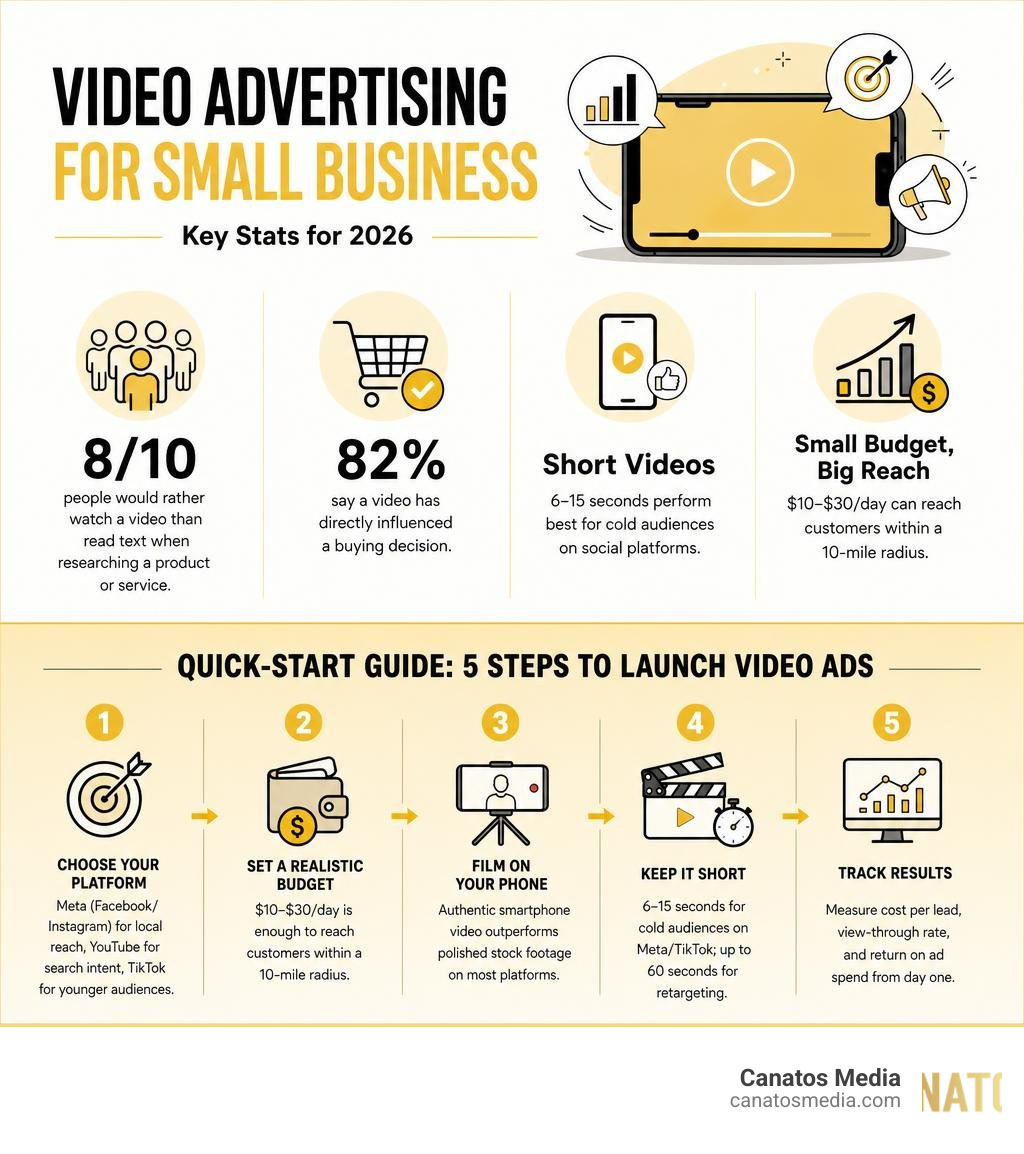
    Video advertising for small business is one of the most cost-effective ways to generate leads, build trust, and convert attention into sales in 2026. Here’s a quick snapshot of what works:

    Quick-start guide:

    1. Choose your platform – Meta (Facebook/Instagram) for local reach, YouTube for search intent, TikTok for younger audiences
    2. Set a realistic budget – $10-$30/day is enough to reach customers within a 10-mile radius
    3. Film on your phone – Authentic smartphone video outperforms polished stock footage on most platforms
    4. Keep it short – 6-15 seconds for cold audiences on Meta/TikTok; up to 60 seconds for retargeting
    5. Track results – Measure cost per lead, view-through rate, and return on ad spend from day one

    Most small business owners know they should be running video ads. But between the cost of agencies, the confusion around platforms, and the fear of being on camera, it never quite happens.

    That gap is expensive. Consider this: 8 out of 10 people would rather watch a video than read text when researching a product or service. And 82% say a video has directly influenced a buying decision. Meanwhile, competitors who are showing up on video are capturing that attention — and those leads.

    The good news? The barrier to entry has never been lower. AI tools, smartphone cameras, and self-serve ad platforms have made it possible for any local business to run professional-quality video ads without a big budget or a production crew.

    This guide walks you through everything — formats, platforms, budgets, production, and measurement — so you can stop leaving leads on the table.

    I’m Nic Canobbio, founder of Canatos Media, and with over two decades in media production I’ve watched video advertising for small business evolve from a luxury into a necessity — our campaigns have generated more than 60 million social media views for brands of every size. I’ll share exactly what we’ve learned so you can apply it to your business today.
    infographic showing key video advertising stats and quick-start steps for small businesses in 2026 infographic

    Key video advertising for small business vocabulary:

    Why Video Advertising for Small Business Is Essential in 2026

    digital ad metrics showing high ROI

    In 2026, the digital landscape is noisier than ever. Static images and text-heavy posts are easily ignored by consumers scrolling through their feeds. If you want your business to be seen, video is no longer optional — it is the single highest-leverage channel a local or growing brand can use.

    This shift is driven by changes in consumer behavior and search platform algorithms. According to recent research, 83% of people want brands to use more video in their communications. Furthermore, 76% of consumers say they are more likely to buy from brands they feel connected with instead of competitors. Video allows you to build that human connection instantly. When potential customers see your face, hear your voice, and watch your team in action, the digital wall crumbles, replaced by immediate trust.

    This trust translates directly into dollars. Small business advertisers see up to 2x higher ROI from digital ads compared to traditional channels like print, radio, or physical mailers. Why? Because social media and search algorithms actively reward video content. Platforms like Meta (Facebook and Instagram), TikTok, and Google give video ads broader reach and lower costs per thousand impressions (CPMs) because video keeps users on their platforms longer.

    For local service businesses in the Tri-state area and Long Island, this is a game-changer. Whether you run a plumbing company in Nassau County, a boutique salon in Brooklyn, or an HVAC service in New Jersey, video ads show your local community that you are real, reliable, and ready to help. To understand how these dynamics fit into a broader strategy, check out The Complete Guide to Video Marketing.

    Choosing Your Strategy: Formats, Budgets, and Platforms

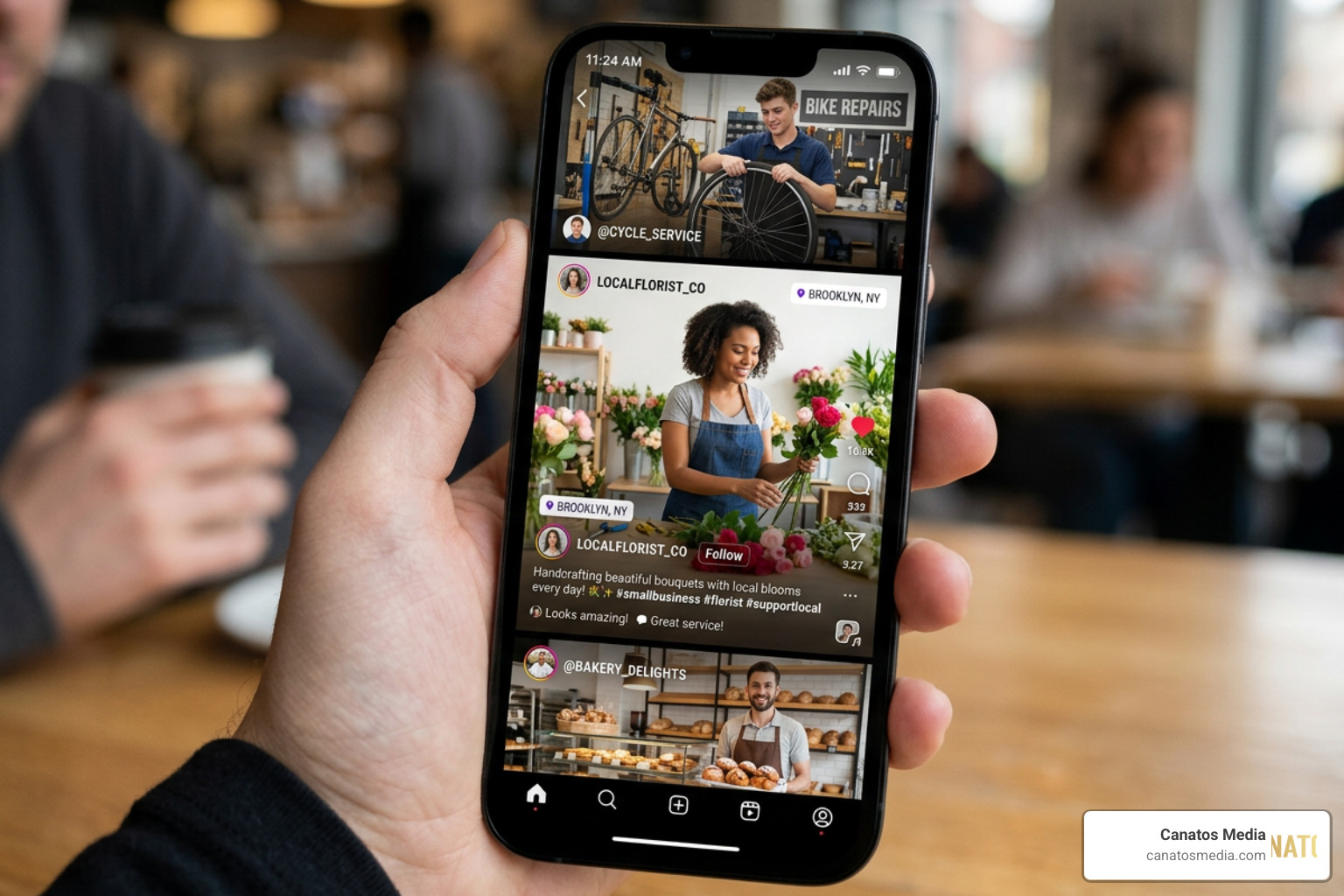
    social media feed showing vertical video ads

    The biggest mistake we see small businesses make is trying to be everywhere at once. Spreading a $500 monthly budget across Meta, YouTube, TikTok, LinkedIn, and Connected TV (CTV) is a recipe for zero results. Instead, you must align your platform selection with your target audience and budget.

    • Meta (Facebook & Instagram): Excellent for “interrupt-and-convert” campaigns. If you have a highly visual product, a compelling local service offer, or want to target specific demographics in the Tri-state area, Meta is your best starting point.
    • YouTube: Ideal for capturing high-intent searchers. Because YouTube is the second-largest search engine in the world, it is the perfect place to run ads targeting people who are actively researching how to solve a problem.
    • TikTok: Perfect for reaching a younger demographic (under 35) with highly authentic, user-generated style content.

    To make sure you are capturing attention where it matters most, you need to understand how to design creatives that hook viewers instantly. You can learn how to structure these campaigns in our guide to Stop the Scroll and Start the Toll with Meta Paid Ads.

    Affordable Formats for Video Advertising for Small Business

    You do not need a Hollywood budget to create high-performing video ads. In fact, some of the most effective and affordable video formats can be produced in a single afternoon:

    • Social Video & Vertical Reels: Shot in a 9:16 vertical format, these feel native to Instagram Reels, TikTok, and YouTube Shorts. They are highly engaging and cost-effective to produce.
    • Customer Testimonials: Video ads featuring real people enjoy 3x higher engagement than those using stock imagery. Grab your smartphone, visit a happy customer, and film them talking about how you solved their problem.
    • Explainer Videos & Product Demos: Show your product or service in action. If you are an organizer, show a before-and-after. If you sell a physical product, show someone unboxing and using it.
    • FAQ Videos: Answer the top three questions you get during sales calls. This builds authority, saves your team time, and qualifies leads before they ever contact you.

    Geo-Targeting and Local Service Video Ads

    For local service businesses, general marketing is a waste of money. You do not care if someone in California sees your ad if you only service Suffolk County, Long Island. This is where hyper-local geo-targeting comes in.

    Using Meta and Google Ads, you can set a tight radius (e.g., 5 to 15 miles) around your business location or target specific zip codes. To maximize the ROI of these campaigns, your video creative must match your targeting. Mentioning local landmarks, referencing neighborhood-specific issues (like local winter weather or beach-town summer rushes), and showing your trucks on recognizable local streets builds instant credibility.

    In fact, 73% of consumers are more likely to hire a local business they have seen on video. If you are ready to dial in your local reach, explore our actionable tips on How to Optimize Short-Form Video Ads for Local Lead Generation.

    From Views to Revenue: Distribution and Measurement

    Getting views is great for the ego, but views do not pay the bills. To turn video views into actual revenue, you need a robust distribution and tracking system.

    First, install tracking pixels (like the Meta Pixel and Google Tag) on your website. Because of modern privacy changes, browser-only pixels can lose 30% to 60% of attribution data. We highly recommend setting up server-side tracking (such as the Meta Conversions API) to ensure you are accurately tracking every lead.

    This setup allows you to build retargeting audiences. Roughly 95% of first-time viewers will not convert. However, retargeted visitors are 70% more likely to convert than first-time viewers. You can build a custom audience of people who watched at least 50% of your initial video ad and serve them a secondary “social proof” ad featuring a customer testimonial.

    Platform Average CPM (Cost per 1k views) Primary Intent Best Video Aspect Ratio
    Meta (FB/IG) $8 – $22 Social Discovery / Interrupt 9:16 (Reels), 4:5 (Feed)
    YouTube $0.03 – $0.10 (per view) Search Intent / Educational 16:9 (Horizontal), 9:16 (Shorts)
    TikTok $6 – $15 Entertainment / Trends 9:16 (Vertical)

    To see how we map out this entire journey, read about How We Turn Video Views into Real Revenue for Service Businesses.

    How to Produce Professional Video Ads on a Budget

    Many small business owners hold back because they think they need a professional camera, expensive lighting, and a soundproof studio. The truth? Your smartphone is more than capable of shooting a high-converting video ad. Audiences in 2026 crave authenticity over polished, corporate-style productions.

    To get started, follow these simple production rules:

    1. Lighting is Key: You do not need expensive lights. Stand in front of a large window to use soft, natural daylight. If you must shoot indoors without natural light, a budget-friendly ring light will keep your face clear and shadow-free.
    2. Prioritize Audio Quality: People will watch a video with average picture quality, but they will instantly swipe away if the audio is scratchy or echoey. Invest $20 to $40 in a clip-on lavalier microphone that plugs directly into your smartphone.
    3. Keep It Steady: Use a cheap tripod or prop your phone up against a stable surface to avoid shaky, handheld footage.
    4. Speak Naturally: Write a loose outline instead of reading a script word-for-word. Speak as if you are talking to a single customer sitting across from you.

    For a deeper dive into why authentic, high-quality video production drives modern leads, check out our guide on Why Video Production is the Key to Modern Lead Generation for Service Businesses.

    Leveraging AI Tools for Video Advertising for Small Business

    If you are short on time, artificial intelligence can speed up your production workflow. Today’s AI tools can help you write, edit, and optimize your video ads in minutes:

    • AI Scriptwriting: Tools like ChatGPT or Claude can draft highly engaging ad scripts based on your specific business details, target audience, and offer.
    • Automated Captioning: Since up to 85% of social media videos are watched with the sound turned off, captions are mandatory. AI editing tools can automatically generate highly accurate, stylized captions in seconds.
    • Smart Video Editors: Platforms can take your raw smartphone footage, trim out the “umms” and pauses, apply color correction, and balance your audio levels automatically.
    • B-Roll and Image Generators: If you need a quick visual element but do not have the footage, AI tools can generate realistic product showcases or motion graphics from a simple text prompt or product photo.

    Measuring Video Campaign ROI

    To know if your video ads are actually working, you must look past “vanity metrics” like likes or shares. Instead, focus on these three critical performance indicators:

    • Hook Rate (3-Second Video View Rate): The percentage of people who watched the first 3 seconds of your video. If this is low (under 30%), your intro hook is not interesting enough.
    • Hold Rate (Average View Duration): How long people stay tuned. This tells you if your core message is engaging.
    • Cost Per Lead (CPL) & Booked Appointments: The actual marketing dollar amount spent to acquire a qualified lead or a booked service call.

    To set up a reliable tracking framework for your business, read our step-by-step guide on How to Measure Video Campaign ROI from Social Views to Booked Appointments.

    Frequently Asked Questions about Video Advertising

    What is the minimum monthly budget for small business video ads?

    You do not need thousands of dollars to start. We recommend these two realistic budget tiers:

    • Local Awareness: $150 to $500 per month. This is perfect for reaching a tight local service area (5 to 10 miles) to keep your brand top-of-mind.
    • Direct Lead Generation: $1,500 to $4,000 per month. This budget level gives platform algorithms enough data to optimize your campaigns, find high-intent prospects, and consistently generate 20 to 80 qualified leads per month.

    Do I need to hire a professional agency to create video ads?

    Not always. If you are just starting out and have a very tight budget, DIY is a great way to learn. You can write your own scripts, film on your phone, and boost posts directly from your social media pages.

    However, as your business grows and your ad spend increases, managing campaigns, designing high-converting creative, and setting up advanced tracking APIs becomes a full-time job. Hiring a specialized partner makes sense when you want to scale your spend efficiently without wasting money on unoptimized ads. To see how professional short-form videos compare in driving real results, read How Cinematic Short-Form Video Drives Meta and Google Lead Generation.

    How do I prevent my video ads from causing ad fatigue?

    Ad fatigue happens when your target audience sees the exact same video ad too many times, causing your conversion rates to drop and your costs to rise. You can easily prevent this by:

    • Capping Frequency: Set frequency caps in your ad platforms so users only see your ad 3 to 4 times per week maximum.
    • Rotating Creatives: Produce 3 to 4 slight variations of your video ad (e.g., testing different 3-second hooks or different background music) and let the platform rotate them.
    • Updating Offers Seasonally: Swap out your creative assets every 4 to 6 weeks to keep your brand looking fresh and active.

    For real-world examples of how creative rotation keeps lead generation consistent, explore How Video-First Campaigns Drive Booked Appointments and Measurable ROI.

    Conclusion

    Video advertising for small business is the single fastest way to build trust, command attention, and grow your revenue in 2026. By combining authentic smartphone footage, clear local targeting, and strategic retargeting, you can compete directly with massive national brands — and win.

    At Canatos Media, we specialize in building integrated, video-first digital marketing strategies for growing businesses across Long Island and the Tri-state area. We handle everything from cinematic short-form video production and automated lead tracking to paid Meta and Google campaigns.

    Ready to stop wasting your ad spend and start turning video views into booked appointments? End-to-End Video Marketing: How We Drive Real Results for Growing Businesses and let’s build your custom video engine today.

  • How We Build Video Ad Campaigns That Drive Multi-Location Brand Growth

    How We Build Video Ad Campaigns That Drive Multi-Location Brand Growth

    The Challenge Multi-Location Brands Face With Generic Video Content

    Multi-location and service-based brands operate in a unique position. Your customers span different neighborhoods, cities, or regions. Your team operates across several physical locations. Yet most video content circulating on social platforms treats every business the same way.

    Generic video templates don’t reflect the nuance of your brand or the specific needs of customers in different markets. A dental practice in Denver faces different competition and seasonal patterns than one in Austin. A home services company managing five locations can’t use the same messaging across all of them.

    What happens next is predictable. The video gets produced, posted, and quietly disappears into the feed. No leads. No phone calls. Just wasted budget and creative effort.

    The real issue isn’t the video quality itself. It’s that most video production workflows don’t account for the sales systems that actually convert viewers into customers. They produce beautiful content in a vacuum, disconnected from your advertising platforms, your lead capture processes, and the specific markets where you operate.

    What to do next: Audit your current video content library. Note which videos generated actual leads or calls, and which ones didn’t. You’ll likely spot a pattern: the ones that worked were specific to a location, service, or customer pain point.

    Why Standard Video Agencies Miss the Mark for Service-Based Businesses

    Traditional video production agencies excel at creative storytelling, but they typically operate in isolation from your marketing strategy. They hand off a finished video and move on. They don’t own the distribution, the ad spend, or the results.

    For service-based businesses and multi-location operators, this creates friction. Your brand needs video content that works across Meta, Google, TikTok, and your website simultaneously. Standard agencies rarely optimize for platform-specific requirements. A 60-second YouTube video doesn’t work the same way on Instagram Reels. A testimonial that lands on Meta ads might bomb on Search.

    Additionally, service-based businesses need video content tied directly to lead generation. You’re not selling a product people discover on impulse. You’re building trust, demonstrating expertise, and creating urgency for services like HVAC repair, legal counsel, landscaping, or fitness coaching. That requires a different video strategy entirely.

    Most agencies also underestimate the production volume required for real growth. Running five locations means you need 5-10x more localized content than a single-location business. Generic agencies treat this as a scaling problem (more shoots, more budget). We treat it as a workflow and template problem.

    What to do next: Ask any video agency how they handle platform optimization and lead integration. If the answer is vague or if they hand off files and disappear, that’s a red flag.

    Our Approach to Cinematic Short-Form Video Ads That Convert

    We start by understanding your customer journey in detail. What problem brings someone to search for your service? What objection holds them back from calling? What proof point makes them confident in your brand?

    Our short-form video production strategy builds cinematic storytelling around these moments. We create 15-60 second videos that feel premium but perform like ads. Think customer testimonials that show transformation, service walkthroughs that build expertise, or location-specific content that resonates with neighborhood markets.

    The creative approach differs from typical social content. We’re not chasing viral moments. We’re designing hooks that stop scrolling, messaging that speaks to specific pain points, and calls-to-action that drive viewers to a lead form or phone number.

    Practically speaking, this means we produce multiple asset variations from each shoot. One testimonial might become a 30-second Meta ad, a 15-second TikTok version, a website hero video, and a 45-second YouTube pre-roll. Platform optimization happens at production, not as an afterthought.

    Each video includes strategic visual branding, text overlays that work with sound off, and pacing optimized for mobile viewing. We test multiple headline variations alongside video variations to find winning combinations.

    What to do next: Identify three customer objections or pain points your prospects mention most often. These become your next video topics.

    How We Integrate Video With Your Full Digital Marketing Strategy

    Video doesn’t live in a silo at our agency. Every video we produce connects to a larger marketing system.

    On the paid side, we layer video content into Meta and Google advertising with cohesive creative sequences. Early-awareness videos introduce your brand. Mid-funnel videos address specific objections. Bottom-funnel videos drive conversions with strong offers and CTAs.

    On the organic side, video gets distributed across your social accounts, website, email, and partner channels in coordinated waves. We build content calendars that reinforce messaging across platforms.

    We also tie video performance back to your lead generation tracking. If a video generates qualified leads, we scale the ad spend behind it. If it underperforms, we diagnostic whether the issue is creative, audience targeting, or platform selection.

    Our approach treats video as one piece of an all-in-one marketing funnel. Social media management, paid advertising, SEO optimization, and website support all work together to amplify video’s impact.

    What to do next: List all the marketing channels where your content currently lives (Instagram, Google Business, website, etc.). Identify where video is missing and where it could have the biggest impact.

    Building Lead Generation Systems Around Your Video Content

    Video drives attention, but attention without a clear conversion path is wasted potential.

    We build lead capture systems directly into your video strategy. This might mean adding a clickable link card to Meta ads that takes viewers to a booking page. It could be a form embed on your website where videos live above the fold. For service businesses, it often means a prominent phone number and “call now” messaging in the video itself.

    We also create landing pages optimized specifically for video ad traffic. When someone clicks your ad, they arrive at a page featuring the same offer, testimonial, or service shown in the video. This consistency dramatically improves conversion rates.

    For multi-location brands, we build location-specific landing pages. Someone watching a video about plumbing in Austin gets routed to your Austin service page, not a generic homepage.

    Lead tracking is equally important. We set up UTM parameters, conversion pixels, and CRM integrations so you understand exactly which videos generated which leads. This data drives our optimization decisions week over week.

    What to do next: Audit your current lead capture process for video traffic. Is there a clear path from ad click to form submission or phone call? If not, that’s your next build.

    Meta and Google Video Ad Optimization We Handle End-to-End

    We manage both the creative and the media buying side of your video campaigns.

    On Meta (Facebook and Instagram), we test different audience segments, placement combinations, and bid strategies to find your most efficient CPC and CPA. We run creative tests systematically, rotating new video variations alongside proven performers to continuously refresh your ads.

    Meta’s advantage is granular audience targeting. We build audiences based on location, interests, behaviors, and lookalike models seeded from your best customers. Video ads perform exceptionally well to these warm audiences.

    Google provides a different opportunity. Video ads on YouTube, Google Search, and the Google Display Network reach high-intent users at different moments. Someone searching for “HVAC repair near me” is further along in the buying journey than someone watching a YouTube video about home maintenance.

    We optimize Google campaigns by keyword relevance, geographic targeting, and bid adjustments. Video ads on Search can outperform text ads significantly for service businesses because they communicate expertise and build trust faster.

    Both platforms require ongoing monitoring and optimization. We track metrics like video completion rate, click-through rate, cost per lead, and cost per acquisition. Poor performance triggers diagnostic analysis and creative or audience iteration.

    What to do next: Review your current ad spend across Meta and Google. Note which channels consistently deliver leads and which don’t. That tells us where optimization effort should focus first.

    Scaling Video Production Across Multiple Locations Without Quality Loss

    One of the biggest challenges multi-location brands face is producing consistent, high-quality video content across all their markets without multiplying costs and timelines.

    We solve this through template-based production systems. We shoot core content pieces once (founder interviews, process walkthroughs, core value propositions) and reuse that footage across variations. We create customizable graphics, text overlays, and location-specific inserts that allow us to produce 10-15 location variations from a single shoot day.

    Our process also includes local content capture. We train your team at each location to film short video clips using smartphones and simple lighting setups. These raw clips feed into our editing workflow, becoming polished promotional content without requiring expensive production crews at every location.

    This hybrid approach means a five-location brand can maintain a consistent, cinematic look while still having location-specific messaging. You’re not spending 5x the production budget to serve 5 locations.

    Production efficiency also scales through our systems. We maintain templates, stock footage libraries, color grades, and music selections that ensure every video feels on-brand despite being produced in batches.

    What to do next: Count how many locations you operate. Then calculate the video production volume you’d need monthly to support them all. That number is likely higher than your current budget allows. Let’s talk about scaling it efficiently.

    Case Study Results From Our Video-First Marketing Campaigns

    Our approach consistently delivers measurable results for multi-location service businesses.

    One home services franchise increased lead volume by 240% within six months by switching to location-specific video ads paired with optimized landing pages. We produced 15-20 short testimonial videos, tested them across Meta and Google, and scaled spend behind winners.

    A dental practice group managing four offices generated 180 new patient acquisitions per month (up from 45) by running video ads showcasing their team and specific procedures. Patient testimonials performed best. We rotated fresh testimonial videos monthly to prevent ad fatigue.

    A fitness chain used before-and-after video transformations paired with limited-time membership offers. Video ads drove membership inquiries at $12 per lead, well below their previous digital cost per lead of $28. Volume increased 65% while cost per acquisition dropped significantly.

    The pattern across these is consistent: video content paired with clear conversion systems, platform-specific optimization, and continuous creative iteration compounds results over time.

    What to do next: Identify a similar business in your industry. Research their social presence. Note whether they’re running video ads. If they are, you’re behind.

    Why Your Next Video Campaign Needs Strategic Platform Placement

    Platform selection dramatically impacts video performance, yet many brands treat all platforms the same way.

    Instagram and Facebook prioritize completion rate and engagement. Short, punchy videos with hooks in the first second perform best. Testimonial videos and before-and-afters thrive here.

    YouTube and Google Search reach different user intent. Someone searching for “best dermatologist near me” is primed to convert. Video ads on Search capture that intent with messaging around expertise and location.

    TikTok and Reels require different creative conventions. The audience expects authentic, less polished content. Branded videos often underperform. User-generated testimonials and behind-the-scenes content work better.

    Your website and email deserve video attention too. Homepage videos with clear CTAs convert better than static images. Email videos increase click-through rates by 25-35% compared to image-based emails.

    We develop a placement strategy that aligns video creative to each platform’s unique strengths and audience expectations. A single video concept becomes multiple platform-optimized variations, each tailored to user behavior and algorithm preferences.

    What to do next: Audit where your customers actually spend time. Don’t assume Facebook works best for you because you’ve heard that before. Look at your analytics. Where are your actual leads coming from?

    Getting Started With a Video Marketing System That Works

    Starting your video-driven growth doesn’t require a massive upfront investment or months of planning paralysis.

    We typically recommend beginning with a discovery call where we audit your current marketing setup, understand your lead generation goals, and identify your top three audience segments. From there, we propose a focused first campaign: 4-6 high-performing video concepts, platform-specific optimization, and paid media seeding across Meta and Google.

    The first campaign runs for 60 days with weekly optimization. We track performance against your cost per lead and volume targets. Winning videos get scaled. Underperformers get replaced with new concepts.

    Most brands see measurable lead increases within 30 days, with significant improvements by day 60. The key is committing to iteration rather than expecting a single perfect video.

    Our process integrates all your marketing channels so video doesn’t exist in isolation. You get social media management, paid advertising, SEO optimization, and website support working cohesively toward lead generation and growth.

    The best time to start was probably last year. The second-best time is this week. If your multi-location brand isn’t running video ads yet, your competitors probably are. Reach out and let’s build a system that works.

    Contact us today for a free consultation to see how we can help you grow your business.

    Frequently Asked Questions (FAQ)

    How do we handle video production quality across multiple locations?

    We build standardized cinematic templates and brand guidelines that our production team applies consistently at each location. Our process includes on-site coordination with local teams, centralized editing and color grading, and quality review checkpoints before any content goes live. This approach keeps your brand visually cohesive while scaling production efficiently across all your service areas.

    What makes your video ads actually convert into leads for service businesses?

    We design each video around your specific customer journey rather than just creating entertaining content. Our ads directly address the problems your target customers face, include clear calls-to-action tied to your lead capture system, and we continuously optimize based on conversion data from Meta and Google platforms. We’ve found that service businesses see the biggest ROI when video content is integrated with landing pages, email sequences, and follow-up systems that we manage together.

    How long does it typically take to see results from a video-first marketing campaign?

    We usually see meaningful engagement data within 2-3 weeks once ads are live, but lead volume and sales impact typically develop over 6-8 weeks as we refine targeting and messaging based on performance. The timeline depends on your industry, budget level, and how quickly we can optimize based on what the data tells us about your audience.

  • SEO Services 101: Find Reliable Providers

    SEO Services 101: Find Reliable Providers

    What Are SEO Services (and Do You Actually Need Them)?

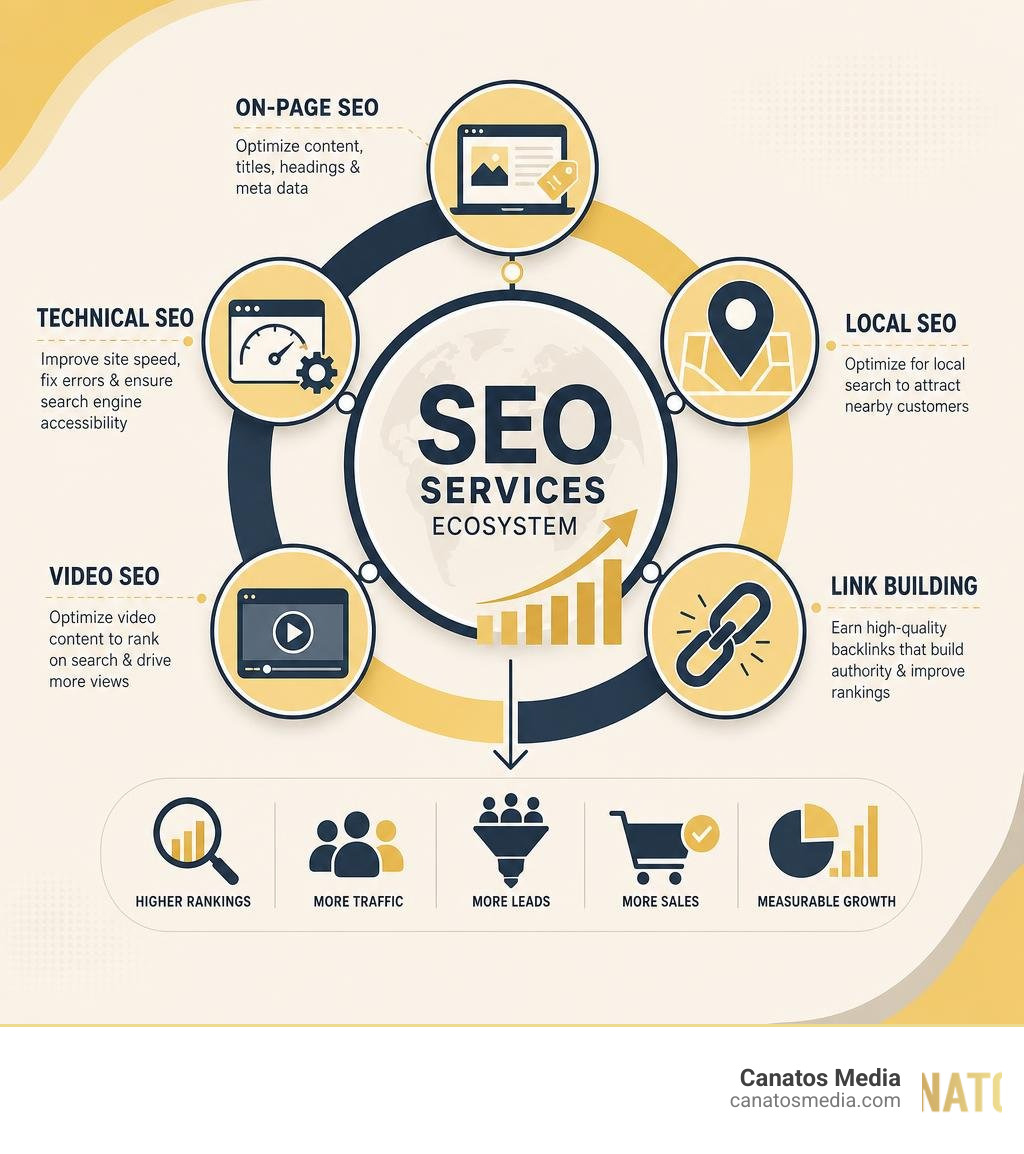
    SEO services are professional solutions that help your business rank higher in search results — driving more visitors, leads, and sales without paying for every click.

    Here’s a quick breakdown of what they typically include:

    • Keyword research — finding the exact terms your customers search for
    • On-page optimization — improving titles, headings, meta descriptions, and content
    • Technical SEO — fixing site speed, crawl errors, and mobile issues
    • Link building — earning backlinks that signal authority to Google
    • Content strategy — creating pages that match what buyers are actually looking for
    • Local SEO — helping nearby customers find your business first
    • Video SEO — optimizing YouTube content to rank on the world’s second-largest search engine
    • Reporting and analytics — tracking rankings, traffic, and revenue outcomes

    If you’re a local business trying to generate consistent leads online, the right SEO partner can be the difference between being found and being invisible.

    Over 81% of US adults use YouTube, and Google processes billions of searches every single day. Yet most small and mid-sized businesses either skip SEO entirely or hand their budget to providers who never deliver real results. The cost of that mistake compounds quietly — while competitors climb the rankings, your business stays buried.

    This guide cuts through the noise. You’ll learn what reliable SEO services actually look like, what separates good agencies from bad ones, and how video SEO on platforms like YouTube fits into a modern growth strategy.

    I’m Nic Canobbio, founder of Canatos Media, and my experience producing content that has generated over 60 million views across social platforms has given me a front-row seat to how SEO services — done right — can transform a brand’s visibility and revenue. Let’s get into it.

    Overview infographic of SEO services ecosystem including on-page, technical, local, video, and link building infographic

    Must-know seo services terms:

    The Evolution of Modern SEO Services

    Search engine optimization is no longer about stuffing keywords into white text at the bottom of a webpage. As we move through June 2026, search engines like Google have evolved into highly sophisticated, intent-driven answer engines. They analyze semantic relationships, evaluate user behavioral signals, and prioritize genuine user experience above all else. Google’s own SEO Starter Guide also emphasizes creating helpful, accessible content that search engines can understand and users can trust.

    This evolution has fundamentally shifted user behavior. Searchers expect instant, highly accurate answers tailored to their specific device and location. With the rise of AI-powered search summaries and conversational queries, the technical hygiene of your website is put to the test daily.

    If your site is slow, clunky, or difficult to navigate on a phone, search engines will simply ignore it. Ensuring your platform is perfectly optimized for handheld devices is no longer optional—it is the baseline for survival. To understand how to align your site with these modern standards, check out our guide on The Definitive Rules for Mobile SEO Success in 2026.

    Traditional Website Optimization vs. YouTube SEO Services

    While traditional website SEO and YouTube SEO share the same ultimate goal—maximizing search visibility—their underlying execution and ranking algorithms are entirely different.

    Traditional website SEO focuses heavily on crawling text, indexing pages, mapping semantic entities, and evaluating domain authority through high-quality backlinks. When we optimize a website, we are working to satisfy Google’s complex web ranking systems by building topical authority and fixing technical infrastructure.

    Video SEO, on the other hand, operates within a closed-loop platform ecosystem where user behavior is king. While text-based metadata matters, YouTube’s algorithm prioritizes signals such as:

    • Watch time: The total cumulative minutes viewers spend watching your video.
    • Audience retention: How long viewers stay tuned before dropping off.
    • Click-through rate (CTR): The percentage of people who click your video after seeing the thumbnail.
    • Session duration: Whether your video keeps users on the platform, even if they click onto another video afterward.

    Because of these differences, a business cannot rely solely on classic web tactics to win on video platforms. If you run an online storefront, you must balance both worlds. Traditional search optimization brings buyers directly to your product pages, while video search builds trust and demonstrates products in action. To see why this balance is critical, read about Why Your Store Needs Ecommerce Website SEO to Survive.

    Why YouTube is the Second-Largest Search Engine

    Many marketers view YouTube purely as a social media network or an entertainment hub. In reality, it is the world’s second-largest search engine, processing over 3 billion searches every single month.

    video search trends

    With over 2.6 billion active users—representing roughly one-quarter of the global population—YouTube has become the primary destination for “how-to” queries, product reviews, and educational content. When users want to see how a product works, learn a new skill, or compare services, they bypass traditional text search entirely in favor of video.

    Every single day, users watch more than 1 billion hours of video content on the platform. This massive shift in user intent means that any modern marketing strategy that ignores video is leaving an enormous amount of traffic on the table. By optimizing your video content to rank for high-intent search terms, we can position your brand directly in front of buyers at the exact moment they are looking for visual answers.

    Optimizing video content for search engines requires a strategic blend of creative production and analytical data. It is not enough to simply upload a high-quality video and hope for the best; you must structure the file, metadata, and channel layout so that search algorithms can easily read, categorize, and recommend your content.

    On-Page Video Optimization Strategies

    On-page video optimization is where technical precision meets human psychology. To capture both search algorithms and human clicks, we focus heavily on the core elements of video metadata:

    • Video Titles: Your title must contain your primary target keyword near the beginning, but it also needs to be written as a compelling hook that drives clicks.
    • Descriptions: YouTube’s algorithm relies heavily on the first 200 characters of your description. We write keyword-rich, natural introductions, followed by detailed outlines, timestamp chapters, helpful links, and a clear call to action.
    • Thumbnails: A custom, high-contrast thumbnail is the single most important factor for improving your click-through rate (CTR). It must visually communicate the video’s promise in less than a second, even on small mobile screens.
    • Tags and Closed Captions: While tags have a smaller impact than they used to, they help categorize your content. Additionally, uploading custom, accurate closed-caption files (instead of relying on automated transcription) provides search engines with a clean text transcript to crawl for relevant keywords.
    • Playlists: Grouping related videos into curated playlists encourages continuous watching, which directly boosts your channel’s overall session duration.

    optimized video metadata

    Competitor Analysis and Profile Optimization

    Before we hit record on a video, we perform deep competitor reviews to identify content gaps in your niche. We analyze what your competitors are ranking for, where their videos fall short, and what search queries are underserved.

    Once we identify those opportunities, we optimize your entire channel profile to convert new viewers into subscribers and leads. This includes designing a professional channel banner, writing a keyword-rich “About” section, setting up a compelling channel trailer for non-subscribers, and organizing your homepage layout to feature your highest-performing playlists.

    For businesses operating in specific regions, this optimization can be tailored for local targeting. Whether you are targeting the tri-state area or building an international audience, aligning your channel profile with geographic search behavior ensures you attract the right kind of viewers to your business.

    Integrating Paid Ads with Organic Video Marketing

    While organic SEO is the ultimate long-term play for sustainable, compounding traffic, integrating paid advertising into your strategy can dramatically accelerate your results. When paid campaigns and organic efforts work together, they create a powerful digital marketing flywheel.

    Maximizing ROI with YouTube Ads

    Paid YouTube ad campaigns allow you to buy immediate visibility at the top of search results and suggested video feeds. This is incredibly useful for launching new products, targeting highly competitive keywords, or building early momentum for a brand-new channel.

    By monitoring ad accounts closely and adjusting campaigns based on real-time performance data, we can ensure your ad spend goes toward highly targeted audiences. This active management helps prevent wasted budget and ensures your video ads drive measurable conversions, rather than just empty views.

    To understand how these two approaches complement each other, let’s compare them side-by-side:

    Feature Organic Video SEO Paid YouTube Ads
    Upfront Cost Lower (requires time/production) Higher (requires direct ad spend)
    Time to Results 3 to 6 months to build authority Instantaneous upon campaign launch
    Longevity Permanent; continues to drive traffic Temporary; stops when budget ends
    Targeting Precision Based on search intent and keywords Highly specific demographics and interests
    Primary Benefit Compounding, trust-building authority Rapid lead generation and brand awareness

    How to Choose the Best YouTube SEO Services for Your Business

    Finding a reliable agency that delivers actual traffic and conversion growth requires looking past vanity metrics like views and subscriber counts. You need a partner who understands how to tie search visibility directly to your business’s bottom line.

    When evaluating providers in the regional landscape, it is helpful to look for agencies that understand your specific geographic market. For instance, businesses looking for regional expertise in the New York and Long Island areas benefit greatly from working with a partner that understands local search behavior, regional demographics, and the competitive landscape of the tri-state area. A local partner can help you optimize your Google Business Profile, target location-specific keywords, and build regional authority that national agencies might overlook.

    As you compare agencies and review pricing models, transparency is key. You should never feel locked into confusing, overpriced contracts that don’t show a clear path to return on investment. To protect your marketing budget, take a look at our practical advice on how to Stop Overpaying for Your Ecommerce SEO Packages and find Affordable SEO Services That Won’t Make Your Wallet Cry.

    Additionally, if you operate an online store, make sure your provider has deep expertise in digital commerce. You can learn how to make the right choice by reading How to Pick an Ecommerce SEO Firm That Actually Delivers and exploring Why Every Store Needs an Ecommerce SEO Specialist.

    Frequently Asked Questions About Video SEO

    To help you better navigate video search, we have compiled answers to some of the most common questions businesses ask when exploring video SEO.

    How is SEO for YouTube different from SEO for websites?

    Website SEO focuses heavily on text optimization, site architecture, and external backlink profiles to rank pages on Google. YouTube SEO is primarily driven by viewer engagement and retention signals. While metadata (titles, descriptions, and tags) helps the algorithm categorize your video, the platform will only rank your content if viewers click on it (CTR) and watch it for a significant period (retention).

    How long does it take to see results from video SEO?

    If we are optimizing existing video content that already has baseline views and search demand, you can see initial visibility improvements in as little as 30 to 60 days. However, building sustainable, long-term organic growth, growing a loyal subscriber base, and dominating competitive search terms typically takes 3 to 6 months of consistent optimization and content publishing.

    What are the most important ranking factors for YouTube videos?

    The most critical ranking factors are click-through rate (CTR), audience retention, and total watch time. YouTube wants to keep users on its platform for as long as possible. If your videos consistently get clicked and keep people watching, the algorithm will reward you with higher search rankings and recommend your videos across the platform.

    Conclusion

    At Canatos Media, we believe that search engine optimization shouldn’t exist in a silo. True digital growth happens when your content, search strategy, and paid campaigns all work together as a single, unified system.

    Whether we are creating cinematic short-form videos that capture attention on social feeds, managing your social media presence, running targeted Meta and Google ad campaigns, or building long-term search authority through on-page, local, and video SEO, our focus is always on driving measurable growth for your business.

    We specialize in helping businesses across the tri-state area and Long Island bridge the gap between creative content and technical performance. If you are ready to stop guessing and start scaling your online presence with an integrated digital strategy, we are here to help.

    Ready to take your search visibility to the next level? Explore our full range of digital marketing solutions and let’s build something great together. Visit the Canatos Media Services Page to get started today.

    For more insights into search engine optimization, browse our dedicated SEO Search Engine Optimization Resource, check out our latest articles in our Category SEO Hub, or filter through our specialized topics in our Tag SEO Directory.

  • How We Optimize Websites for AEO and SEO While Producing Video Content

    How We Optimize Websites for AEO and SEO While Producing Video Content

    The Challenge: Fragmented Marketing Tools Drain Your Resources

    Most business owners we meet are juggling three or four different vendors. One handles video production. Another manages their social media. A third optimizes their website for search. The result? Disjointed messaging, wasted budget, and campaigns that don’t compound their impact.

    At Canatos Media, we’ve built a different model. We treat video production, website optimization, and SEO as parts of a single integrated system. When your website content, technical structure, and visual assets all work together, they amplify each other’s performance.

    Most growth-focused business owners operate with what we call the “vendor archipelago” problem. Your video team creates beautiful short-form content optimized for social feeds. Your SEO specialist optimizes for Google rankings. Your paid ads manager runs campaigns on Meta platforms. None of them have full visibility into what the others are doing.

    This fragmentation creates real costs:

    • Messaging inconsistency across channels damages brand recall
    • Video content created for social rarely gets optimized for search visibility
    • Website updates happen in isolation from your content calendar
    • Budget allocation becomes reactive instead of strategic

    We’ve seen businesses spend $50,000 on cinematic brand videos that never appear in search results or drive qualified traffic to their site. The creative was excellent. The technical foundation was missing.

    What to do next: Audit your current vendors. Document how often they communicate directly with each other about strategy. If the answer is “not often,” you’re likely experiencing revenue leakage from this fragmentation.

    Why Most Agencies Fail at Integration

    True integration requires expertise across three distinct disciplines: creative production, technical SEO, and digital marketing strategy. Most agencies are built as specialists in one area who then bolt on services in others.

    A video production house hires an SEO consultant. A social media management firm adds “website optimization” to their service menu. The work improves each area in isolation, but integration points remain weak because the team lacks shared vocabulary and workflow systems.

    Real integration means:

    • Your video strategist understands core web vitals and metadata requirements
    • Your SEO team reviews scripts and shot lists before production begins
    • Your paid ads strategy incorporates organic search performance data
    • Website changes are planned alongside content calendars, not after

    Most agencies can’t sustain this because it requires constant cross-functional collaboration and shared accountability. It’s harder to staff, harder to scale, and harder to manage. We’ve built our entire operation around this challenge.

    How We Combine Video Production with Technical Website Optimization

    Our approach starts with strategy alignment. Before we shoot a single frame, we map your target keywords, search intent, website architecture, and competitive landscape. This research informs creative direction and production decisions.

    When we produce cinematic website videos, we optimize for both viewer engagement and technical SEO. That means:

    • Hosting videos on your domain (not just embedded third-party platforms) to build site authority
    • Creating custom thumbnails and descriptions optimized for your target keywords
    • Structuring video metadata so search engines understand content context
    • Designing video layouts that improve page speed and user experience metrics

    Your website isn’t a showcase for videos. Videos are strategic assets that solve for both human viewers and algorithmic visibility.

    During production, we also capture supplementary assets: short clips for social, behind-the-scenes content, testimonials, and process footage. This multiplies content output without multiplying production days, making your budget stretch further.

    Actionable takeaway: When evaluating video production partners, ask whether they optimize video hosting and metadata for SEO. If they treat video as a social-only asset, you’re leaving search visibility on the table.

    Our AEO Optimization Approach for Video-First Brands

    AEO stands for Answer Engine Optimization, which focuses on optimizing content to appear in AI-powered search results and conversational interfaces. As AI search tools grow in prominence, AEO becomes increasingly critical alongside traditional SEO.

    We approach AEO optimization by structuring content to directly answer the specific questions your target audience asks. This means:

    • Creating clear, concise answers within your website copy that AI systems can extract and cite
    • Using schema markup to help AI understand your expertise, authority, and trustworthiness
    • Building topical clusters where one pillar page supports multiple detailed subtopic pages
    • Producing video content that demonstrates solutions, not just describes them

    For a service-based brand, this might look like a detailed page about a specific problem your service solves, supported by a video showing real client results, supplemented by case studies and frequently asked sections that match actual customer questions.

    AI search engines reward content that provides immediate value while signaling deeper expertise. Your website should do both simultaneously.

    SEO Excellence Without Compromising Creative Quality

    The tension we often hear from creative teams is real: won’t SEO requirements constrain our creative vision?

    Not when SEO is baked into strategy from the start. The best SEO work feels invisible to viewers because it’s built into structure, not forced onto content.

    Our process prioritizes messaging first, optimization second. We identify the core story you need to tell, then build SEO requirements into how we tell it. Your headline might include a target keyword because that keyword describes what you actually do. Your page structure uses H2 and H3 tags because clear hierarchy serves readers, not just search bots.

    We’ve learned that most creative constraints come from poor SEO implementation by non-specialists, not from SEO itself. When someone retrofits keyword requirements onto finished copy, the result feels forced. When keywords inform strategy early, they shape better, clearer messaging.

    Technical SEO also matters enormously. Your website’s speed, mobile responsiveness, Core Web Vitals, and crawlability affect both search rankings and user experience. These aren’t creative decisions, but they’re creative enablers. A slow website can’t rank well, regardless of content quality.

    Real Results: Video Content That Ranks and Converts

    We work with multi-location service brands and growth-focused companies where video content directly impacts lead generation and sales velocity. Here’s what integrated optimization achieves:

    A pest control company producing short-form content for social media could instead produce a series of cinematic website videos about service areas, each optimized for local search intent. The video itself ranks for queries like “termite treatment in [city name],” directing qualified leads to a conversion-focused page.

    A B2B service provider creates educational video content answering their prospects’ most-asked questions. Each video page ranks for those questions while also scoring on Core Web Vitals, directly improving search visibility and user experience simultaneously.

    When content works at the intersection of creative appeal and technical optimization, metrics improve across the board. Viewers stay longer. Bounce rates decrease. Conversion rates increase. Search rankings rise because all these signals feed into algorithm evaluation.

    Our End-to-End Integrated Process

    Our workflow looks different from traditional agency setups:

    Discovery and Strategy Phase: We audit your current digital presence, research your competitive landscape, and identify keyword opportunities aligned with your business goals. This includes understanding your sales process so content aligns with buyer journey stage.

    Content Calendar and Production Planning: We map a year-long content calendar that balances social content, website pages, video production, and paid ad needs. Everything connects to the same strategic threads.

    Production and Optimization: As we create assets, we optimize them for multiple formats and platforms. A single production day might yield social shorts, website videos, testimonial footage, and case study material. Meta and Google advertising assets are built simultaneously.

    Technical Implementation: Our team handles website deployment, video hosting, schema markup, metadata optimization, and Core Web Vitals monitoring. Creative quality never suffers because technical work happens in parallel, not as an afterthought.

    Ongoing Management: We provide all-in-one social content management, paid advertising, and SEO monitoring. Your content engine stays active, and we adjust strategy based on performance data.

    Each phase delivers measurable outputs aligned to your growth objectives.

    Why Choose an Integrated Solution Over Separate Vendors

    Integrated services cost less than hiring best-in-class specialists in each category separately. More importantly, they deliver better results because strategy compounds rather than conflicts.

    When your video team, SEO specialist, and paid ads manager all report to the same leadership with aligned goals and shared data, budget allocation becomes logical rather than political. The website redesign that would normally cut into monthly production budget instead enhances it. The SEO win that would normally sit in one silo now amplifies paid advertising performance.

    You also get faster execution. Instead of waiting for one vendor to finish before another begins, integrated work happens in parallel. Months of sequential handoffs become weeks of coordinated production.

    We’ve built Canatos Media specifically for growth-focused owners who need both creative excellence and measurable business impact. We combine cinematic storytelling with technical precision because your brand deserves both.

    Ready to align your video production with your SEO strategy? Let’s talk about how an integrated approach can accelerate your path to more leads and stronger rankings.

    Contact us today for a free consultation to see how we can help you grow your business.

    Frequently Asked Questions (FAQ)

    How do we ensure our video content is optimized for both search engines and user engagement?

    We build SEO and AEO optimization into our video production from the start, rather than treating it as an afterthought. Our team coordinates technical elements like metadata, schema markup, and keyword integration with our creative team to ensure every video performs well in search results while maintaining cinematic quality. We also design our website architecture to support video indexing and featured snippets, so your content gets discovered by both search algorithms and your target audience.

    What’s the difference between how we approach AEO versus traditional SEO?

    We recognize that AEO focuses on answer engines and AI-powered search tools, which prioritize direct, cited information and source credibility. Our approach structures your video content and website copy to answer specific user questions while building authority through quality cinematic storytelling. Traditional SEO remains crucial, but we layer AEO strategies on top so your brand appears across Google Search, AI overviews, and emerging answer engine platforms.

    Why shouldn’t we just hire separate video and SEO vendors?

    When video production and SEO work in silos, you end up with beautiful content that doesn’t rank and technical optimization that feels disconnected from your brand story. We integrate these disciplines from strategy through execution, so your website architecture supports video performance, your content targets keywords your audience actually searches for, and your lead generation systems capture attention from every stage of the customer journey. This unified approach saves you time coordinating between vendors and produces measurably better results.

  • Music Video Production 101: From Script to Screen

    Music Video Production 101: From Script to Screen

    Why Music Video Production Is the Most Powerful Tool for Artist Visibility

    Music video production is the process of creating a visual companion to a song — from the initial creative concept all the way through filming, editing, and delivering a platform-ready final cut.

    Here’s a quick breakdown of what it involves:

    1. Pre-Production — Concept development, storyboarding, location scouting, casting, and planning
    2. Production — Directing, lighting, filming performances and narrative scenes
    3. Post-Production — Editing, color grading, visual effects, and sound design
    4. Delivery — Exporting platform-ready files for YouTube, TikTok, Spotify Canvas, and more

    Music videos account for over 25% of all YouTube views worldwide. A well-executed video can reach an audience 10 times the size of an artist’s existing listener base — driving streams, playlist placements, and real revenue.

    The format has been a cultural force for decades. Many credit Queen’s 1975 hit Bohemian Rhapsody as the video that first popularized the format, and the medium has only grown more essential since. Today, a single video isn’t just a creative statement — it’s a growth engine.

    Whether you’re an independent artist or releasing through a major label, the quality of your visual content directly impacts how seriously the industry and your audience take you. A strong concept with cinematic execution can go viral with little to no marketing budget. A weak video can undercut even a great song.

    I’m Nic Canobbio, founder of Canatos Media, and with over two decades of experience in media production — including social content that has reached more than 60 million views — music video production is one of the core disciplines I’ve built my career around. In this guide, I’ll walk you through everything you need to know to make smart, informed decisions about your next video.

    Music video production workflow infographic: 4 stages from concept to platform delivery infographic

    Music video production vocabulary:

    The 4 Stages of Professional Music Video Production

    To the untrained eye, a music video looks like a seamless flow of beautiful imagery synchronized perfectly to a beat. Behind the scenes, however, it is a highly structured process. Professional music video production relies on a clear, four-stage pipeline to transform an abstract musical idea into a polished marketing asset.

    By understanding how we move from a blank page to a finished file, artists and labels can better collaborate with directors to protect both their creative vision and their budgets. For a deeper look at how these phases mirror traditional filmmaking, check out our guide on Lights Camera Action: A Deep Dive into the Three Stages of Film.

    Pre-Production: Concept, Storyboarding, and Planning

    Pre-production is where the foundation of your video is built. If you wing it here, your shoot will fall apart on set. During this phase, we work closely with the artist or record label to establish the visual identity of the track.

    First, we draft a visual treatment—a document outlining the narrative theme, color palette, and camera style. We then translate this treatment into mood boards and detailed storyboards. Mapping each shot to specific timestamps in the song ensures that the narrative pacing matches the musical structure.

    Once the creative direction is locked, the logistical heavy lifting begins. This includes:

    • Location Scouting: Finding the perfect settings around the Tri-State area or Long Island that fit the visual tone.
    • Shot Lists: Detailing every single camera setup, angle, and lens requirement.
    • Casting: Auditioning actors, dancers, or extras.
    • Scheduling and Call Sheets: Structuring the shoot day down to the minute so the crew and talent know exactly where to be.

    Production: Directing, Lighting, and Capturing the Performance

    Production is the actual shoot day (or days). This is where the director, cinematographer, and crew execute the plan. A typical music video relies on two primary visual elements: performance footage (the artist singing or playing their instrument) and narrative footage (story-driven scenes).

    Directing actors and musicians requires a unique touch. Musicians must be coached on playback miming—performing the song with high energy to a sped-up or slowed-down audio track to capture specific visual effects, while maintaining perfect lip-sync.

    Lighting is configured to establish depth and mood, while camera movements are carefully choreographed to match the song’s energy. We also pay strict attention to continuity and proper slating of takes to make the editor’s life easier in the next stage.

    Post-Production: Editing, Color Grading, and Visual Effects

    Once the cameras stop rolling, the project moves into post-production. This is where the raw footage is shaped into a final story.

    1. The Rough Cut: The editor syncs the performance footage to the master audio track and selects the best narrative takes, building a loose timeline.
    2. The Fine Cut: The edit is tightened, focusing on cutting to match the emotional flow of the music rather than just cutting on every beat.
    3. Color Grading: A colorist adjusts the tones, contrast, and saturation to give the video a cinematic look that matches the mood board.
    4. Visual Effects (VFX): Any green-screen composites, 3D elements, or digital cleanups are integrated. If you want to explore how stylized digital visuals can elevate a campaign, read our Animation Station: The Ultimate Guide to Digital Marketing Animation Videos.
    5. Sound Design: Adding subtle environmental sound effects (like a car door closing or rain falling) during breaks in the music to ground the narrative.

    Essential Gear and Crew Roles in Music Video Production

    To achieve a high-end, commercial look, you need the right tools and the right hands operating them. While consumer cameras have become incredibly advanced in 2026, the gap between DIY and professional work lies in the specialized gear and the expertise of a dedicated crew.

    A professional crew operating high-end cinema cameras and lighting setups on a soundstage set

    Understanding these tools and roles will help you navigate a professional set with confidence. For a broader overview of how these services fit together, see our Beginners Guide to Video Production Services.

    Camera and Lighting Equipment for Cinematic Visuals

    Professional music video production relies on tools designed to manipulate light and movement. Here is the essential gear package we bring to a high-end shoot:

    • Cinema Cameras: We shoot on industry-standard systems from RED or ARRI, capable of capturing up to 8K resolution with wide dynamic range. This ensures the footage holds up under intense color grading.
    • Prime Lenses: Unlike zoom lenses, prime lenses have fixed focal lengths. They offer superior sharpness, beautiful background blur (bokeh), and exceptional low-light performance.
    • Three-Point Lighting Setup: A standard configuration using a Key Light (main light on the subject), Fill Light (softens shadows), and Backlight (separates the subject from the background). We also utilize customizable RGB LED panels to introduce stylized color washes.
    • Camera Stabilizers: Gimbals, Steadicams, and dollies allow for smooth, sweeping movements that follow the artist dynamically.

    Key Crew Roles on a Professional Set

    A great director is nothing without a skilled crew. On a professional set, roles are clearly defined to ensure maximum efficiency:

    • The Director: The creative lead who guides the performance of the artist and actors, ensuring the visual narrative aligns with the song’s emotional core.
    • The Producer: The logistical mastermind who handles budgeting, scheduling, permits, catering, and crew hiring.
    • The Cinematographer (Director of Photography): The camera and lighting expert who works with the director to frame shots, choose lenses, and design the lighting look.
    • The Gaffer: The head of the lighting department who physically sets up and shapes the light fixtures.
    • The Editor: The post-production specialist who cuts the footage, syncs the audio, and manages the visual pacing.

    Budgeting and Costs: What Does a Music Video Cost in 2026?

    One of the most common questions artists ask is: “How much does a music video cost?” In 2026, the answer depends entirely on your creative scope, location, and production value.

    While simple, single-location performance videos can be produced on modest budgets, cinematic multi-day productions require a much larger investment.

    Cost Factors: Locations, Talent, and Post-Production

    When budgeting for a music video production, several variable costs must be balanced:

    • Location Permits & Fees: Shooting on location in New York or Long Island requires official permits and liability insurance. Renting dedicated soundstages or unique narrative sets (like vintage rooms or black-box studios) adds to the baseline cost.
    • Talent Fees: Hiring professional actors, background dancers, and choreographers requires fair compensation.
    • Post-Production Complexity: Complex visual effects, extensive color grading, and rapid turnaround times increase the editing hours.
    • Crew and Catering: A professional crew expects standard day rates, and keeping everyone fed and energized is a non-negotiable part of a smooth shoot.

    DIY vs. Professional Music Video Production

    Many emerging artists start with a DIY approach. While this is a great way to experiment, there comes a point where professional quality is required to compete on a global scale.

    Feature DIY Music Video Production Professional Music Video Production
    Creative Control High, but limited by technical execution Collaborative, guided by experienced directors
    Technical Quality Consumer-grade; limited lighting and framing Cinematic 4K/8K; professional lighting and grading
    Pre-Production Often rushed or skipped Meticulous storyboarding, permitting, and planning
    Distribution Reach Limited to existing social circles Optimized for major streaming, VEVO, and social platforms
    Asset Delivery Typically just one horizontal video file Full suite: horizontal master, vertical cuts, Canvas loop

    Choosing a professional team means you aren’t just paying for someone to press “record.” You are investing in a strategic visual asset designed to grow your brand. If you are still on the fence about whether to hire a team, read our breakdown on Dont Wing It: Why Professional Production Services Video Matter.

    The landscape of music video production is evolving rapidly in 2026. Technology has democratized high-end visual effects, while the rise of short-form mobile platforms has fundamentally changed how audiences consume video content.

    An editor utilizing advanced AI-assisted color grading and editing tools in a modern post-production suite

    AI Tools and Virtual Production in Music Video Production

    Artificial intelligence and virtual production are no longer futuristic concepts—they are active parts of our daily pipeline. Modern AI tools help editors automate tedious tasks like syncing multicam footage, isolating subjects for rotoscoping, and generating initial color-match passes.

    Additionally, we use AI to help storyboard surreal concepts that would have otherwise cost hundreds of thousands of dollars to scout and build.

    For projects requiring fantastical environments, virtual production—using green screens, CGI, and LED volume walls—allows us to place artists in custom digital worlds without leaving our Tri-State area studios.

    To see how these visual techniques translate to digital marketing campaigns, explore our insights on Short Form Video Production.

    Vertical Formats and Social Media Optimization in Music Video Production

    A music video launch in 2026 rarely lives only on YouTube. To maximize your investment, your video must be optimized for the platforms where your audience spends their time.

    This means planning for vertical formats (9:16 aspect ratio) right from the start. During pre-production, we frame our shots to ensure they can be cropped cleanly for TikTok, Instagram Reels, and YouTube Shorts without losing key visual information.

    By capturing high-quality behind-the-scenes (BTS) content and short-form teasers alongside the main shoot, we generate a complete visual campaign that feeds the social media algorithm for weeks.

    A beautiful music video is useless if it gets taken down due to copyright strikes or legal disputes. Protecting your intellectual property and establishing clear distribution rights is a vital part of the production process.

    For a comprehensive look at how to build an audience around your visual assets, read The Complete Guide to Video Marketing.

    Before we roll cameras, we ensure all legal boxes are checked:

    • Music Licensing: If you are an independent artist, you must hold the rights to both the composition and the master recording of the track. If you are working with a label, we coordinate with their legal team to secure the necessary clearances.
    • Talent Releases: Every actor, dancer, and extra appearing on screen must sign a talent release form. This grants us and the artist the permanent right to use their likeness in the video and promotional materials.
    • Location Permits & Liability Insurance: Shooting on public or private property in New York or Long Island requires official permits and production insurance to protect against accidental damage or injury.

    Platform-Specific Delivery: YouTube, TikTok, and Spotify Canvas

    When the final edit is approved, we don’t just hand you a single video file. We deliver an organized suite of assets tailored to different platforms:

    • YouTube Master: The high-bitrate, horizontal 4K version designed for the big screen and official VEVO channels.
    • TikTok & Instagram Cuts: 15-to-30-second vertical teasers designed to hook viewers in the first three seconds and drive them to streaming platforms.
    • Spotify Canvas: An 8-second, looping, vertical video with no sound that plays on mobile devices while the song streams. This format has been proven to increase track shares and playlist adds.

    By connecting your production directly to a distribution strategy, we turn your creative vision into a performance marketing machine. Learn more about this integrated approach in Cinematic Storytelling Meets Performance Marketing: A Complete Guide.

    Frequently Asked Questions about Music Video Production

    How long does it take to produce a professional music video?

    The typical timeline for a professional music video is 2 to 4 weeks from initial concept to final delivery. Pre-production usually takes 1 to 2 weeks to lock down locations, permits, and casting.

    The physical shoot typically takes 1 to 2 days. Post-production—including editing, color grading, and revision rounds—takes another 1 to 2 weeks depending on the complexity of the visual effects.

    What is the typical budget range for a music video?

    In the professional industry, budgets vary widely based on scope:

    • $5,000 to $15,000: Great for high-quality, single-location performance videos, stylized studio shoots, or simple narrative concepts with a lean crew.
    • $15,000 to $50,000: Allows for multi-location shoots, professional actors, custom set designs, and more advanced lighting setups.
    • $50,000 to $150,000+: Cinematic, multi-day productions with large crews, specialized camera rigs, extensive visual effects, and high-profile talent.

    Do I need a record label to hire a professional production company?

    Not at all. While we frequently work with major and independent labels, we also work directly with independent artists.

    If you have a clear vision, a dedicated budget, and a song you believe in, a professional production company can help you bridge the gap between “indie artist” and “industry professional.”

    Conclusion

    At Canatos Media, we believe that music video production is the ultimate intersection of art and strategy. A great music video doesn’t just decorate a song – it defines your brand, captivates your audience, and drives measurable growth across streaming and social platforms.

    Whether you are looking to shoot a cinematic narrative on Long Island or need a suite of high-energy vertical assets for a digital campaign, we bring an integrated strategy that connects stunning cinematic storytelling with modern digital marketing.

    Ready to bring your music to life? Let’s build your visual world together. Explore our Short Form Video Production services and contact us today to get started.

    Industry Resources & Regional Partners

    If you are researching the wider production landscape or looking for regional specialists outside our Tri-State area, you can explore:

  • Building Integrated Lead Generation Systems That Convert Social Traffic Into Sales

    Building Integrated Lead Generation Systems That Convert Social Traffic Into Sales

    Why Most Brands Fail to Convert Social Attention Into Leads

    Your brand gets thousands of views on social media each month. Yet your sales pipeline stays thin. The gap between attention and actual leads reveals a fundamental problem: most brands treat social content, website design, and sales follow-up as separate projects instead of one connected system.

    We’ve built our entire approach around closing that gap. At Canatos Media, we’ve learned that the brands converting the most leads aren’t the ones with the flashiest viral videos. They’re the ones with integrated systems where every piece of content, every landing page, and every follow-up message works together to move prospects from awareness to action.

    This article walks you through how integrated lead generation actually works, why fragmented tools fail, and exactly how we connect social storytelling with measurable sales results.

    You post consistently. Your engagement metrics look solid. But when you check your CRM, the lead count hasn’t moved. This happens because a view is not a lead, and a like is not a sale.

    Most brands create social content in isolation. They focus on entertainment value, trends, or vanity metrics without asking the core question: where do we want viewers to go next? Without a clear next step, even high-performing content evaporates. Someone watches your 15-second video, feels engaged, closes the app, and moves on with their day.

    The second problem is friction. Even if your content points people toward your website, a slow landing page, confusing navigation, or weak call-to-action kills conversion. A prospect needs a frictionless path from “I saw your video” to “I’m interested in learning more.” When that path is broken, you lose momentum.

    Third, most brands don’t nurture. A viewer who isn’t ready to buy today needs to stay connected until they are. Without email sequences, retargeting ads, or follow-up systems, you’re relying on someone to remember you months later. That rarely happens.

    What to do next: Map your current customer journey from social view to lead capture. Identify where people drop off.

    The Problem With Fragmented Marketing Tools and Agencies

    Many growth-focused brands work with multiple vendors. One agency handles social media. Another manages paid advertising. A third builds your website. A fourth runs email. Each team optimizes for their own metrics, but nobody owns the conversion system as a whole.

    This creates several breakdowns. First, data doesn’t flow smoothly between platforms. Your social agency doesn’t know what happens when traffic hits your website, so they can’t refine targeting. Your email vendor sends messages without understanding what content prospects already consumed. Second, strategy gets inconsistent. One team focuses on follower growth while another chases click-through rates. Nobody’s rowing in the same direction.

    Third, hand-offs slow everything down. A new promotion idea takes weeks because it requires approval from multiple vendors and manual integration between tools. You lose speed in a market that rewards fast movement.

    We’ve found that brands owning the most efficient lead generation systems work with partners who understand both content creation and conversion mechanics. That alignment matters more than team size.

    What to do next: Audit who owns each part of your current marketing system. List where manual hand-offs slow you down.

    What Integrated Lead Generation Actually Means

    Integrated lead generation is a system where every element reinforces the others. Your social content doesn’t just entertain; it qualifies prospects and moves them toward your offer. Your website doesn’t just look good; it captures intent and delivers personalized next steps. Your email doesn’t just broadcast; it uses behavioral data to send the right message at the right time.

    Think of it as a three-layer framework:

    Attraction layer: Video and social content that builds awareness and establishes authority. This is where most brands start, but it’s not where they stop.

    Conversion layer: Websites, landing pages, and lead capture forms optimized for the specific audience segment that just engaged with your content. A prospect who watched a video about your pricing page should land on pricing details, not a generic homepage.

    Nurture layer: Automated sequences that stay in touch with people who showed interest but aren’t buying yet. This includes email, retargeting ads, and personalized website experiences.

    When these three layers work together, your cost per lead drops dramatically. You’re not wasting money trying to convert someone not yet ready. You’re not losing people who were ready but didn’t know how to take the next step.

    What to do next: Identify which layer is weakest in your current system. Usually it’s the nurture layer.

    How We Connect Social Content With Sales-Ready Funnels

    We start by understanding your actual buyer. Not the broadest possible audience, but the specific person most likely to become a high-value customer. Their pain points. Their decision timeline. What objections they typically have.

    From there, we create short-form video content designed to address those pain points directly. A dental practice owner might see a 45-second video about why patient acquisition costs are rising (the pain point). That viewer reaches a moment of recognition, and we give them a clear next step: a free guide to reducing patient acquisition costs or a discovery call.

    The video lives on social platforms where your buyer is scrolling. But it’s not random content hoping for engagement. Every script and visual element is optimized for one outcome: getting qualified prospects to take that next step.

    When they click, they land on a page designed specifically for people who just watched that video. If the video focused on patient acquisition, the landing page goes deeper on that topic. It’s not about promoting your entire practice. It’s about solving the specific problem they just learned about. That page includes a clear conversion moment, whether that’s a form, a phone number, or a link to schedule a call.

    We then track what happens next. Did they fill out the form? Did they call? If they didn’t convert, did they visit your website later? That data shapes our next outreach through retargeting ads or email sequences.

    Our all-in-one marketing funnel approach brings all these pieces together so nothing falls through the cracks.

    What to do next: List three specific pain points your best customers had before working with you. These become the foundation for your next content series.

    Our Cinematic Approach to Brand Storytelling and Engagement

    Not all social content is created equal. We’ve learned that cinematic production quality significantly increases both engagement and the perceived value of your brand. A rough, smartphone-quality video signals one message. A professionally shot, well-lit, thoughtfully edited video signals another.

    This doesn’t mean every video needs a Hollywood budget. It means intentional production choices. Professional lighting. Clean audio. Strategic camera movement. Authentic storytelling. These elements build trust faster than generic content.

    When prospects see high-quality visual storytelling, they’re more likely to watch to completion, more likely to take action, and more likely to trust your expertise. We’ve seen this directly in our own metrics. Clients who shift to cinematic production see engagement rates jump 40-60% compared to their previous content.

    Storytelling also differentiates you in crowded markets. A plumber posting before-and-after photos is normal. A plumber telling the story of how an emergency repair saved a family’s business gets shared. Story creates emotional connection, and emotional connection drives loyalty and referrals.

    Our cinematic website videos combine this production quality with strategic website placement so prospects encounter your brand story at the moment they’re most ready to engage.

    What to do next: Identify one recent customer win or transformation that would make a compelling three-minute story. Start scripting it this week.

    Building Website Systems That Capture and Nurture Leads

    Your website is where social traffic converts or dies. Too many brands treat their website as a digital brochure instead of a lead generation engine. That’s a missed opportunity.

    An effective lead capture website has distinct sections for different visitor types. Someone visiting from a video about pricing needs immediate access to pricing information. Someone arriving from a video about case studies needs social proof and examples. Someone clicking from a retargeting ad needs a reminder of what they previously engaged with.

    Beyond navigation, the website itself becomes a tool for qualification. Your lead form should ask enough questions to determine fit, but not so many that people abandon it. A service-based business might ask about project scope, timeline, and budget. A SaaS product might ask about team size and current solution. That data tells your sales team exactly who they’re talking to and what they need.

    Then the website becomes an ongoing engagement tool. Once someone submits their information, they should see a confirmation page that sets expectations for follow-up. If they don’t convert on first visit, retargeting ads bring them back. Abandoned cart sequences remind them of what they were looking at. Email sequences keep providing value even if they’re not ready to buy.

    The technology stack matters here. Your forms should integrate with your CRM so no lead is ever manually entered. Your email platform should segment based on which content prospects engaged with. Your analytics should track which traffic sources produce the best leads, not just the most traffic.

    What to do next: Audit your current website form. How many fields does it have? Can you reduce it by 30% and still qualify leads?

    Multi-Location Brands Need Unified Digital Systems

    Brands with multiple locations face a specific challenge: centralized growth strategy that respects local market differences. You can’t use the same messaging in New York that works in Austin. But you also can’t manage ten separate social media accounts, websites, and lead systems.

    The solution is a unified system with built-in localization. Your core brand story and values stay consistent. Your content library and production approach remain the same. But messaging, offers, and targeting shift based on local market dynamics.

    Multi-location brands we work with use a hub-and-spoke model. We produce core content at the brand level, then adapt it for each location’s social channels. A dental practice might create a general video about emergency care, then produce location-specific versions highlighting each practice’s hours and location.

    The same applies to lead capture. A centralized website might be the hub, but each location has a dedicated landing page with location-specific phone numbers and appointment links. Lead data flows to a central CRM, but managers at each location see only their local leads.

    This approach reduces production costs by 50-70% compared to managing each location independently, while maintaining the quality and consistency that builds brand trust.

    What to do next: If you operate multiple locations, create a content asset list that could be adapted across locations. Which messaging is universal? Which needs local customization?

    Lead Generation Metrics That Actually Matter

    Vanity metrics feel good but don’t drive growth. Views, likes, and followers are worth tracking, but they’re not your real north star. The metrics that matter are the ones directly connected to revenue.

    Track these consistently:

    Cost per lead: How much are you spending (across all marketing channels) for each qualified lead? This tells you if your system is efficient.

    Lead quality score: Not all leads are equal. A lead from a qualified prospect ready to buy this quarter is worth more than a lead from someone still in research mode. Score your leads on fit and readiness.

    Lead-to-customer conversion rate: What percentage of captured leads actually become paying customers? This shows how well your nurture system works.

    Customer acquisition cost: The true cost to turn a lead into a paying customer, accounting for sales time and nurture investment. This is the number that matters most.

    Return on ad spend: For paid social and retargeting, what’s the revenue generated per dollar spent? Track this by campaign and audience.

    Engagement-to-conversion correlation: Which content pieces actually drive leads? Not which pieces get the most views, but which ones actually move people toward conversion.

    Most brands we work with realize their social content with the highest engagement produces zero leads. Their lowest-view content converts like crazy. That misalignment is exactly why integrated systems matter. Engagement metrics guide creative decisions, but conversion metrics guide budget allocation.

    What to do next: Set up a simple spreadsheet tracking these six metrics monthly. You’ll spot trends within 60 days.

    Getting Started With Your Lead Generation Strategy

    Building an integrated lead generation system doesn’t happen overnight, but it does start with clear decisions about strategy before any content gets produced.

    Start by defining your ideal customer profile with specificity. Not “businesses with 10-50 employees” but “dental practice owners in metropolitan areas with 2-4 locations, struggling with patient acquisition, and with $500K+ annual marketing budget.” That specificity shapes every decision forward.

    Next, map the transformation your customer seeks. Where are they now? Where do they want to be? What’s holding them back? That journey becomes your content roadmap. Your earliest content addresses awareness and early education. Middle-stage content tackles objections and builds credibility. Late-stage content handles final questions and encourages action.

    Then structure your conversion system. Define exactly where you want social traffic to land. Build that landing page specifically for those visitors. Create email sequences that follow up based on behavior. Set up retargeting to stay in front of people who didn’t convert immediately.

    Finally, establish measurement from day one. Know what you’re optimizing for. Cost per lead? Lead quality? Customer lifetime value? Your answer shapes which channels get investment and when you make changes.

    We work with growth-focused business owners through this entire process. We produce the cinematic content that attracts qualified prospects. We build the conversion-optimized websites and landing pages that capture them. We integrate everything so your marketing system works as one coherent machine instead of disconnected pieces.

    If you’re ready to turn your social attention into measurable leads and sales, we’re here to help build the system that does it.

    Contact us today for a free consultation to see how we can help you grow your business.

    Frequently Asked Questions (FAQ)

    How do we connect social media content with actual lead generation?

    We build cinematic short-form videos that stop the scroll, then direct that engaged audience to conversion-focused landing pages and sales funnels. Our process integrates Meta and Google advertising with website systems designed to capture contact information, qualify leads, and nurture prospects toward sales. Rather than treating social content and lead capture as separate steps, we design them as one continuous path that turns attention into actionable leads.

    What makes our approach different from using multiple agencies or disconnected tools?

    We handle your entire system under one strategy, which means your video content, paid ads, social management, website, and lead nurturing all work together toward the same conversion goals. When different teams or platforms operate independently, leads fall through gaps and messaging gets inconsistent. We own the full integration, so every piece of content and every customer touchpoint reinforces your brand and moves prospects closer to a sale.

    Which types of businesses benefit most from our integrated lead generation systems?

    We specialize in multi-location service-based brands and growth-focused companies that need consistent lead flow across multiple locations or service lines. If you’re scaling and need visual content that builds trust while simultaneously driving measurable leads and sales, our systems are designed for you. Brands that have struggled with either beautiful content that doesn’t convert or generic funnels that lack brand personality see the biggest impact.

  • A – Z Guide to Meta Ads Management Services

    A – Z Guide to Meta Ads Management Services

    Why Is Meta Ads Management Crucial for Businesses in 2026?

    The digital advertising landscape has undergone a massive transformation. In June 2026, simply pressing the “Boost Post” button on Facebook or Instagram is no longer a viable strategy; it is a guaranteed way to burn through your marketing budget. Navigating paid social media now requires a highly sophisticated, professional approach to achieve a positive return on ad spend (ROAS).

    Meta Ads Management Funnel: Awareness to Conversion

    Meta’s ecosystem remains an absolute powerhouse for global and local reach. The numbers speak for themselves:

    • Meta platforms reach over 3.6 billion monthly active users, with more than 77% of all internet users active on at least one of its platforms (Facebook, Instagram, Messenger, or WhatsApp).
    • Facebook alone boasts over 2.9 billion active users and remains one of the most powerful digital advertising platforms within Meta, offering businesses unmatched reach, precise targeting, and high engagement.
    • Instagram has more than 2 billion active users, with Reels and video content experiencing explosive watch-time growth of over 30% recently.

    Despite this massive audience, capturing attention has never been more difficult. In 2026, Meta’s ad delivery system relies heavily on advanced machine learning algorithms (such as the Andromeda AI engine) and automated campaign structures. At the same time, privacy regulations and browser-side tracking limitations (stemming from iOS 14.5 and the ongoing phase-out of third-party cookies) have made traditional tracking methods obsolete.

    Without professional management, businesses struggle with “creative fatigue,” incorrect campaign objectives, and broken tracking systems that miss up to 50% of conversions. Professional Meta Ads management ensures that your campaigns are built on a solid data foundation, utilizing server-side tracking and dynamic, high-converting creative assets. This systematic approach prevents wasted ad spend, allowing optimized, AI-powered Meta campaigns to regularly achieve a ROAS in the healthy 3x to 5x range.

    The Meta Ads Funnel Strategy for Tri-State Businesses infographic

    What Are Meta Ads Management Services and How Do They Work?

    At its core, professional Meta Ads management is the end-to-end administration, optimization, and creative development of paid advertising campaigns across Meta’s entire suite of applications. This includes:

    • Facebook: Feeds, Stories, Reels, Right Column, Marketplace, and In-Stream Video.
    • Instagram: Feed, Stories, Explore, Reels, and Shop.
    • Messenger: Sponsored messages and inbox ads.
    • WhatsApp: Click-to-WhatsApp ads that initiate direct conversations.
    • Audience Network: Digital ad placements on external mobile apps and websites.

    Professional management services do not just involve “running ads.” They encompass a continuous engineering loop divided into four core components:

    1. Strategic Planning & Funnel Architecture: Mapping out the customer journey. We design full-funnel strategies that move users from cold awareness (prospecting) to mid-funnel consideration (engagement/lead generation) to bottom-funnel conversion (sales/retargeting).
    2. Creative Production & Copywriting: Building visual assets—specifically cinematic short-form videos, user-generated content (UGC), and high-impact carousels—paired with persuasive, brand-aligned copy.
    3. Media Buying & Algorithmic Optimization: Setting up campaigns within the ad auction, configuring bidding strategies (such as Cost Cap or Value Optimization), and letting Meta’s AI optimize delivery.
    4. Tracking & Data Infrastructure: Installing and maintaining the technical tools required to feed accurate data back to Meta’s algorithm.

    These campaigns are managed using two primary platforms: Meta Business Suite and Meta Ads Manager. While Meta Business Suite acts as a centralized dashboard for organic content and basic business operations, Meta Ads Manager is the heavy-duty workspace where media buyers build, test, and scale campaigns.

    To understand how these platforms operate, you can read our guides on Mastering Meta Business Suite Ads Manager for Beginners and How to Navigate Meta Ad Manager Like a Pro. For the official platform documentation, you can explore the Marketing Tools and Advertising Solutions on Facebook and … – Meta resource page.

    What Are the Different Meta Ads Management Options Available to Businesses?

    When deciding how to manage your Meta advertising, you have four primary paths. Each option has distinct trade-offs regarding cost, time commitment, creative capability, and scalability.

    Comparison Matrix: DIY vs Agency vs Freelancer vs AI

    Management Option Typical Monthly Cost Time Commitment Creative Production Best Suited For
    DIY (Self-Service) $0 (Only ad spend) Very High (15-25 hrs/week) Limited (Canva templates, basic photos) Startups spending under $1,500/month
    Freelance Specialists $500 – $2,000/month Low Variable (Often requires you to provide assets) Small businesses with simple lead-gen needs
    AI-Powered Automation $200 – $1,200/month Low None (Relies on existing assets) E-commerce brands looking for basic optimization
    Professional Agency $2,000 – $15,000+ (or % of spend) None High (Cinematic video, UGC, design) Businesses spending $3,000+/month seeking scale

    1. DIY Self-Management

    Managing campaigns yourself is highly cost-effective for businesses in their infancy. However, it requires a steep learning curve. Business owners often find themselves spending 15 to 25 hours a week troubleshooting technical issues, writing copy, and analyzing data, which pulls them away from running their actual business.

    2. Freelance Specialists

    Hiring a freelance media buyer can bridge the gap between DIY and an agency. Freelancers are often highly skilled in technical setup and bid management. However, they rarely have the resources to handle high-end creative production, meaning you will still need to supply them with videos, images, and copy.

    3. AI-Powered Automation Tools

    AI tools offer a middle ground by automating bid adjustments, audience expansion, and basic budget allocation. While excellent for technical efficiency, these tools cannot build a cohesive brand strategy, write emotionally resonant copy, or produce cinematic video content.

    4. Professional Digital Marketing Agencies

    A full-service agency provides an integrated, “done-for-you” solution. Agencies handle everything from technical tracking and media buying to high-end creative production and strategic positioning.

    When Should You Transition to an Agency?

    If your monthly ad spend exceeds $1,500 to $3,000, transitioning to professional management is highly recommended. Below this spend level, the data volume is often too low for Meta’s algorithm to exit its “learning phase” efficiently, and errors in targeting or tracking can quickly drain your budget.

    At Canatos Media, we provide an integrated agency solution specifically tailored for businesses in the Tri-State area and Long Island. We don’t just push buttons in Ads Manager; we align your high-end cinematic short-form video content with advanced paid social strategies to build a sustainable customer acquisition engine. You can explore our full range of services in our Category Ad Management section.

    How Do Professional Agencies Optimize Targeting and Ad Creatives?

    In 2026, the old way of laser-targeting specific interests—such as trying to target “32-year-old females in Long Island who love green smoothies and yoga”—is dead. Hyper-targeting restricts Meta’s machine learning, driving up cost-per-thousand-impressions (CPMs) and preventing campaigns from scaling.

    Today, professional agencies rely on algorithmic targeting through tools like Advantage+ Audience and Andromeda AI. We feed Meta’s algorithm a broad audience, and the machine uses real-time behavioral signals to find the exact users most likely to convert.

    Because targeting has become automated, your ad creative is now your primary targeting tool. The visual hook, the messaging, and the aesthetic style of your ad determine who stops scrolling and who gets bypassed.

    High-Performing Cinematic Short-Form Video Structure

    To optimize ad creatives, professional agencies focus on:

    • Cinematic Short-Form Video & UGC: Highly polished, cinematic short-form video combined with authentic, user-generated content (UGC) style ads outperform traditional corporate commercials. They feel native to platforms like Instagram Reels and TikTok, capturing attention without feeling like an aggressive sales pitch. To see how we execute this, read How Cinematic Short Form Content Improves Meta Paid Ad Performance and learn How to Scale Short Form Ad Creative Across Meta and Google Ads.
    • The 3-Second Hook: The first three seconds of a video ad determine 50% of its success. Agencies test multiple “hooks” (both visual and text-based) to see what stops the scroll.
    • Structured A/B Testing: We use a systematic testing framework. Instead of guessing, we launch “concepts” (a single creative idea) with three distinct variations (different hooks, background music, or call-to-actions). We set strict financial cut-offs: if an asset does not hit our target key performance indicators (KPIs) within a set budget, we cut it and scale the winners.

    For a deeper look at how these creative and structural elements work together in modern campaigns, you can watch The COMPLETE Meta Tutorial (Meta Ads, Meta Business … – YouTube .

    How Do Agencies Handle Tracking, Budgeting, and Compliance?

    Behind every beautiful ad creative lies a complex technical infrastructure. Professional agencies manage three critical pillars to ensure your campaigns run smoothly: tracking, budget optimization, and policy compliance.

    1. Server-Side Tracking (Conversions API)

    Ever since Apple introduced iOS 14.5, browser-based tracking (the traditional Meta Pixel) has lost its reliability, frequently missing 30% to 50% of conversion events. To combat this, agencies implement the Meta Conversions API (CAPI).

    CAPI creates a direct, server-to-server connection between your website and Meta. This ensures accurate attribution, improves your Event Match Quality, and feeds clean data back to Meta’s AI. This technical upgrade alone can drop your cost-per-result by 15% to 40%. If you are still relying solely on the browser pixel, you are likely wasting a significant portion of your budget. Learn how to fix this in our guide on how to Stop Burning Cash on Bad Meta Ads.

    2. Budget Optimization Strategies

    Agencies utilize two primary budgeting methods depending on the campaign’s maturity:

    • Campaign Budget Optimization (CBO): Meta automatically distributes your budget across different ad sets in real time, favoring the highest-performing audiences.
    • Ad Set Budget Optimization (ABO): The budget is locked at the ad set level, which is ideal for controlled A/B testing of specific audiences or creative concepts.

    When scaling budgets, agencies avoid making massive, sudden budget increases. Raising a budget by more than 20% to 30% at once can trigger a “learning phase reset,” forcing Meta’s algorithm to restart its optimization process from scratch. We scale budgets incrementally every week to maintain stable performance.

    3. Compliance and Advertising Standards

    Meta enforces strict Advertising Standards to protect its users. Getting your ad account flagged or disabled can paralyze your business. Agencies ensure strict compliance by avoiding prohibited content (such as deceptive claims, low-quality landing pages, or clickbait) and navigating restricted categories (like housing, employment, finance, or social issues) which require special ad category declarations and age targeting restrictions.

    How Much Do Meta Ads Management Services Cost in 2026?

    Understanding the total cost of Meta advertising requires looking at both platform costs (what you pay Meta to show your ads) and management costs (what you pay an agency or tool to run them).

    Meta Ads 2026 Budget Allocation Breakdown infographic

    2. Platform Benchmarks (June 2026)

    • Median Cost Per Click (CPC): $1.12 (up roughly 8% year-over-year)
    • Average Cost Per Thousand Impressions (CPM): $12.50
    • Cost Per Lead (CPL): Ranges from $25 in e-commerce to $180+ in highly competitive B2B or financial services.

    2. Agency Pricing Models

    Agencies generally charge using one of three structures:

    • Flat Monthly Fee: A predictable monthly retainer (typically starting around $1,500 to $5,000+ depending on scope). We strongly advocate for flat fees because they eliminate the conflict of interest inherent in other models; we want to focus on growing your revenue, not just inflating your ad spend.
    • Percentage of Ad Spend: The agency charges a fee (usually 15% to 25%) of your total monthly ad budget, often with a minimum base fee of $2,000.
    • Performance-Based / Hybrid: A lower base fee combined with a percentage of generated revenue or leads (typically 10% to 20% of the return).

    3. Hidden Costs to Keep in Mind

    When planning your budget, platform spend and management fees are only part of the equation. You must also account for:

    • Creative Production: High-quality video and design assets can cost between $1,000 and $8,000+ per month if sourced externally.
    • Software Subscriptions: Third-party tracking, attribution tools, and creative software can add $200 to $1,200/month.
    • Testing Budgets: You should allocate 20% to 40% of your initial budget purely to testing hooks, angles, and audiences.

    For a comprehensive breakdown of budgeting and pricing structures, read our Meta Ads Management Ultimate Guide.

    How Do Meta Ads Integrate With Your Broader Digital Marketing Strategy?

    Meta Ads do not operate in a vacuum. To maximize your return on investment, paid social must be integrated into a holistic, multi-channel digital marketing strategy.

    The Synergy Between Meta and Google Ads

    One of the most powerful digital marketing combinations is pairing Meta Ads with Google Ads.

    • Meta Ads Create Demand: Social media is a discovery engine. Users scrolling through Instagram Reels aren’t actively shopping; your creative interrupts their scroll and introduces a desire or solution they didn’t know they needed.
    • Google Ads Capture Demand: Once a user is introduced to your brand on Meta, they often open a new tab and search for your business or product on Google. If you do not have search ads or strong SEO in place, your competitors will capture that high-intent traffic.

    We call this the “handshake” between paid social and paid search. You can read more about this powerful combination in our guide on Meta Google Advertising.

    Integrating with SEO, Content, and Email Marketing

    An integrated strategy connects all digital touchpoints:

    • SEO & Content: High-performing organic blog posts and website content provide excellent landing pages for your Meta campaigns. Conversely, data from your paid ads can reveal which headlines and topics get the highest click-through rates, guiding your organic content strategy.
    • Email Marketing: Meta lead generation campaigns are highly effective for building your email list. Once a user opts in, automated email sequences can nurture those leads, driving down your overall customer acquisition cost (CAC).

    To see how these channels work together step-by-step, review our Step-by-Step Guide to Paid Ads and explore The Ultimate Guide to Social Media Ads.

    What Are the Most Frequently Asked Questions About Meta Ads Management?

    What is the minimum budget required to start with Meta Ads?

    While Meta technically allows you to run ads for as little as $1 per day per ad set, a practical budget for businesses looking to grow is at least $30 to $50 per day ($900 to $1,500 per month) for testing, and $50 to $150+ per day for active sales or lead generation campaigns.

    Accounts spending under $30 per day often experience 40% to 60% higher costs per result. This happens because the budget is too small to generate the volume of conversion data (ideally 50 conversions per week per ad set) that Meta’s algorithm needs to optimize and exit the learning phase.

    How long does it take to see results from professional Meta Ads management?

    We recommend evaluating Meta campaigns on a 90-day optimization timeline:

    • Weeks 1–2 (Onboarding & Setup): Installing the Conversions API, auditing past data, and producing initial creative assets.
    • Weeks 3–4 (Testing & Learning): Launching initial campaigns. Actionable data begins to accumulate as the algorithm tests different creative hooks and audiences.
    • Weeks 5–8 (Optimization): Turning off underperforming creatives, scaling winning ad sets, and refining the retargeting funnel.
    • Weeks 9–12 (Iterative Scaling): Consistently growing the budget on winning concepts while maintaining a stable ROAS.

    Why is my Meta ad account getting rejected, and how do I fix it?

    Ad rejections typically occur due to violations of Meta’s Advertising Standards. Common culprits include:

    • Deceptive or Exaggerated Claims: Promising unrealistic results (e.g., “lose 10 pounds in 3 days” or “double your income overnight”).
    • Low-Quality Landing Pages: Your ad must match the destination page. If your landing page is slow, broken, or covered in pop-up ads, Meta will reject the ad.
    • Personal Attributes: You cannot imply that you know a user’s personal characteristics (e.g., “Are you struggling with debt?” or “As a 40-year-old woman…”).

    If your ad is rejected, do not delete it. Go to the Account Quality dashboard in Meta Business Suite, review the specific policy violation, edit the ad to comply, or request a manual review if you believe the automated rejection was an error.

    How Can You Get Started With Meta Ads Management Today?

    Choosing the right Meta ads management option comes down to your current stage of business growth:

    • If you are spending under $1,500/month, start with a DIY approach or basic AI tools while focusing heavily on capturing authentic, raw smartphone video content.
    • If you are spending over $3,000/month and want to scale without spending dozens of hours managing campaigns, hiring a professional agency is the most effective path forward.

    At Canatos Media, we serve businesses across the Tri-State area and Long Island by providing a fully integrated marketing solution. We don’t believe in isolated strategies. We combine cinematic short-form video production, expert paid media management (Meta and Google), SEO, and website support to build cohesive, high-converting acquisition funnels.

    Ready to stop guessing and start scaling? Book a discovery call with Canatos Media today to see how we can turn your social presence into a powerful revenue engine.

  • Why Multi-Location Brands Choose Canatos Over Traditional Content Services

    Why Multi-Location Brands Choose Canatos Over Traditional Content Services

    The Multi-Location Brand Content Challenge

    Managing content across multiple locations is fundamentally different from running a single-location business. Each branch needs localized messaging, consistent brand standards, and regular fresh content. The problem intensifies when you’re trying to maintain a cohesive brand identity while accounting for regional differences, local market conditions, and varying customer needs.

    Most multi-location brands face three recurring obstacles. First, they struggle with production bottlenecks: filming at five locations monthly while maintaining cinematic quality becomes logistically complex and expensive. Second, there’s the consistency problem. One location’s social feed might look polished while another appears dormant or amateurish, creating fragmented brand perception. Third, they rarely see direct connection between the content they produce and actual lead generation or sales, making it hard to justify ongoing investment.

    We understand this pressure because we work with growth-focused business owners operating across multiple territories. The gap between needing quality visual content and actually producing it at scale is where most brands get stuck.

    Why Traditional Video Services Fall Short

    Traditional video production agencies typically operate on a project-by-project basis. You request a video, they produce it, and the relationship ends until your next request. This model doesn’t align with how multi-location brands actually operate.

    Here’s where the disconnect appears: standard video services focus on one-off deliverables rather than sustainable systems. They’re not thinking about your next month’s content calendar, integration with your paid advertising strategy, or how each video feeds into your overall lead generation pipeline. They produce content in isolation without understanding your sales funnel or target customer journey.

    Additionally, traditional services rarely scale efficiently. When you need videos across ten locations, costs multiply disproportionately. They also don’t typically manage the distribution side, leaving you to figure out social posting schedules, paid amplification, and performance tracking on your own. You end up with beautiful content that doesn’t drive measurable business outcomes.

    Our Integrated Video-First Approach

    We built our methodology around the specific needs of multi-location brands. Rather than treating video as a standalone deliverable, we position it as the centerpiece of a fully integrated digital marketing system.

    Our approach includes four core components working together:

    • Scalable production planning: We develop quarterly content calendars that cover all your locations while maintaining cinematic quality and consistent brand storytelling
    • Strategic video content: Every video serves a specific purpose within your lead generation funnel, whether it’s awareness-stage storytelling or conversion-focused testimonials
    • Integrated distribution: Content goes directly into coordinated social media management and paid advertising campaigns rather than sitting unused
    • Performance measurement: We track how each video contributes to leads, conversions, and revenue, adjusting strategy based on real data

    The key difference is that we’re building a system, not fulfilling orders. This means your content production becomes more predictable, more efficient, and directly tied to business growth metrics.

    Cinematic Quality at Scale Across Locations

    Multi-location brands often assume they must choose between budget-friendly content and cinematically compelling visuals. We’ve engineered a production model that delivers both.

    Our process starts with understanding your brand’s visual identity and storytelling style. We establish templates, color palettes, and narrative frameworks that ensure every location’s content feels part of the same brand family. Standardizing these elements doesn’t make content repetitive, it creates recognizable consistency. A customer seeing your content across platforms immediately knows it’s you.

    Production efficiency comes through strategic planning. Rather than one-off shoots, we batch film multiple locations in targeted production runs. This concentrates travel time and crew costs while maintaining the cinematic production value that makes your brand stand out. We also develop location-specific variations that honor local market nuances without diluting your core brand message.

    The result is that you get premium visual storytelling across all your locations without the premium price tag of individual, isolated production projects.

    From Content to Measurable Leads

    Producing beautiful content means nothing if it doesn’t influence customer behavior. This is why we design every video with your sales funnel in mind from day one.

    We segment content into three categories based on where it sits in your customer journey:

    • Awareness videos: Cinematic brand stories that stop the scroll and build emotional connection
    • Consideration videos: Customer testimonials, service explanations, and location-specific demonstrations that answer customer questions
    • Conversion videos: Clear value propositions and calls-to-action designed to push interested prospects toward booking or inquiry

    Each video type uses different visual approaches, messaging, and calls-to-action. A brand story video might focus on emotional resonance and values, while a service explanation prioritizes clarity and directness. Mapping content to the funnel ensures we’re not just creating views, we’re creating qualified leads.

    Social Media Management and Paid Advertising Integration

    Content only performs when it reaches the right people at the right time. We handle both organic distribution and paid amplification through social media management that coordinates across all your platforms.

    Our team develops platform-specific posting strategies. Instagram Reels require different cuts and pacing than LinkedIn videos. TikTok’s audience expects different energy than YouTube. Rather than posting identical content everywhere, we adapt each video for its platform while maintaining brand consistency.

    On the paid side, we run coordinated Meta and Google advertising campaigns that target your ideal customers by location, interests, and behavior. A video performing well in one region gets amplified with paid spend. Underperforming content gets tested with different audience segments or messaging angles. This test-and-refine cycle is continuous, ensuring your ad spend works harder every month.

    The integration means content production, distribution, and paid advertising all inform each other rather than operating separately.

    SEO and AEO Optimization for Visibility

    Video content supports your visibility across search engines in ways many brands overlook. We implement SEO and AEO (AI-Powered Search Engine Optimization) strategies that make sure your video content gets discovered.

    Every video gets optimized for search with strategic metadata, transcripts, and keyword placement. Multi-location brands benefit especially from AEO strategies that help your content appear in AI-powered search results and answer engine queries. When potential customers ask AI assistants about services in your area, we want your content showing up.

    We also ensure that short-form video content reinforces your overall website SEO strategy. Video engagement signals boost your site’s authority, and we structure internal linking to drive traffic between your social presence and key conversion pages. This creates a unified search visibility strategy rather than siloed social and website efforts.

    Real Results for Growth-Focused Business Owners

    Results look different across industries, but the pattern is consistent. Service-based brands typically see 30-50% increases in qualified leads within the first three months of running a coordinated video and advertising strategy. Franchise and multi-location operators often experience 25-40% improvements in customer acquisition cost while maintaining or increasing conversion rates.

    These outcomes come from the system, not from any single video going viral. Consistent, strategically targeted content production combined with integrated paid advertising and social management creates compounding growth. Early months establish baseline data, middle months refine targeting, and later months amplify what’s working.

    We track everything: video views, engagement rates, click-throughs, form submissions, phone calls, and ultimately revenue. This data tells us which content types resonate, which locations respond to specific messaging, and where to shift budget for maximum return.

    Building Systems That Grow With Your Brand

    As your business scales, your content strategy should scale with it. We design our approach to accommodate growth, whether that’s adding new locations, expanding into new service lines, or increasing market share in existing territories.

    The systems we build are repeatable and sustainable. Once we establish your content templates, production cadence, and distribution protocols, adding new locations becomes straightforward rather than starting from scratch. A new branch gets integrated into existing content calendars and advertising pools rather than requiring entirely new strategy.

    We also build flexibility into our approach. Market conditions change, customer preferences evolve, and your business priorities shift. Our system allows us to pivot strategy, test new content formats, or emphasize different messaging without requiring a complete overhaul. You’re not locked into rigid contracts; you’re partnering with a team that adapts as you grow.

    Getting Started With Strategic Content Production

    The first step is understanding where you currently stand. We typically begin with a discovery conversation focused on your existing content efforts, sales process, and growth targets for the next 12 months.

    From there, we develop a customized content strategy that includes production timelines, budget allocation, and projected lead and revenue impact. We’re transparent about what’s realistic for your industry and market, and we establish baseline metrics so we can track progress against actual goals rather than vanity metrics.

    Ready to build a scalable content and marketing system that turns attention into growth? Let’s talk about your specific situation and explore whether our integrated video-first approach aligns with your business goals.

    Contact us today for a free consultation to see how we can help you grow your business.

    Frequently Asked Questions (FAQ)

    How do we handle content production across multiple locations without losing brand consistency?

    We develop a comprehensive brand style guide and content framework upfront that our team applies across all locations. Our cinematic approach ensures visual consistency while we customize messaging and local details to reflect each market’s unique audience. We manage the entire production pipeline, so your team doesn’t have to coordinate between different vendors.

    Can we actually turn video content into measurable leads and sales?

    Yes. We integrate video production with paid advertising, social media management, and lead capture systems designed to move viewers toward conversion. Our approach connects content directly to your sales funnel through Meta and Google advertising, then tracks performance so we can optimize what’s working and adjust what isn’t.

    What makes your video production process different for franchises or service-based businesses?

    We build scalable production systems that maintain quality while we expand across your locations. Rather than treating each video as a standalone project, we create templates, messaging frameworks, and workflows that our team executes efficiently. This approach lets us produce cinematic content at a fraction of traditional timeline and cost, even as your business grows.