Why Most Online Stores Never Find the Right Ecommerce SEO Partner
An ecommerce seo firm is a specialized agency that helps online stores rank higher in search engines, drive qualified organic traffic, and turn that traffic into real revenue — not just clicks.
Top things to look for when choosing an ecommerce SEO firm:
- Ecommerce-specific experience — not a generalist agency that “also does ecommerce”
- Revenue-first reporting — tracks organic revenue and conversions, not just rankings
- Platform expertise — deep knowledge of Shopify, Magento, WooCommerce, or BigCommerce
- Technical SEO capabilities — crawl budget management, Core Web Vitals, structured data
- AI and GEO readiness — optimizes for Google AI Overviews, ChatGPT, and Perplexity
- Transparent process — clear deliverables, no black-box reporting
- Proven case studies — real numbers, not vague claims
The ecommerce landscape in 2026 is more competitive than ever. Organic search has evolved beyond blue links — AI-powered tools like ChatGPT and Google AI Overviews now shape how shoppers discover products before they ever visit your store. At the same time, paid advertising costs keep climbing, making organic traffic one of the few sustainable, high-ROI channels left for online stores.
The problem? Not all SEO agencies are built for ecommerce. Managing thousands of product pages, seasonal keyword shifts, faceted navigation, and crawl budgets requires a completely different skill set than a standard content or lead-gen SEO campaign. Picking the wrong partner wastes both time and money.
I’m Nic Canobbio — through my work at Canatos Media leading data-driven content and digital growth strategies, I’ve seen how the right ecommerce seo firm can transform organic search into a predictable revenue engine. This guide will help you cut through the noise and find a partner that actually delivers.
Why Your Online Store Needs a Specialized Ecommerce SEO Firm in 2026
In 2026, search is no longer a static list of results; it is generative, conversational, and highly unpredictable. For online stores in the tri-state area and Long Island, the stakes have never been higher. If you aren’t visible where people are searching—whether that’s Google, TikTok, or ChatGPT—you are effectively invisible to your customers.
A specialized ecommerce seo firm understands that ecommerce isn’t just about traffic; it’s about transactional intent. While a general SEO agency might celebrate a blog post getting 10,000 hits, an ecommerce expert cares about how many of those visitors actually added a product to their cart.

The Complexity of Scale
Unlike a service-based website with ten pages, an online store might have 500, 5,000, or even 50,000 SKUs. This creates unique challenges:
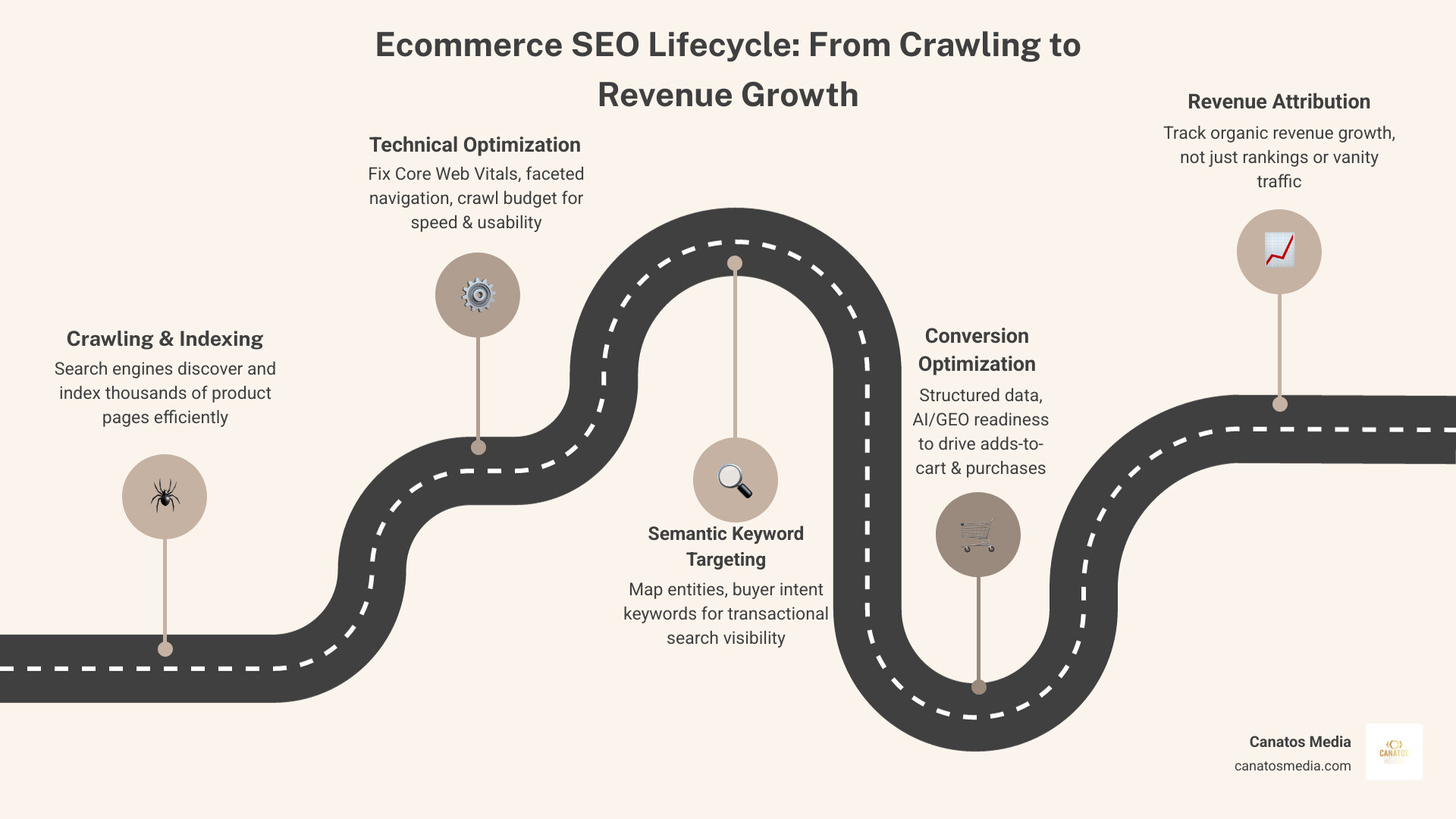
- Crawl Budget Management: Ensuring search engines don’t waste time on low-value pages (like login screens or search filters) and instead focus on your top-selling products.
- Faceted Navigation: Managing those helpful sidebar filters (size, color, price) so they don’t create thousands of duplicate content issues.
- Seasonal Trends: Preparing for Black Friday or summer surges months in advance so you’re ranking when the “buy” intent is highest.
At Canatos Media, we believe in integrated strategies that connect your technical foundation with high-quality content. We focus on sustainable growth—the kind that has facilitated over 20 million ecommerce transactions across the industry. While rankings are a leading indicator, the only metric that truly matters in 2026 is organic revenue.
Furthermore, with the rise of AI-driven discovery, your store needs to be optimized for more than just “blue links.” You need AI search optimization to ensure your products appear in generative summaries and conversational AI responses.
Key Elements of a High-Performance Strategy
To outpace the competition, your ecommerce seo firm must move beyond basic keyword stuffing. A high-performance strategy is built on a “revenue-grade” framework that prioritizes the most profitable pages of your site.
Technical Foundation and Core Web Vitals
Site speed is no longer “nice to have”—it’s a conversion killer. Statistics show that nearly 40% of people leave a site if it takes more than 3 seconds to load. In 2026, Google’s Core Web Vitals (LCP, INP, and CLS) are the baseline for ranking. If your site is sluggish, your rankings will suffer, and your ad spend will be wasted on high bounce rates.

Semantic SEO and Entity Mapping
Modern search engines use “entities” to understand the relationship between products, brands, and user intent. Advanced technical SEO now involves semantic keyword mapping. This means instead of just targeting “running shoes,” we optimize for the entire ecosystem of that product: “best marathon footwear for flat feet,” “durable carbon-plate trainers,” and “moisture-wicking socks.”
Traditional SEO vs. Ecommerce SEO
It is helpful to understand how these two worlds differ. Here is a quick breakdown:
| Feature | Traditional SEO | Ecommerce SEO |
|---|---|---|
| Primary Goal | Awareness & Lead Gen | Sales & Revenue |
| Page Volume | Low (10-50 pages) | High (500 – 100,000+ pages) |
| Technical Focus | Content & Backlinks | Crawl Budget & Faceted Nav |
| Keyword Intent | Informational/Educational | Transactional/Commercial |
| Success Metric | Form Fills/Calls | Organic Revenue/ROAS |
By focusing on the buyer’s journey, we ensure that your category pages act as persuasive landing hubs. As seen in our Case Studies, transforming a generic category list into a high-intent “buying guide” can drastically reduce Customer Acquisition Costs (CAC).
Navigating AI Search and GEO Optimization
The biggest shift we’ve seen leading into 2026 is the rise of Generative Engine Optimization (GEO). Search is becoming a conversation. When a user asks ChatGPT, “What are the best sustainable leather boots for a New York winter?” your brand needs to be the answer.
ChatGPT and AI Overviews
Top-tier agencies are now optimizing for visibility in AI Overviews and LLMs (Large Language Models). This requires:
- Structured Data (Schema): Giving AI agents clear, machine-readable data about your prices, availability, and reviews.
- Brand Authority: Building a digital footprint that proves your brand is a trusted expert.
- Conversational Content: Writing in a way that answers the specific questions shoppers ask AI tools.
We regularly discuss these shifts on our Blog, highlighting how sites that achieve 25M+ monthly visitors are those that embrace AI discovery rather than fighting it. If your ecommerce seo firm isn’t talking about GEO, they are living in 2020.
Common Pitfalls to Avoid When Hiring
Hiring an agency is a major investment. Unfortunately, many businesses fall into what we call the “Shitty Agency Problem”—where you’re sold by a senior executive but then passed off to a junior staffer who has never managed a site with more than 200 SKUs.
Watch out for these red flags:
- Vanity Metrics: If an agency only talks about “ranking #1 for [obscure keyword],” run. You can’t pay your employees with rankings; you need revenue.
- Long-Term “Lock-In” Contracts: While SEO takes time, you should never be trapped in a 12-month contract with no exit clause. We believe in transparency and fair pricing based on measurable outcomes.
- Lack of CRO Integration: Traffic is useless if your site doesn’t convert. A 40% bounce rate often stems from a disconnect between what the user searched for and what they saw on the page.
- Technical Debt: Agencies that ignore 404 errors or use 302 (temporary) redirects instead of 301 (permanent) redirects are actively harming your site’s long-term health.
Frequently Asked Questions about Ecommerce SEO
How long does it take to see results from an ecommerce SEO firm?
Typically, you will see “leading KPIs”—such as ranking improvements for long-tail keywords and technical health scores—within the first 3 months. Significant surges in traffic and meaningful organic revenue growth usually materialize between 3 to 6 months.
We have seen real-world examples where a focused roadmap led to a 1,065% increase in organic revenue over a year by prioritizing “quick wins” like category page optimization.
What is the typical pricing for an ecommerce SEO firm?
High-quality ecommerce SEO is a managed service that requires a team of specialists (developers, copywriters, and strategists). Pricing often starts around $5,000 monthly for mid-sized stores. At Canatos Media, we use custom scoping to ensure your budget aligns with your revenue goals. We don’t believe in one-size-fits-all packages; we believe in ROI attribution that proves the value of every dollar spent.
What platforms do top agencies specialize in?
The best firms are platform-agnostic but have deep technical “black belts” in specific systems. Common specializations include:
- Shopify & Shopify Plus: Great for scaling quickly with integrated SEO tools.
- Magento (Adobe Commerce): Ideal for massive catalogs but requires heavy technical lifting.
- BigCommerce: Known for strong out-of-the-box SEO features.
- WooCommerce: Highly customizable for WordPress-based stores.
A top-tier ecommerce seo firm should also be an expert in site migrations—ensuring that if you move from Magento to Shopify, you don’t lose your hard-earned organic rankings in the process.
Conclusion
Choosing an ecommerce seo firm is one of the most important decisions you’ll make for your online store’s growth. In the tri-state area and Long Island, where competition is fierce, you need more than just a “vendor”—you need a partner who understands the intersection of content, technology, and commerce.
At Canatos Media, we don’t just “do SEO.” We build growth engines. By combining cinematic short-form video, expert social media management, and data-driven paid ads with our revenue-focused SEO strategies, we help brands dominate their niche.
Ready to turn your store into an organic revenue machine? Explore our full range of digital marketing services and let’s start growing your brand today.